
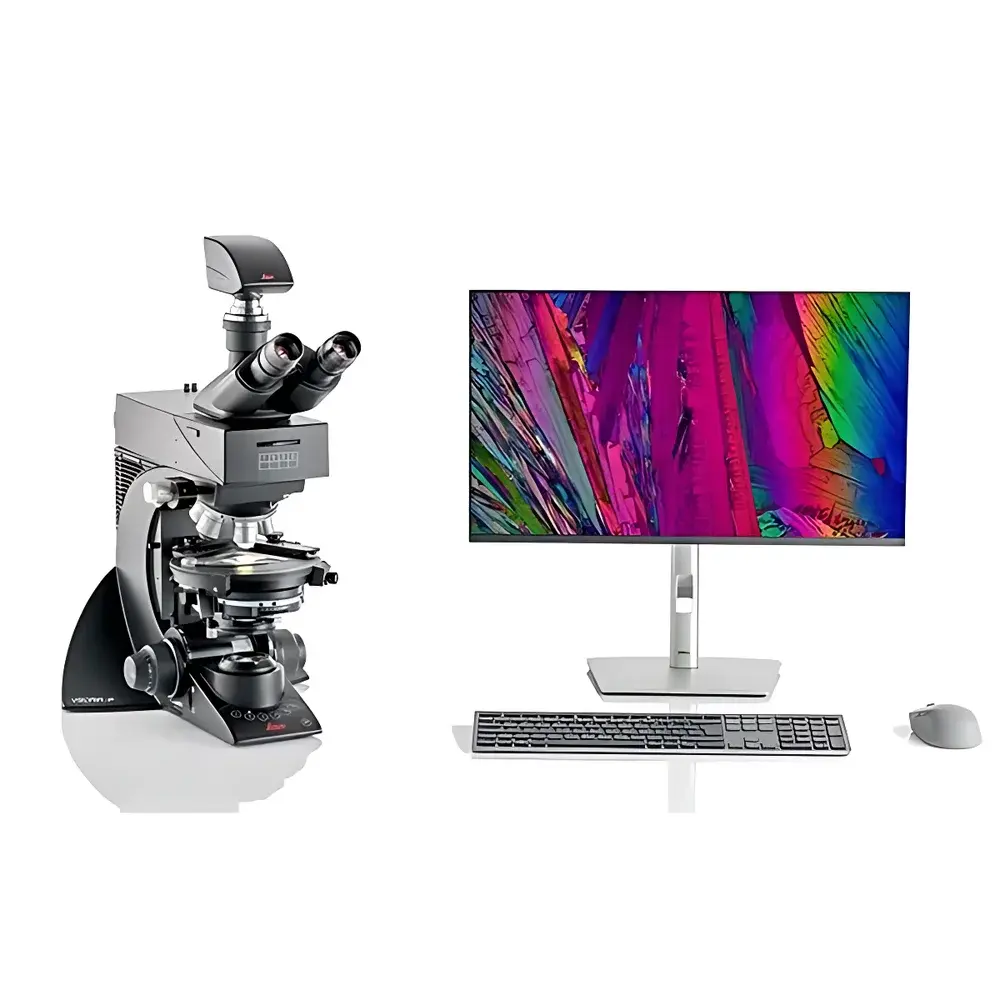
Leica Visoria P Polarizing Microscope
| Brand | Leica |
|---|---|
| Origin | Germany |
| Model | Visoria P |
| Configuration | Upright |
| Image Analysis System | Integrated |
| Eyepieces | 20 mm, 22 mm, 25 mm field of view |
| Illumination Management | Automatic brightness compensation across magnifications and observation modes |
| Focus Mechanism | Three-step coarse/fine focusing with mechanical focus stop |
| Stage Controls | Ergonomic, height- and torque-adjustable XY mechanical stage |
| Handedness | Switchable between right- and left-handed operation |
| Documentation | One-touch image capture with embedded metadata (magnification, objective, filter status, exposure settings) |
| Compliance | Designed to support ISO/IEC 17025-compliant workflows and GLP documentation requirements |
Overview
The Leica Visoria P Polarizing Microscope is an upright metallurgical microscope engineered for routine polarized light analysis in materials science laboratories, quality control environments, and failure analysis centers. It operates on the fundamental principles of transmitted and reflected polarized light microscopy—utilizing a polarizer-analyzer pair, rotatable specimen stage, and strain-free optical path—to reveal birefringence, crystal orientation, stress distribution, and phase anisotropy in opaque and transparent anisotropic specimens. Unlike general-purpose optical microscopes, the Visoria P integrates dedicated polarization optics into its core optical train, including a fixed polarizer in the illumination path and a rotatable analyzer above the objective turret. Its modular design supports both incident (reflected) and transmitted illumination configurations—making it suitable for metallographic sample evaluation, mineral identification, polymer morphology assessment, and semiconductor wafer inspection. The instrument’s German-engineered optical architecture ensures high contrast, minimal polarization artifacts, and consistent color fidelity across magnifications.
Key Features
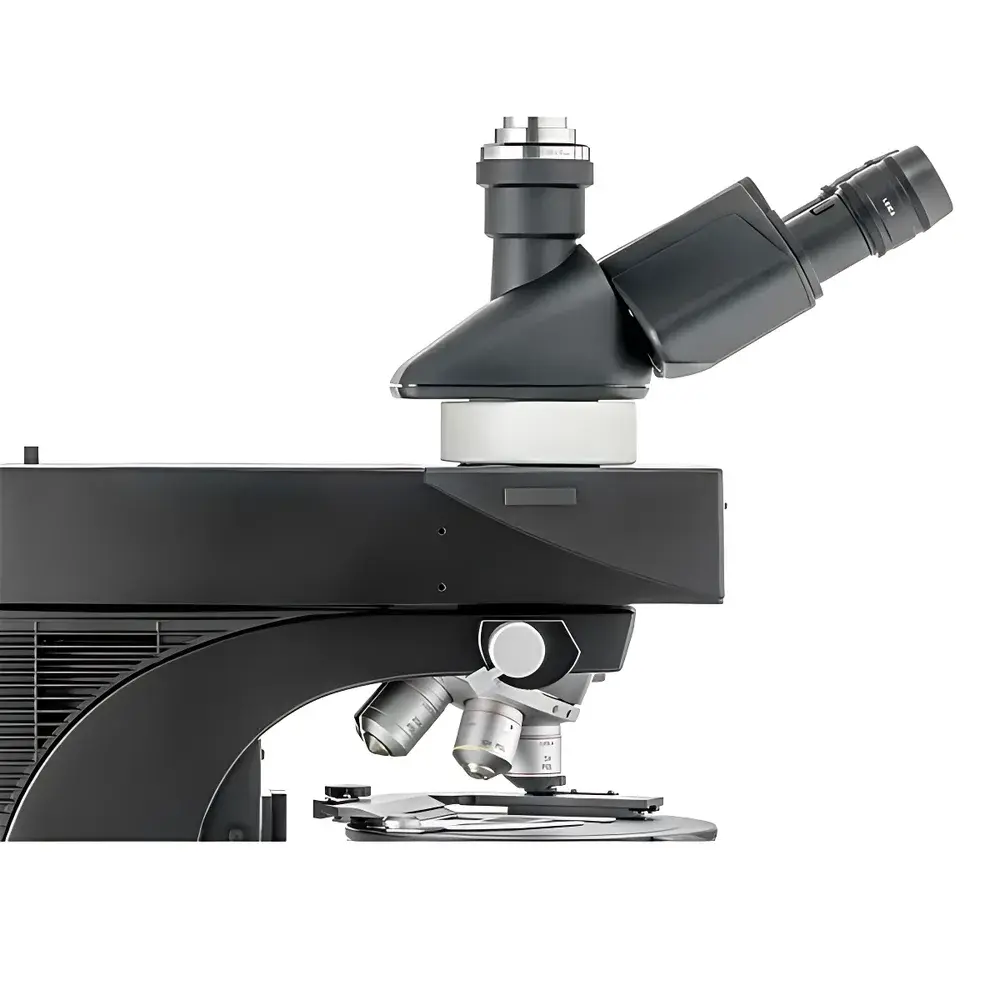
- Ergonomic three-stage focusing system: Coarse, medium, and fine focus knobs provide precise depth control—critical for high-magnification polarized imaging of polished metallographic sections or thin-sectioned geological samples.
- Automatic illumination management: Real-time LED intensity adjustment compensates for changes in magnification, objective NA, and polarizer/analyzer orientation—maintaining optimal signal-to-noise ratio without manual recalibration.
- Color-coded aperture and objective alignment: Intuitive visual coding reduces setup errors during rapid switching between objectives (e.g., 5×, 10×, 20×, 50×, 100× oil) and corresponding condenser aperture settings.
- Adjustable mechanical stage: Height and torque of XY stage controls are user-configurable to minimize repetitive motion strain—validated per ISO 9241-5 ergonomic guidelines for sustained daily use.
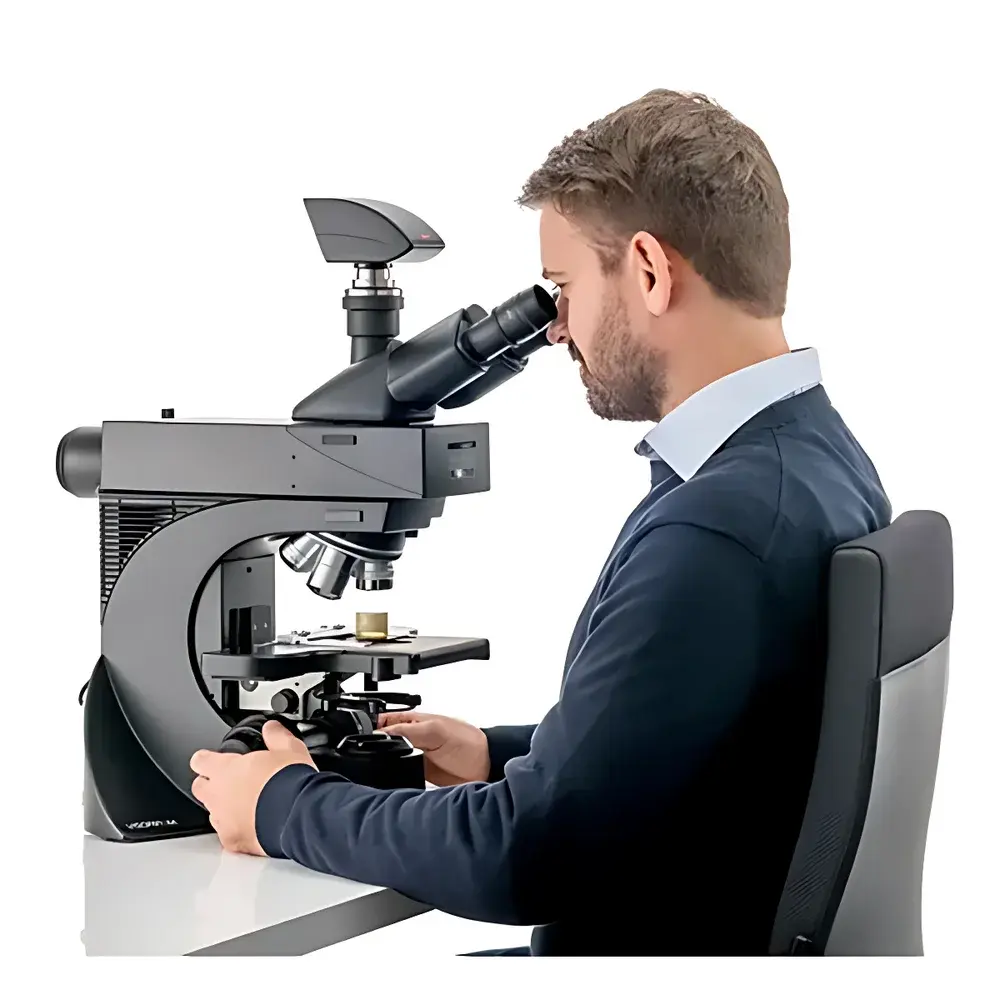
- Bilateral operability: All primary controls—including focus, stage translation, and illumination toggle—are symmetrically arranged to permit seamless transition between right- and left-handed operation without tooling or reconfiguration.
- Integrated focus stop mechanism: Prevents accidental contact between objective front lens and specimen surface—essential for preserving both expensive objectives and delicate polished samples.
Sample Compatibility & Compliance
The Visoria P accommodates standard 25 mm and 32 mm diameter metallographic mounts, as well as petrographic thin sections (30 µm thickness), polymer films, and ceramic cross-sections. Its reflected-light capability supports non-transparent samples up to 50 mm in height; transmitted mode requires standard 1 mm thick glass slides or specialized quartz holders for UV-compatible applications. The system complies with DIN EN ISO 10816-3 for vibration-sensitive instrumentation and meets CE marking requirements for laboratory equipment safety (2014/30/EU EMC Directive and 2014/35/EU Low Voltage Directive). When paired with Leica Application Suite (LAS) X software, it supports audit-trail generation and electronic signature functionality compliant with FDA 21 CFR Part 11 for regulated environments.
Software & Data Management
The Visoria P ships with Leica LAS X Core software, enabling one-click image acquisition with automatic metadata embedding—including objective ID, polarizer/analyzer angles, exposure time, gain, and stage coordinates. Batch acquisition modes support time-lapse polarization rotation series (e.g., 0°–180° in 5° increments) for quantitative birefringence mapping. Export formats include TIFF (16-bit), JPEG2000, and annotated PDF reports compatible with LIMS integration. Raw image data is stored in vendor-neutral DNG format, ensuring long-term archival integrity. Software licensing includes remote calibration validation tools and firmware update notifications via Leica’s secure TLS-encrypted service portal.
Applications
- Metallurgical QC: Grain boundary analysis, inclusion identification (ASTM E45), and heat-treatment verification in ferrous and non-ferrous alloys.
- Geosciences: Mineral identification and extinction angle measurement in thin sections (following ASTM D5777 protocols).
- Pharmaceutical solid-state characterization: Polymorph differentiation and crystallinity assessment in active pharmaceutical ingredients (APIs).
- Electronics manufacturing: Stress-induced birefringence detection in silicon wafers and encapsulant resins (IPC-TM-650 2.1.1).
- Polymer R&D: Spherulite size distribution, lamellar orientation, and phase separation kinetics under thermal or mechanical load.
FAQ
Does the Visoria P support motorized stage or autofocus?
No—the Visoria P is a manually operated platform optimized for cost-effective, high-reliability routine analysis. Motorization and autofocus are available on the Leica DM4 M and DM6 M series.
Can I upgrade to fluorescence or differential interference contrast (DIC)?
Fluorescence is not supported due to absence of excitation filter cubes and high-intensity mercury/xenon lamp options. DIC is incompatible with the Visoria P’s fixed optical path design; consider the Leica DM2700 M for combined DIC/polarization capability.
Is the polarizer/analyzer rotation angle digitally encoded?
Yes—rotation positions are tracked via integrated optical encoders and logged with each acquired image in LAS X software, enabling reproducible angular measurements traceable to NIST standards.
What is the maximum numerical aperture (NA) supported by the Visoria P optical system?
The system supports objectives up to NA 0.90 in reflected mode and NA 0.75 in transmitted mode, compatible with Leica EC Epiplan and PL Fluotar polarized objective families.
How does the Visoria P meet GLP documentation requirements?
Through LAS X’s electronic lab notebook (ELN) module, which enforces user authentication, timestamped audit trails, version-controlled SOP linking, and exportable PDF reports with digital signatures—fully aligned with OECD GLP Principles and ISO/IEC 17025 clause 7.8.




