
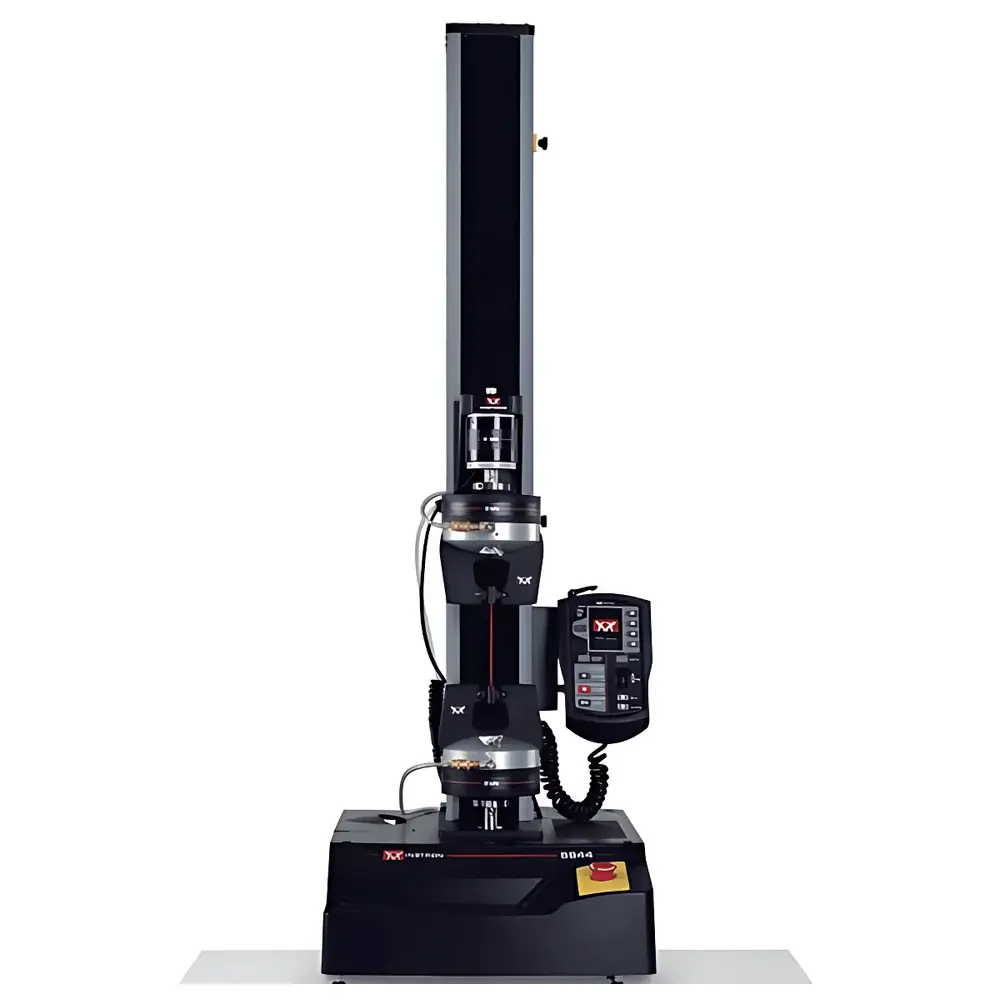
Instron 5940 Series Single-Column Desktop Universal Testing System
| Brand | Instron |
|---|---|
| Origin | USA |
| Model | 5940 Series |
| Load Capacity | Up to 2 kN (5944), 1 kN (5943), 0.5 kN (5942) |
| Instrument Type | Electromechanical Universal Testing Machine |
| Compliance | ASTM E4, E8, E9, E21, ISO 6892-1, ISO 527, ISO 179, USP <1041>, FDA 21 CFR Part 11 (via Bluehill software) |
| Connectivity | Integrated Ethernet |
| Sensor Channels | Up to 4 built-in analog input channels |
| Data Acquisition Rate | Up to 5 kHz (standard), configurable |
| Speed Range | 0.001–2540 mm/min (model-dependent) |
| Return Speed | Up to 2540 mm/min |
| Frame Stiffness | ≥ 12 kN/mm (5944 model) |
| Alignment Accuracy | ≤ ±0.01 mm axial offset over full stroke |
| Footprint | 406 × 457 mm (W × D) |
Overview
The Instron 5940 Series is a precision-engineered single-column electromechanical universal testing system designed for tensile, compression, flexure, peel, and shear testing of small- to medium-sized specimens in research, quality control, and regulatory-compliant environments. Operating on a servo-controlled ball-screw actuation principle, the system delivers high-fidelity force-displacement data across its full load range—0.5 kN (5942), 1 kN (5943), and 2 kN (5944)—with traceable calibration per ISO/IEC 17025-accredited procedures. Its compact footprint (under 0.2 m²) enables deployment in space-constrained laboratories without compromising mechanical integrity: the monolithic aluminum column, preloaded linear bearings, and integrated T-slot tabletop collectively ensure axial alignment within ±0.01 mm and frame stiffness exceeding 12 kN/mm—critical parameters for minimizing compliance error in low-force, high-strain applications such as biomedical polymer characterization or thin-film adhesion testing.
Key Features
- High-stiffness single-column architecture with precision-ground linear bearings and rigid monolithic column for minimal deflection and repeatable alignment
- Integrated Ethernet interface (10/100BASE-T) enabling deterministic communication with host PCs—no USB-to-serial adapters or driver dependencies
- Up to four simultaneously active analog sensor inputs (load, extensometer, environmental transducers) with 24-bit ADC resolution and factory-traceable linearity ≤ ±0.02% of reading
- Enhanced motion control firmware delivering speed accuracy of ±0.1% of setpoint across 0.001–2540 mm/min, including rapid return at full speed to minimize cycle time
- Dedicated front-panel interface with real-time graphical display, soft-key navigation, and programmable specimen protection limits (force, displacement, strain)
- T-slot anodized aluminum tabletop (200 × 200 mm usable area) with integrated LED task lighting optimized for micro-specimen handling and optical extensometry
- Optional pneumatic actuator interface with auto-clamp sequencing logic—reducing operator intervention and improving inter-test consistency
Sample Compatibility & Compliance
The 5940 Series accommodates specimens from sub-millimeter fibers (e.g., electrospun nanofibers, suture threads) to structural components up to 100 mm in height and 75 mm in width. Standard fixtures include wedge-action tensile grips, compression platens, bend fixtures per ASTM D790, and peel test assemblies compliant with ASTM D903 and ISO 8510-2. All mechanical components meet RoHS and REACH directives. System-level validation supports IQ/OQ protocols aligned with GLP, GMP, and ISO 17025 requirements. When configured with Bluehill Universal software, the platform satisfies audit-trail, electronic signature, and data-integrity mandates under FDA 21 CFR Part 11 and EU Annex 11.
Software & Data Management
Instron Bluehill Universal software (v4.x or later) provides method-driven test definition, real-time curve overlay, automated pass/fail evaluation against user-defined limits, and export-ready reporting in PDF, Excel, and XML formats. The software embeds over 120 pre-validated test methods—including ASTM D638, ISO 527-2, ISO 179-1, and USP —with customizable calculation modules for modulus, yield point, elongation at break, and energy absorption. Raw data is stored in vendor-neutral HDF5 format with embedded metadata (operator ID, timestamp, calibration certificate ID, environmental conditions). Audit trails log all user actions—including parameter edits, result overrides, and report exports—with immutable timestamps and role-based access control.
Applications
This system is routinely deployed in regulated and non-regulated settings for mechanical property assessment of: medical device components (catheter shafts, stent crimping forces, suture tensile strength); biodegradable polymers (PLA, PCL films under ISO 10993-12); elastomeric seals and gaskets; food packaging films (ASTM F88 seal strength); textile yarns and nonwovens (ISO 9073-3); pharmaceutical tablet coatings (tablet hardness per USP ); and micro-electromechanical systems (MEMS) packaging substrates. Its low-noise transduction chain and high sampling fidelity make it suitable for dynamic modulus mapping via cyclic loading protocols.
FAQ
What standards does the 5940 Series comply with?
It meets or exceeds ASTM E4 (force verification), E8/E21 (tensile testing of metals), ISO 6892-1 (metallic materials), ISO 527 (plastics), ISO 179 (impact resistance), and USP (mechanical testing of pharmaceutical packaging).
Can the system be validated for GxP environments?
Yes—when paired with Bluehill Universal and documented IQ/OQ protocols, it supports 21 CFR Part 11 compliance, including electronic signatures, audit trails, and data integrity controls.
Is extensometry supported?
Yes—both contact (clip-on, pneumatic) and non-contact (video, laser) extensometers integrate natively via the 4-channel analog input or USB Vision interface.
What is the maximum recommended specimen height?
For optimal alignment and stiffness, the standard configuration supports specimens up to 100 mm tall; extended travel options are available upon request.
How is calibration maintained?
Load cells are supplied with NIST-traceable calibration certificates; optional annual recalibration services include uncertainty budgets and ISO/IEC 17025 reporting.



