
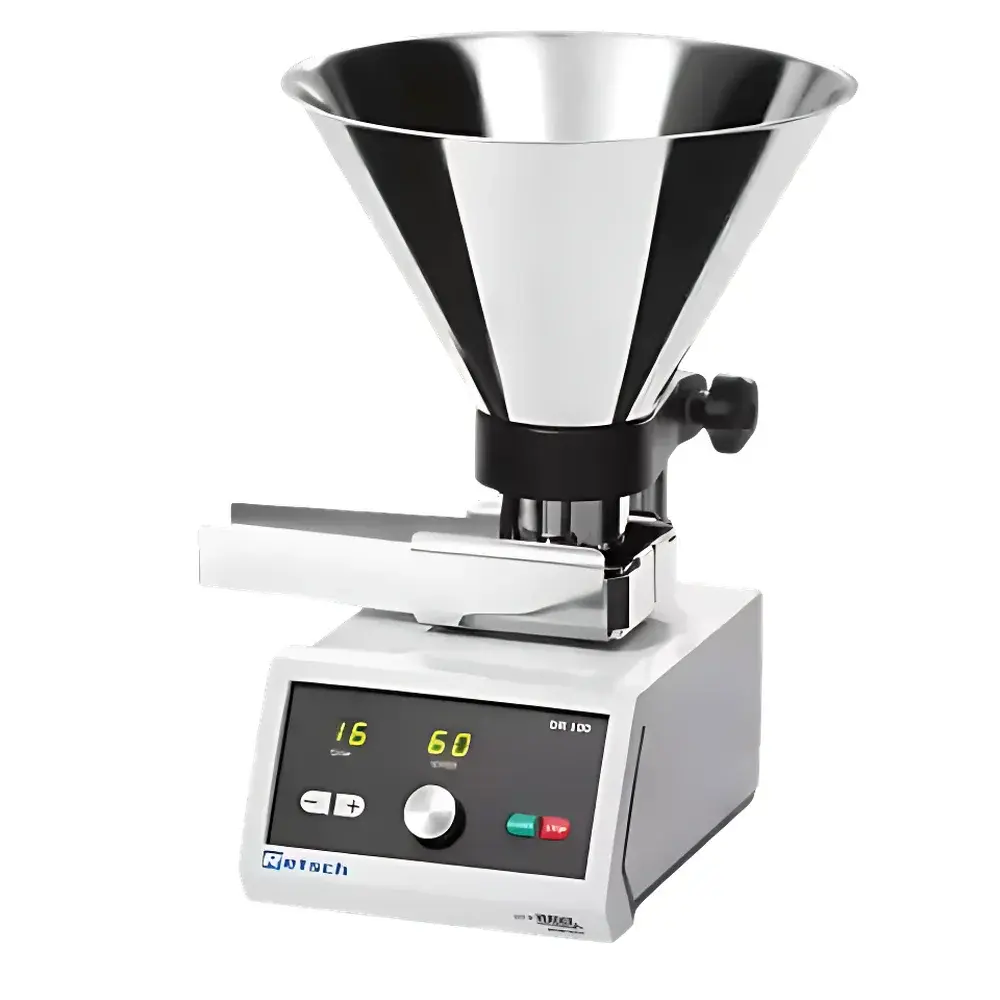
RETSCH DR 100 Vibratory Feed Unit
| Brand | RETSCH |
|---|---|
| Origin | Germany |
| Model | DR 100 |
| Feed Mechanism | Vibratory |
| Max. Feed Width | 15 mm / 40 mm / 75 mm / 75/40 mm (dual-channel) |
| Control Interface | Digital input/output (0–10 V, TTL), optional RS-232 or Ethernet |
| Drive Type | Electromagnetic vibrator with adjustable amplitude and frequency |
| Power Supply | 100–240 V AC, 50/60 Hz |
| Housing Material | Stainless steel (AISI 304), anodized aluminum |
| IP Rating | IP54 |
| Weight | 8.2 kg |
| Dimensions (W × H × D) | 220 × 290 × 240 mm |
Overview
The RETSCH DR 100 is a precision-engineered vibratory feed unit designed for the controlled, reproducible delivery of free-flowing bulk solids and fine powders into downstream analytical or processing equipment. Operating on electromagnetic vibration principles, the DR 100 generates calibrated oscillatory motion to fluidize and meter material across its feed trough—eliminating bridging, rat-holing, or pulsation commonly observed in gravity-fed or screw-driven systems. Its core function is not sample preparation per se, but rather sample *introduction*: it serves as a critical interface between manual or automated sample handling and instruments requiring consistent mass flow rates—including RETSCH’s own planetary ball mills (e.g., PM 100), sieve shakers (AS 200), laser diffraction particle analyzers (PSA), and external devices such as XRF spectrometers, elemental analyzers, or automated press systems. The unit’s modular trough design supports four standard widths (15 mm, 40 mm, 75 mm, and dual 75/40 mm), enabling adaptation to diverse particle size distributions, bulk densities, and throughput requirements without mechanical recalibration.
Key Features
- Electromagnetically driven vibration system with continuously adjustable frequency (0–100 Hz) and amplitude (0–2 mm peak-to-peak), ensuring granular control over feed rate and flow stability.
- Digital speed setting via front-panel keypad or external analog/digital signal input (0–10 V DC or TTL), supporting integration into automated lab workflows and LIMS-controlled environments.
- Stainless steel (AISI 304) feed trough and housing provide chemical resistance, corrosion protection, and compliance with ISO 8573-1 for cleanroom-compatible operation.
- Compact footprint (220 × 290 × 240 mm) and tool-free trough insertion enable rapid configuration changes and seamless installation beneath sieves, mills, or analytical inlets.
- IP54-rated enclosure ensures operational reliability in dusty laboratory environments typical of mineralogical, pharmaceutical, or cement QA/QC labs.
- Quick-release, smooth-surface troughs facilitate residue-free cleaning—critical for cross-sample integrity in regulated applications governed by USP <429>, ASTM E1938, or ISO 13320-compliant particle sizing protocols.
Sample Compatibility & Compliance
The DR 100 handles dry, non-cohesive, and moderately cohesive powders with particle sizes ranging from 2 mm, including metal oxides, pharmaceutical excipients, catalysts, ceramics, coal ash, and ground polymers. It is unsuitable for sticky, hygroscopic, or fibrous materials without prior drying or conditioning. All wetted components comply with FDA 21 CFR §177.2600 for indirect food contact. The unit meets CE marking requirements under the EU Machinery Directive 2006/42/EC and EMC Directive 2014/30/EU. When integrated into GMP-compliant workflows, its digital control interface supports audit-trail-capable operation when paired with validated SCADA or LabWare LIMS platforms—enabling full traceability of feed parameters (vibration frequency, duration, start/stop timestamps) per batch or sample ID.
Software & Data Management
While the DR 100 operates as a standalone hardware module, its analog and digital I/O ports allow bidirectional communication with third-party control software. Standard integration includes trigger-based activation synchronized with sieve shaking cycles (e.g., AS 200 digital mode), mill start commands (PM 100 pro), or data acquisition systems logging feed duration vs. mass collected. Optional RS-232 or Ethernet modules enable remote parameter adjustment and real-time status monitoring (vibration status, overload detection, thermal shutdown alerts). No proprietary software is required; configuration is performed via hardware-level signal mapping compatible with LabVIEW, MATLAB Instrument Control Toolbox, or PLC-based automation (Siemens S7, Allen-Bradley CompactLogix).
Applications
- Consistent feeding of powder samples into RETSCH PS100 or Camsizer XT laser diffraction analyzers for repeatable particle size distribution (PSD) measurements under ISO 13320.
- Automated dosing of reference standards into X-ray fluorescence (XRF) sample cups prior to fusion or pressing—reducing operator variability in geochemical and metallurgical labs.
- Controlled introduction of milled material into hydraulic pellet presses (e.g., HP 40) to ensure uniform green density and minimize die-fill variation in tablet formulation studies.
- Feeding ground biomass or soil extracts into thermal gravimetric analyzers (TGA) or elemental combustion analyzers (CHNS/O), where precise mass-on-sample is critical for stoichiometric accuracy.
- Integration into multi-step sample prep lines compliant with ASTM D7429 (airborne particulate matter analysis) or ISO 16267 (coal sampling for proximate analysis).
FAQ
Can the DR 100 handle moist or agglomerated powders?
No. It is engineered exclusively for free-flowing, dry materials. Moisture content above 0.5% w/w or strong interparticle cohesion will cause arching and flow interruption.
Is calibration required before use?
The DR 100 does not require periodic metrological calibration. However, users must perform empirical flow-rate verification using gravimetric collection at defined vibration settings for each new material type—documented per ISO/IEC 17025 method validation requirements.
Does it support 21 CFR Part 11 compliance?
The base unit does not include electronic signature or audit trail functionality. Full Part 11 compliance is achievable only when integrated with validated third-party software platforms that manage user authentication, change control, and electronic records retention.
What maintenance is recommended?
Monthly inspection of vibration coil integrity and trough mounting screws; annual replacement of the electromagnetic drive spring assembly (part no. 20.710.0002) to maintain amplitude consistency across the service life.
Can multiple DR 100 units be synchronized?
Yes—via master-slave TTL triggering or shared analog control voltage, enabling parallel feeding into multi-inlet analyzers or sequential loading of press dies in high-throughput QA environments.



