
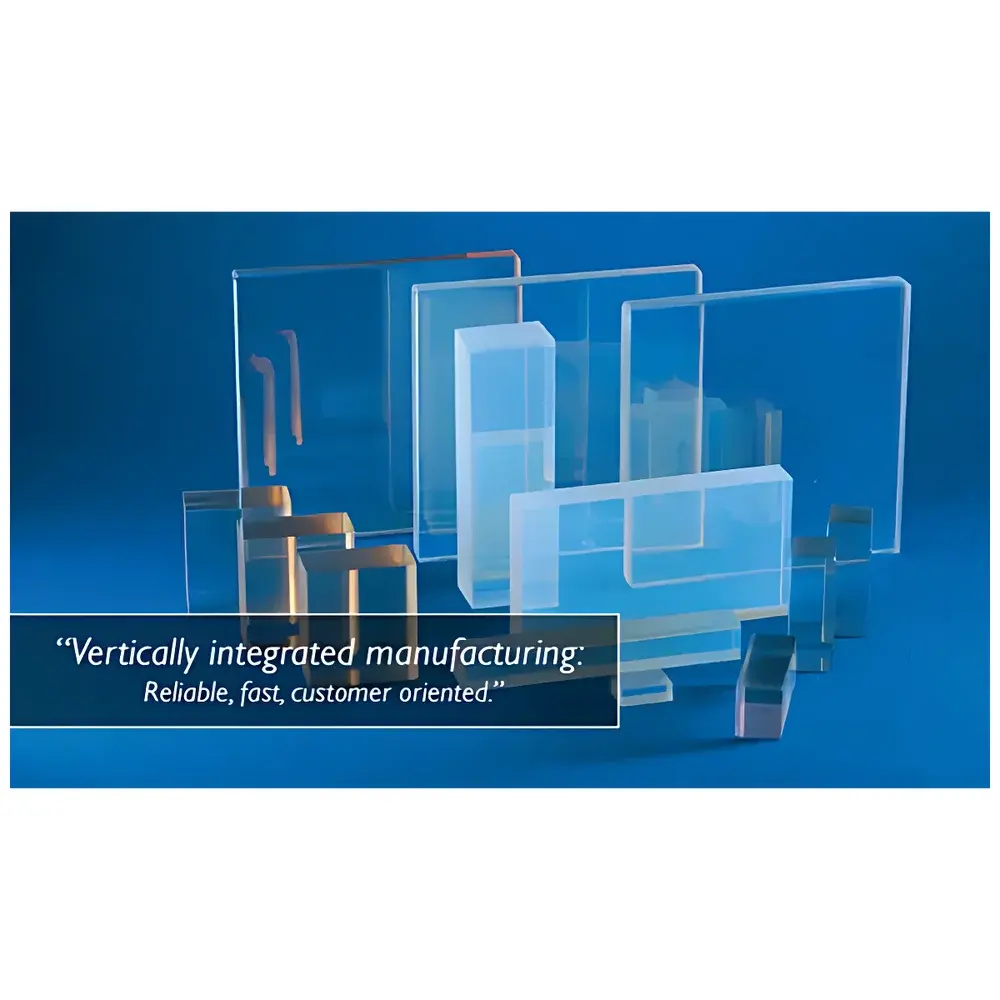
OptiGrate VBG-2000 Series Volume Bragg Grating for 1.9–3.0 µm Wavelength Range
| Brand | OptiGrate |
|---|---|
| Origin | USA |
| Manufacturer Type | Authorized Distributor |
| Product Category | Imported |
| Model | Volume Bragg Grating (VBG) |
| Pricing | Upon Technical Consultation |
Overview
The OptiGrate VBG-2000 Series Volume Bragg Grating is a monolithic, bulk-optic wavelength-selective element engineered for high-stability spectral control in the mid-infrared spectral region spanning 1.9 to 3.0 µm. Unlike surface-relief gratings or thin-film interference filters, this device operates on the principle of Bragg diffraction within a photosensitive silicate glass volume medium—where a periodic modulation of refractive index is permanently recorded via UV-induced photoinscription. This volumetric structure enables exceptional thermal stability (coefficient of thermal expansion 5 J/cm² at 10 ns, 10 Hz, 2090 nm), making it suitable for demanding intra-cavity and extracavity applications in high-power solid-state and semiconductor laser systems.
Key Features
- Wavelength-selective reflection with center wavelength tunable across 1900–3000 nm (e.g., 1908 nm, 2090 nm, 2109 nm, 2122 nm)
- Full-width at half-maximum (FWHM) adjustable from 0.1 nm to 2.0 nm, enabling precise linewidth control for narrow-linewidth oscillators
- Polarization-insensitive operation—no angular or spectral shift with input polarization state
- Diffraction efficiency configurable from 10% to >99%, supporting both high-reflector (HR) and output coupler (OC) cavity configurations
- Robust monolithic architecture with no adhesives or coatings—immune to humidity, vacuum outgassing, and long-term irradiation degradation
- Standard substrate dimensions: 8 mm × 6 mm × 10 mm (custom geometries available upon request)
Sample Compatibility & Compliance
The VBG-2000 is compatible with continuous-wave (CW) and pulsed laser sources operating in the 1.9–3.0 µm range, including Tm³⁺- and Ho³⁺-doped fiber lasers, diode-pumped solid-state (DPSS) lasers, and optical parametric oscillators (OPOs). Its all-glass construction ensures compliance with ISO 10110-7 surface quality standards and meets MIL-PRF-13830B scratch-dig specifications. As a passive optical component, it requires no electrical interface or active cooling, and its performance remains stable under ambient temperature fluctuations from –40 °C to +85 °C. The device is fully compatible with laser safety standards IEC 60825-1 and EN 60825-1 for Class 4 laser system integration.
Software & Data Management
While the VBG-2000 is a passive optical element without embedded firmware or digital interface, its spectral performance is fully characterized and documented per ISO/IEC 17025-accredited calibration procedures. Each unit is supplied with a traceable spectral report—including measured center wavelength (±0.05 nm), FWHM (±0.02 nm), peak reflectivity, sideband suppression ratio (>30 dB), and angular acceptance bandwidth (±0.5 mrad). These data are delivered in machine-readable CSV and PDF formats, supporting integration into automated test logs and GLP/GMP-compliant documentation workflows. For system-level validation, the grating’s spectral response can be modeled using rigorous coupled-wave analysis (RCWA) or transfer-matrix method (TMM) software tools such as RSoft™ or MATLAB® custom scripts.
Applications
- Intra-cavity wavelength stabilization and line-narrowing for Tm/Ho-doped fiber and bulk lasers
- Output coupling mirrors in high-efficiency 2 µm Q-switched and mode-locked oscillators
- Narrowband spectral filtering (FWHM < 0.2 nm) for gas sensing platforms targeting CO, CO₂, NH₃, and H₂O absorption lines
- Beam combining and spectral beam cleanup in multi-emitter diode laser stacks
- Reference elements in Fourier-transform infrared (FTIR) spectrometers and wavelength meters requiring absolute spectral fidelity
- Pump source stabilization for optical parametric amplifiers (OPAs) and difference-frequency generation (DFG) systems extending into the 3–12 µm range
FAQ
What is the maximum average power handling capability of the VBG-2000?
Typical continuous-wave power handling exceeds 100 W/cm² at 2090 nm with appropriate heat sinking; pulsed operation supports >5 J/cm² at 10 ns pulse width.
Can the VBG be used at non-normal incidence?
Yes—angular tuning of ±2° around Bragg angle maintains >95% peak efficiency; full angular acceptance bandwidth is specified per unit and provided in calibration reports.
Is custom coating required for AR treatment?
Standard units include broadband anti-reflection (BBAR) coating on both entrance and exit faces (R < 0.25% per surface, 1.9–3.0 µm); custom AR designs (e.g., dual-band or polarization-selective) are available.
How is wavelength calibration traceability ensured?
Each VBG undergoes spectral verification using a NIST-traceable FTIR spectrometer calibrated against certified reference lasers; uncertainty budgets comply with ISO/IEC 17025 requirements.
Do you support OEM integration and volume supply agreements?
Yes—OptiGrate provides mechanical drawings, mounting recommendations, environmental testing reports (thermal cycling, vibration), and dedicated engineering support for system integrators and laser manufacturers.




