
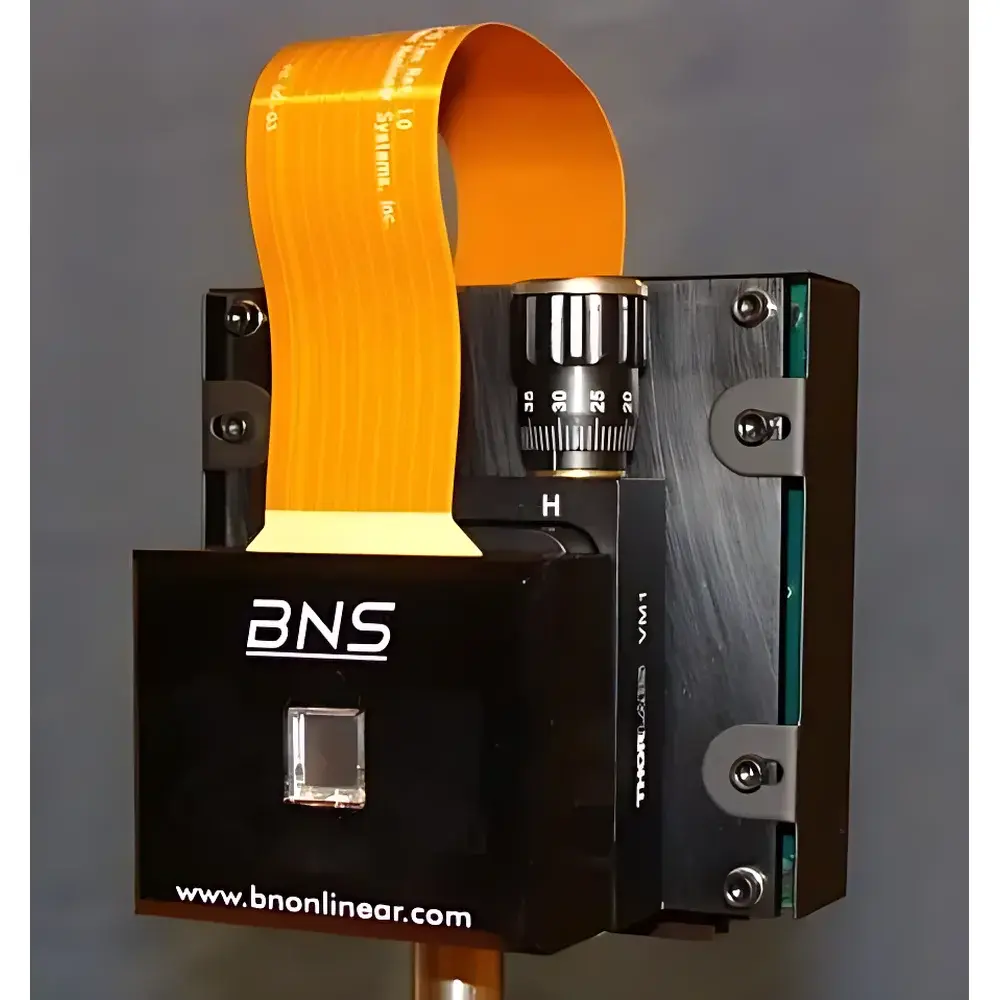
BNS P12,288 Reflective Phase-Only Liquid Crystal Spatial Light Modulator
| Origin | USA |
|---|---|
| Manufacturer Type | Distributor |
| Origin Category | Imported |
| Model | Spatial Light Modulator |
| Quotation | Upon Request |
| Component Category | Optical Component |
| Array Format | 1×12,288 |
| Active Area | 19.66 × 19.66 mm |
| Design Wavelength Range | 635–1550 nm (user-specified λ in nm) |
| Diffraction Efficiency (zero-order) | 80–95% |
| Duty Cycle | Up to 100% |
| External Window | Broadband AR-coated (Rₐᵥg < 1% over 450–865 nm or 850–1650 nm) |
| Fill Factor | 100% |
| Operating Mode | Reflective |
| Maximum Steering Angle | ±4°–±7° |
| Phase Stroke (double-pass) | ~2π at specified wavelength |
| Resolvable Phase Levels | ≥50 linear levels over 2π |
| Pixel Pitch | 1.6 µm |
| Reflected Wavefront Distortion (RMS) | λ/10–λ/5 |
| Response Time | 5–30 ms |
| Spatial Resolution | TBD |
| Switching Frequency | 30–200 Hz |
| Liquid Crystal Type | Zero-Twist Nematic (ZTN) |
| Drive Voltage | Low-voltage operation (< 5 V RMS) |
Overview
The BNS P12,288 is a high-density, reflective, phase-only liquid crystal spatial light modulator (SLM) engineered for precision beam steering, wavefront shaping, and programmable diffractive optics in demanding optical systems. Based on a monolithic CMOS backplane architecture integrated with a zero-twist nematic (ZTN) liquid crystal layer, this 1×12,288 linear array delivers deterministic, voltage-controlled phase modulation across its full 19.66 mm active width. Unlike transmissive SLMs or mechanically scanned mirrors, the P12,288 operates entirely in reflection mode and leverages the electro-optic birefringence of aligned ZTN material to induce spatially resolved, analog phase shifts—enabling diffraction-limited beam deflection without moving parts. Its 1.6 µm pixel pitch supports sub-milliradian angular resolution and enables high-order grating generation for applications requiring rapid, repeatable, and stable optical path control—including ultrafast pulse shaping, adaptive lithography illumination, and real-time optical alignment systems.
Key Features
- Monolithic CMOS-integrated architecture ensures precise pixel addressing, low crosstalk, and high uniformity across the full 12,288-pixel array
- 100% fill factor and broadband anti-reflection coating (Ravg < 1% over 450–865 nm or 850–1650 nm) maximize optical throughput and minimize ghost reflections
- Phase stroke of approximately 2π (double-pass configuration) at user-specified design wavelength (635–1550 nm), calibrated per order
- Resolvable phase depth of ≥50 linear levels over full 2π range, supporting high-fidelity wavefront synthesis and iterative optimization algorithms
- Low-voltage drive electronics (< 5 V RMS) ensure compatibility with standard DAC interfaces and reduce thermal load on optical benches
- Reflective operation eliminates substrate-induced wavefront distortion and simplifies integration into folded-path or retroreflected systems
- Response time of 5–30 ms enables closed-loop correction at frame rates up to 200 Hz under optimized driving conditions
- Fully solid-state construction provides immunity to mechanical wear, acoustic vibration, and long-term drift—critical for GLP-compliant metrology setups
Sample Compatibility & Compliance
The P12,288 is compatible with continuous-wave and pulsed laser sources operating across visible to near-infrared bands (635–1550 nm). It is routinely deployed in ISO/IEC 17025-accredited optical laboratories for beam characterization, interferometric alignment, and laser processing system calibration. The device meets RoHS Directive 2011/65/EU requirements for hazardous substance restriction and conforms to IEC 61000-4-2 (ESD immunity) and IEC 61000-4-3 (radiated RF immunity) standards. While not inherently FDA 21 CFR Part 11 compliant as a standalone component, its digital interface supports traceable firmware logging when integrated with validated host software adhering to GMP/GLP data integrity protocols.
Software & Data Management
The P12,288 is supported by BNS’s native SLM Control Suite—a cross-platform application enabling real-time phase map upload, LUT calibration, gamma correction, and dynamic pattern sequencing. The SDK provides C/C++, Python, and MATLAB APIs for integration into custom automation frameworks (e.g., LabVIEW, EPICS, or Python-based control stacks). All phase patterns are stored in IEEE 754-compliant 16-bit signed integer format; metadata including timestamp, wavelength specification, and calibration ID are embedded in EXIF-compatible headers. Audit trails for pattern uploads, parameter changes, and system resets can be exported in CSV or XML for regulatory review. Firmware updates preserve factory-calibrated phase-response curves and support user-defined nonlinearity compensation tables.
Applications
- Non-mechanical laser beam steering for free-space optical communications and LiDAR scanning architectures
- Dynamic phase mask generation in maskless photolithography and direct-write nanofabrication tools
- Adaptive pulse compression and spectral phase modulation in Ti:sapphire and Yb-fiber amplifier chains
- Real-time aberration correction in multi-kilowatt industrial laser delivery systems
- Programmable diffractive optical elements (DOEs) for structured illumination microscopy and optical trapping arrays
- Calibration reference for Shack–Hartmann and lateral shearing interferometers (e.g., Phasics SID4 series)
- Angle-selective filtering using tunable Bragg gratings in volume holographic media
FAQ
What is the maximum usable steering angle for a given wavelength?
Steering angle depends on pixel pitch, design wavelength, and grating order. For first-order deflection at λ = 1064 nm, ±4.2° is typical; at λ = 635 nm, ±7.1° is achievable—subject to diffraction efficiency roll-off beyond ±5°.
Can the P12,288 operate in amplitude modulation mode?
No—it is optimized for pure phase modulation. Amplitude control requires external polarization optics (e.g., polarizer-analyzer pair) and introduces polarization-dependent loss and reduced extinction ratio.
Is wavefront distortion measured per unit area or across the full aperture?
RMS wavefront error (λ/10–λ/5) is measured over the entire 19.66 mm active width using a calibrated interferometer at the specified design wavelength.
Does the device require temperature stabilization?
Operation is rated from 15°C to 35°C ambient. For sub-λ/20 stability over extended periods (>8 h), active thermal regulation of the mounting base is recommended.
How is phase calibration performed and maintained?
Factory calibration includes per-pixel phase-response mapping at the ordered wavelength. Users may perform in situ recalibration using an inline interferometer and BNS’s PhaseLock utility, with results saved as device-specific LUT files.





