
Auniontech NewDEL High-Power Fiber-Coupled LED Light Source
| Brand | Auniontech |
|---|---|
| Origin | Shanghai, China |
| Manufacturer Type | Authorized Distributor |
| Product Category | Domestic |
| Model | Tunable & Broadband Fiber-Coupled LED Source |
| Light Source Type | Solid-State LED |
| Wavelength Range | 275–1100 nm (UV–NIR) |
| Coupling Interface | SMA 905 (up to 1000 µm multimode fiber, FC optional) |
| Output Power | Model-Dependent |
| PWM Frequency | 1–500 Hz (default 490 Hz) |
| Trigger Modes | Internal (10 ms–32 s delay/period), External TTL (0–5 V, 50 Ω) |
| Communication | RS-232 (DB-9 female), USB-A via FTDI converter |
| Monitoring Output | BNC (50 Ω, PWM/pulse waveform) |
| Thermal Management | Passive heatsink with integrated temperature sensor |
| Power Supply | 90–264 VAC, 47–63 Hz → 12 VDC / 12 W (DOE VI, Class B EMI) |
| Certifications | cUL/UL, RCM, CB, CE |
| Dimensions | 119.1 × 115.1 × 51.6 mm |
| Weight | 0.5 kg |
Overview
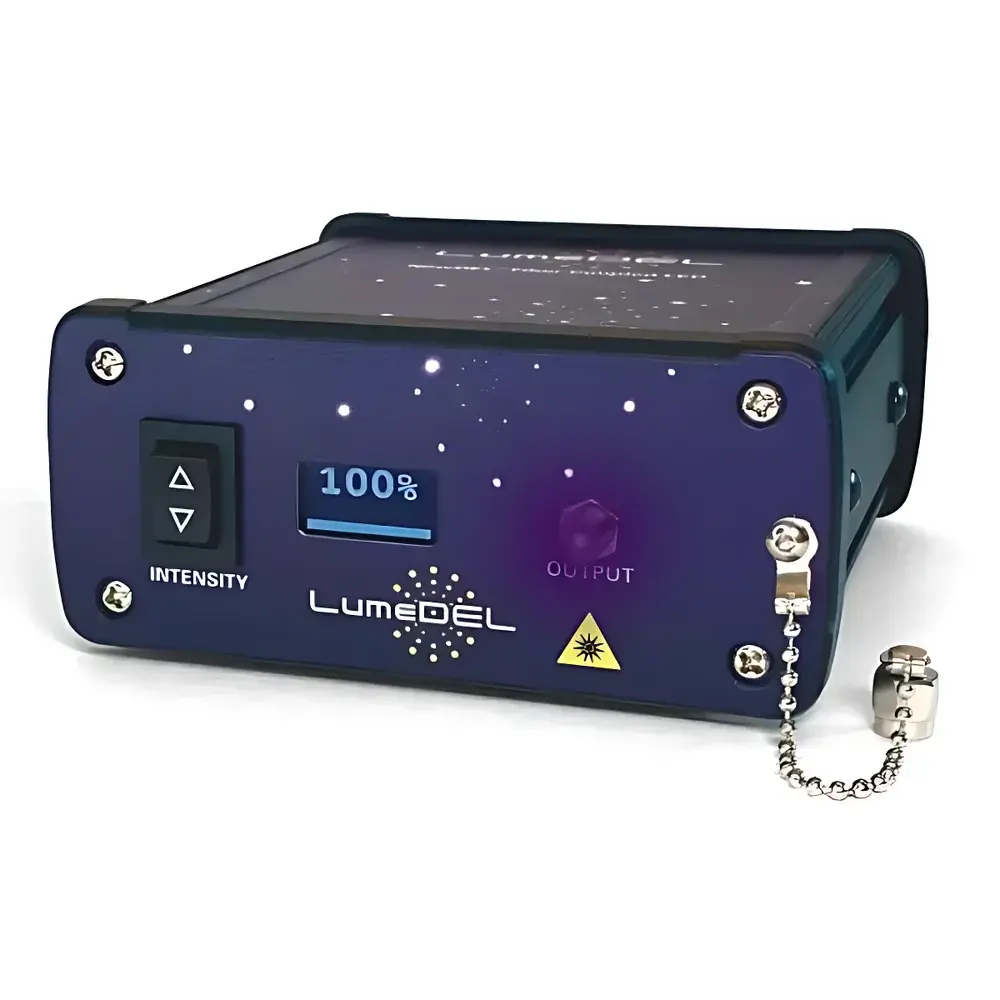
The Auniontech NewDEL High-Power Fiber-Coupled LED Light Source is an engineered solid-state illumination platform designed for precision optical applications requiring stable, spectrally pure, and controllable radiant flux across the ultraviolet (275 nm), visible (400–700 nm), and near-infrared (700–1100 nm) spectral regions. Unlike arc-lamp or laser-based sources, the NewDEL leverages high-efficiency, thermally stabilized LEDs coupled directly into multimode optical fibers—enabling repeatable irradiance delivery without spectral drift, lamp aging, or mechanical alignment sensitivity. Its core architecture integrates a dedicated microcontroller-driven current source, real-time thermal monitoring, and passive thermal management—eliminating fan-induced vibration, acoustic noise, and power consumption overhead typical of active-cooled systems. The device operates on pulse-width modulation (PWM) rather than analog current control, preserving spectral fidelity across intensity settings—a critical requirement for quantitative photobiomodulation, fluorescence excitation, and spectroscopic calibration where wavelength-dependent quantum yield must remain invariant.
Key Features
- Wavelength coverage from 275 nm (UVC) to 1100 nm (NIR), with discrete narrowband models and broadband white variants available
- Integrated driver and microcontroller—fully operational out-of-the-box without external controllers or software dependencies
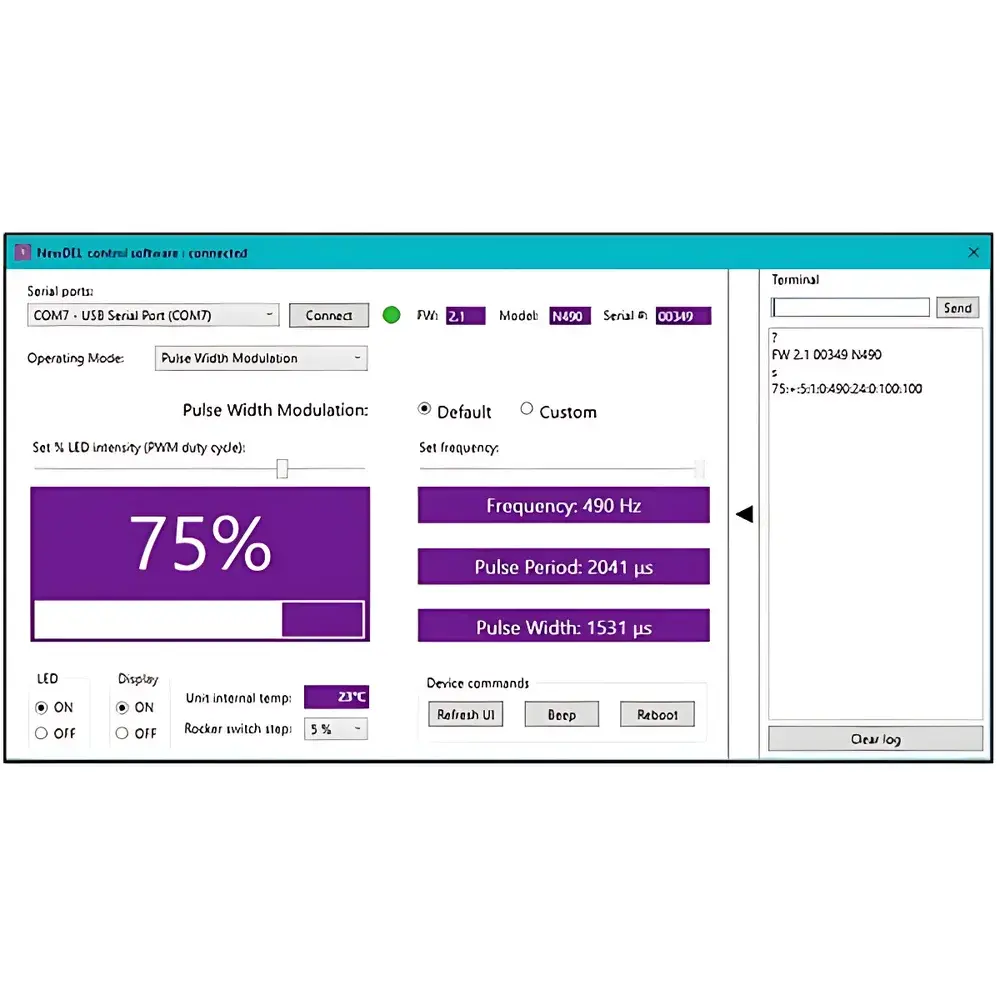
- Three operational modes: manual front-panel control, Windows®-based GUI, and programmable serial interface (RS-232) supporting custom automation scripts
- PWM dimming (1–500 Hz, adjustable in 1%, 2%, 4%, 5%, or 10% steps) ensures spectral stability; no wavelength shift with intensity variation
- Internal thermal regulation via passive heatsink and embedded temperature sensor—monitored and reported via software; extends LED lifetime beyond 20,000 hours
- SMA 905 fiber coupling optimized for high-NA, large-core multimode fibers (up to 1000 µm); FC connector available upon request
- BNC-triggered synchronization (50 Ω impedance matched) and BNC-monitor output for real-time waveform verification during time-resolved experiments
- EEPROM-stored configuration memory retains user-defined parameters—including PWM frequency, trigger delays, and duty cycles—across power cycles
- Compliant with international safety and EMC standards: UL/cUL 61010-1, IEC 61326-1 (EMC), IEC 62471 (photobiological safety), and RoHS 3
Sample Compatibility & Compliance
The NewDEL platform is compatible with standard silica-based multimode fibers (e.g., Thorlabs M36L01, Ocean Insight QP1000-2-SR) and supports integration into regulated environments. Its stable radiometric output enables traceable use in GLP-compliant optical validation protocols, including those referenced in ISO/IEC 17025 for calibration laboratories. While not FDA-cleared as a medical device, its spectral output profiles meet ASTM E308-22 requirements for illuminant characterization and are routinely deployed in preclinical PDT dosimetry, fNIRS system validation, and UVGI efficacy testing per CDC/NIOSH guidelines. The absence of mercury or xenon eliminates hazardous material handling concerns—supporting compliance with EU Directive 2011/65/EU (RoHS) and facilitating laboratory waste stream simplification.
Software & Data Management
Auniontech provides a native Windows® application with intuitive tab-based navigation for intensity calibration, timing sequence definition, and real-time thermal telemetry. All operational parameters—including PWM frequency, internal trigger period/delay, external trigger edge detection (rising/falling), and EEPROM write protection—are configurable and logged with timestamps. The RS-232 command set follows ASCII protocol conventions (e.g., SET:PWM=250, GET:TEMP?) and is compatible with LabVIEW™, Python (pySerial), MATLAB®, and National Instruments DAQ platforms. Audit-trail functionality—though not 21 CFR Part 11 compliant by default—can be enabled via third-party logging middleware for GxP-aligned workflows. Firmware updates are delivered via signed .hex files with CRC-32 validation to ensure integrity.
Applications
- UV Applications: Germicidal irradiation (UVGI) dose mapping, photopolymerization kinetics, UV-Vis absorbance reference standards, and photochemical reaction initiation
- Visible Applications: Optogenetic stimulation (ChR2, C1V1), fluorescence-guided surgery (indocyanine green, protoporphyrin IX), photodynamic therapy (PDT) light dosing, and antimicrobial blue light (aBL) studies
- NIR Applications: Functional near-infrared spectroscopy (fNIRS) source modules, tissue oxygenation monitoring, NIR reflectance imaging, and low-level light therapy (LLLT) research
- Broadband Applications: Spectral reflectance calibration (ASTM E308), hyperspectral camera illumination, and white-light interferometry reference sources
FAQ
Is the NewDEL suitable for GLP or GMP environments?
Yes—its stable output, EEPROM parameter persistence, and thermal telemetry support documented instrument qualification (IQ/OQ/PQ). Full 21 CFR Part 11 compliance requires external audit-log infrastructure.
Can multiple NewDEL units be synchronized?
Yes—via external TTL triggering with sub-millisecond jitter using the BNC sync input; master-slave configurations are supported through programmable delay offsets.
What fiber types are recommended for maximum coupling efficiency?
Multimode fibers with NA ≥ 0.22 and core diameter ≥ 400 µm (e.g., Thorlabs FG105LCA, LEONI 1000/1100 µm silica/silica) yield optimal power transfer; FC-PC connectors require optional adapter.
Does the unit support analog voltage control?
No—only digital PWM and TTL triggering are implemented to preserve spectral integrity; analog dimming is intentionally omitted.
How is thermal performance validated across ambient conditions?
Each unit undergoes 72-hour burn-in at 40°C ambient with continuous thermal logging; output stability is verified to ±1.5% over 8 hours at rated power.




