
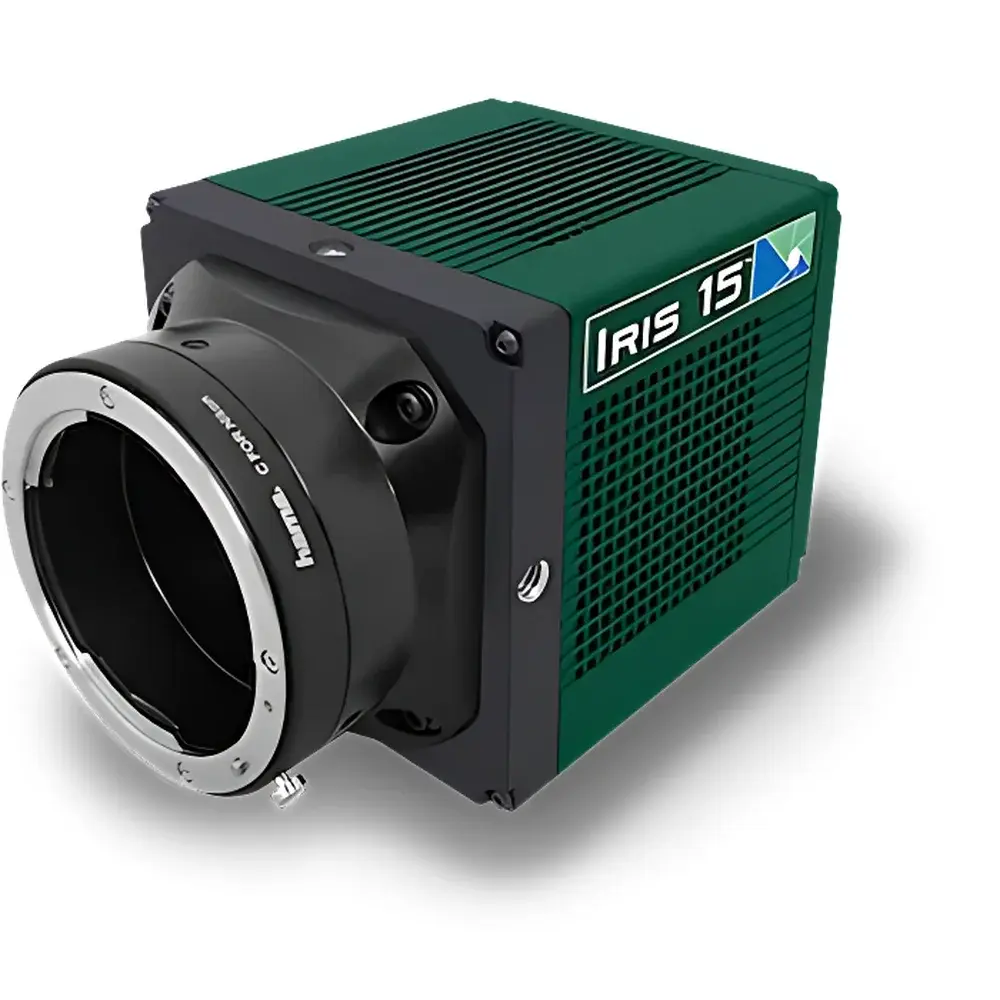
Teledyne Imaging Iris Series High-Resolution, Large-Field-of-View sCMOS Cameras
| Origin | Imported |
|---|---|
| Manufacturer Type | Authorized Distributor |
| Model | Iris Series |
| Price Range | USD 42,000 – 70,000 |
| Sensor Format | Iris 15 — 25 mm diagonal |
| Resolution | Iris 15 — 5056 × 2960 (15 MP) |
| Pixel Size | 4.25 µm × 4.25 µm |
| Quantum Efficiency | 73% (peak, 550 nm) |
| Spectral Response | 400–1000 nm (Visible to NIR) |
| Interface | PCIe Gen3 x4 (Iris 15) |
| Noise Reduction | Pattern Noise Reduction (PNR) + Correlated Double Sampling (CDS) |
| Cooling | Thermoelectric (TE), ΔT ≤ 45 °C below ambient |
| Dimensions | Iris 15 — 78 × 78 × 108 mm |
Overview
The Teledyne Imaging Iris Series represents a class of scientific complementary metal-oxide-semiconductor (sCMOS) cameras engineered for demanding quantitative optical microscopy and low-light imaging applications. Built upon high-fidelity sCMOS sensor architecture, the Iris platform delivers exceptional spatial resolution, large field-of-view coverage, and photon-limited sensitivity—enabling rigorous data acquisition in live-cell imaging, super-resolution microscopy, light-sheet tomography, and time-resolved fluorescence assays. Unlike conventional CCD or early-generation CMOS sensors, Iris cameras leverage advanced on-chip correlated double sampling (CDS), pixel-level pattern noise correction, and precisely calibrated analog-to-digital conversion to achieve sub-electron read noise (95% intra-frame linearity across full dynamic range. The series comprises two optimized variants: the Iris 15, featuring a 25 mm diagonal sensor format ideal for wide-field epifluorescence and macro-scale biological imaging; and the Iris 9, with a 17.8 mm field optimized for high-magnification confocal and lattice light-sheet configurations where pixel density and temporal fidelity are prioritized.
Key Features
- Large-format sCMOS architecture: Iris 15 integrates a 5056 × 2960 (15 MP) sensor with 25 mm diagonal active area—maximizing field coverage without sacrificing resolution when paired with modern wide-field objectives (e.g., 10×/0.4 NA or 20×/0.75 NA).
- Uniform 4.25 µm pixel pitch: Enables Nyquist-sampled imaging at common magnifications (e.g., 60× oil immersion with 25 mm tube lens yields ~0.17 µm/pixel sampling), preserving fine structural detail while minimizing aliasing artifacts.
- Programmable Scan Mode (PSM): Provides direct register-level control over rolling shutter timing—including line exposure duration, inter-line delay, and global reset synchronization—supporting precise synchronization with pulsed lasers, galvo scanners, or stage motion controllers (e.g., for synchronized multi-plane acquisition or structured illumination).
- Dual-stage noise suppression: Combines hardware-based correlated double sampling (CDS) with firmware-applied pattern noise reduction (PNR), effectively eliminating fixed-pattern noise (FPN), column-wise banding, and pixel non-uniformity—critical for quantitative intensity measurements and ratiometric analysis.
- Thermally stabilized imaging core: Integrated Peltier cooling maintains sensor temperature within ±0.1 °C stability, reducing dark current to <0.5 e⁻/pixel/s at −20 °C operating point—ensuring consistent performance across multi-hour acquisitions.
Sample Compatibility & Compliance
The Iris Series is compatible with standard C-mount and F-mount optical interfaces, and supports integration into OEM microscope platforms via SDK-controlled trigger I/O (TTL-compatible input/output lines). All models comply with CE, FCC Class A, and RoHS directives. Firmware and driver stacks adhere to GenICam v3.3 standards, ensuring interoperability with third-party acquisition software (e.g., Micro-Manager, NIS-Elements, MetaMorph, and custom LabVIEW or Python-based frameworks). For regulated environments, the Iris SDK supports audit-trail logging, user-access controls, and metadata stamping aligned with GLP/GMP documentation requirements. While not FDA 21 CFR Part 11 certified out-of-the-box, the camera’s deterministic frame timestamping, immutable image headers, and reproducible gain/offset calibration enable validation-ready deployment in preclinical imaging workflows.
Software & Data Management
Teledyne’s Spinnaker SDK provides cross-platform (Windows/Linux/macOS) C++, C#, Python, and MATLAB APIs with real-time streaming support up to 1.2 GB/s (PCIe variant). The SDK includes built-in support for ROI binning, pixel defect correction maps, flat-field compensation, and hardware-triggered burst acquisition (up to 10,000 frames at full resolution with on-board buffering). Image metadata—including exposure time, sensor temperature, gain setting, and timestamp (with microsecond precision)—is embedded in TIFF, HDF5, and vendor-neutral NDX file formats. For high-throughput labs, Spinnaker integrates seamlessly with OpenSlide-compatible tile servers and OMERO-compatible repositories, enabling scalable archiving and AI-ready dataset curation.
Applications
- Live-cell calcium imaging with GCaMP or jRGECO reporters requiring high SNR at ≥100 fps
- Wide-field deconvolution microscopy of whole-organism samples (e.g., zebrafish embryos, Drosophila larvae)
- Single-molecule localization microscopy (SMLM) using dSTORM or PALM protocols
- Quantitative phase contrast and differential interference contrast (DIC) time-lapse studies
- Industrial metrology of micro-optical components under broadband illumination
- Multi-spectral reflectance mapping in semiconductor wafer inspection
FAQ
What is the maximum sustained frame rate at full resolution for Iris 15?
At 5056 × 2960 (15 MP), Iris 15 achieves 30 fps via PCIe interface with lossless compression enabled; uncompressed streaming is supported at 22 fps.
Does Iris support hardware triggering with variable exposure per frame?
Yes—Programmable Scan Mode allows per-frame exposure adjustment via external TTL pulse width modulation, enabling adaptive acquisition in fluctuating illumination conditions.
Can Iris cameras be used in vacuum or high-humidity environments?
No—the cameras are rated for operation in ambient laboratory environments only (IEC 60529 IP20). Enclosure integration is required for non-standard environmental deployment.
Is sensor calibration data provided with each unit?
Yes—each Iris camera ships with factory-measured gain/offset tables, pixel defect maps, and quantum efficiency curves traceable to NIST-calibrated photodiodes.
How is cooling performance verified during manufacturing?
Every unit undergoes thermal soak testing at −20 °C setpoint for ≥4 hours, with dark current and noise metrics validated against ISO 15739:2013 imaging noise standards.




