
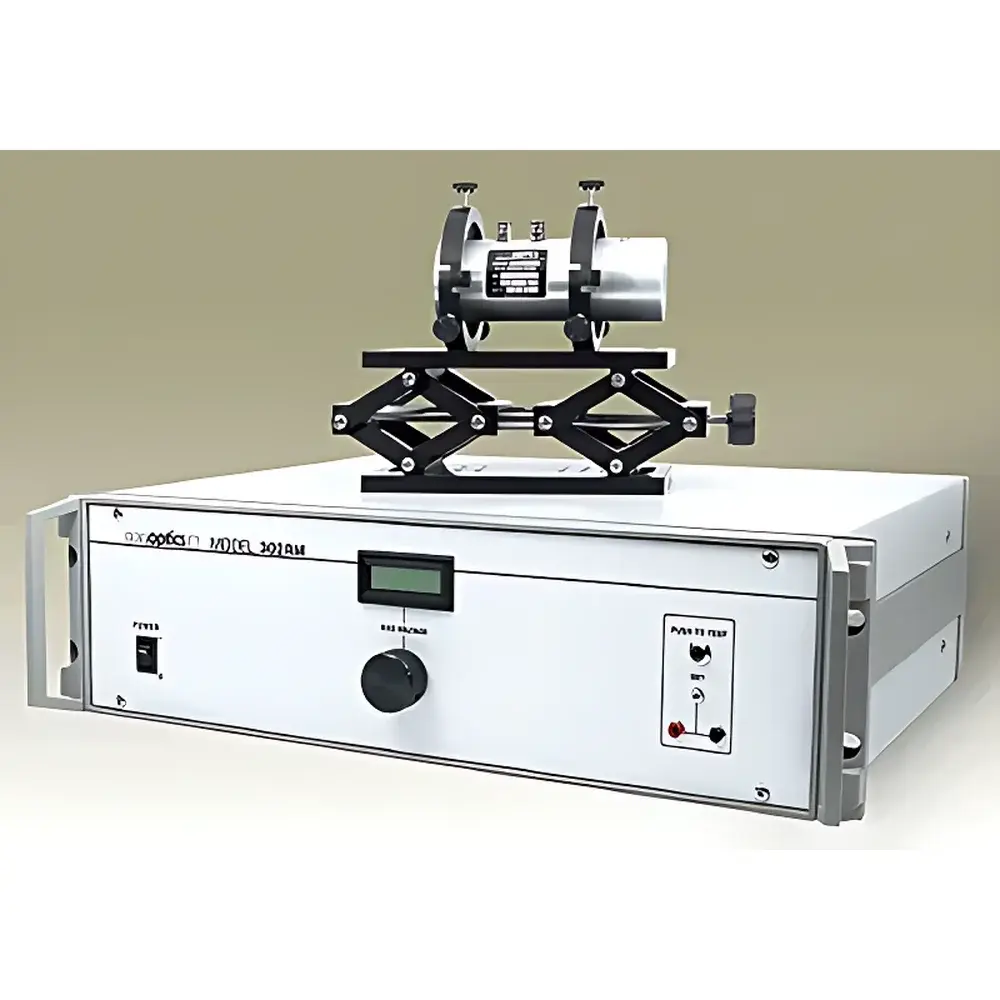
ConOptics Low-Voltage Electro-Optic Modulator
| Origin | USA |
|---|---|
| Manufacturer Type | Authorized Distributor |
| Origin Category | Imported |
| Model | ConOptics EO Modulator |
| Pricing | Upon Request |
Overview
The ConOptics Low-Voltage Electro-Optic Modulator is a precision transverse-field electro-optic device engineered for high-fidelity intensity, phase, and polarization modulation of laser beams across ultraviolet, visible, and near-to-mid infrared spectral ranges. Based on the Pockels effect in single-crystal electro-optic media—including ammonium dihydrogen phosphate (ADP), potassium dideuterium phosphate (KD*P), and lithium tantalate (LTA)—these modulators operate without intrinsic birefringence drift or thermal hysteresis, ensuring long-term stability under continuous-wave and pulsed laser operation. Unlike longitudinal configurations, the transverse geometry enables significantly reduced half-wave voltage (Vπ)—as low as 60 V @ 1064 nm for the LTA-based M360-160 model—while maintaining high extinction ratios (>500:1 at 633 nm and 1064 nm) and broad optical bandwidths up to 200 MHz. The modulator’s design complies with fundamental requirements for laser cavity dumping, regenerative amplification seeding, optical pulse picking, Q-switching, and coherent control experiments in ultrafast and quantum optics laboratories.
Key Features
- Transverse electro-optic architecture enabling low-drive-voltage operation (Vπ from 60 V to 970 V depending on crystal type, aperture, and wavelength)
- Three crystal platform options: ADP (240–800 nm), KD*P (240–1100 nm), and LTA (700–2000 nm), each optimized for specific spectral and thermal stability requirements
- Aperture diameters ranging from 2.5 mm to 3.5 mm; integrated polarizer options available for intensity modulation configurations
- Rise/fall times from 3.5 ns (100 MHz analog driver) to 1 µs (low-frequency lumped-capacitance drivers), supporting both analog and digital modulation protocols
- Modulator-to-driver compatibility validated per ConOptics system integration tables—ensuring impedance matching (50 Ω, 100 Ω, or lumped-capacitance), bandwidth alignment, and transmission efficiency >85% at designated wavelengths
- Configurable operational modes: intensity modulator (standard), polarization rotator, voltage-tunable waveplate, and phase modulator (requires dedicated half-cell biasing; irreversible reconfiguration)
Sample Compatibility & Compliance
The ConOptics modulator series supports collimated free-space beams with TEM00 or low-order multimode profiles. Input beam diameter must remain within specified aperture limits to avoid clipping-induced wavefront distortion and contrast degradation. All models are vacuum-compatible and rated for continuous operation at ambient temperatures (15–30 °C) with <±0.5 °C thermal stability recommended for sub-percent Vπ repeatability. Crystal mounts employ stress-free kinematic designs compliant with ISO 10110-7 surface quality standards. While not certified to a specific regulatory framework, the modulators meet baseline mechanical and optical performance criteria referenced in ISO/IEC 17025 calibration environments and support GLP-compliant experimental documentation when paired with traceable drive electronics and power supplies.
Software & Data Management
ConOptics modulators are hardware-agnostic and require no proprietary firmware or embedded controllers. Drive signal generation is performed externally using standard RF sources, arbitrary waveform generators (AWGs), or OEM-integrated timing systems. For laboratory-scale automation, users commonly integrate these modulators with LabVIEW, Python (via PyVISA or NI-DAQmx), or MATLAB-based control stacks. When used in FDA-regulated or GMP-aligned optical manufacturing processes (e.g., laser-based wafer inspection or medical device calibration), full audit trails—including drive voltage logs, temperature monitoring records, and beam alignment timestamps—must be maintained externally. No native data logging or cloud connectivity is provided; all compliance-related data management remains the responsibility of the end-user’s instrument control infrastructure.
Applications
- Laser pulse selection and cavity-dumped amplifier seeding in Ti:sapphire and Yb:fiber ultrafast systems
- High-repetition-rate Q-switching for Nd:YAG, Nd:YVO4, and Er-doped fiber lasers
- Intensity stabilization loops in interferometric metrology and gravitational wave detection pre-stabilization stages
- Phase encoding in coherent optical communications testbeds (O-band to L-band)
- Quantum state preparation via polarization or phase manipulation in trapped-ion and neutral-atom platforms
- Optical disk mastering and laser direct imaging where precise temporal gating of UV excimer sources is required
FAQ
Can the same modulator be used interchangeably as an intensity and phase modulator?
No. Phase modulation requires biasing only one electrode pair and operating the crystal in a half-wave configuration; this physically disables the symmetric electrode arrangement needed for linear intensity modulation. Reconfiguration is irreversible.
What determines the choice between ADP, KD*P, and LTA crystals?
Wavelength range, damage threshold, and thermal coefficient of Vπ. ADP offers lowest Vπ below 500 nm but limited IR transmission; KD*P balances broad UV–NIR coverage and moderate thermo-optic sensitivity; LTA provides superior mid-IR transmission and lower thermal drift above 1000 nm.
Is polarization-maintaining fiber coupling supported?
These are free-space devices. Fiber coupling requires external collimation optics and polarization alignment stages; ConOptics does not supply integrated PM-fiber pigtails.
Do ConOptics modulators comply with RoHS or REACH?
Yes—crystal substrates and housing materials conform to EU Directive 2011/65/EU (RoHS2) and Regulation (EC) No. 1907/2006 (REACH), with full material declarations available upon request to authorized distributors.
How is Vπ calibrated and verified during installation?
Vπ is measured in situ using a stabilized HeNe or diode laser at the target wavelength, with photodetector-based null-point detection in a Mach–Zehnder or polarimetric setup. ConOptics provides traceable reference measurements per batch but recommends end-user verification under actual optical path conditions.





