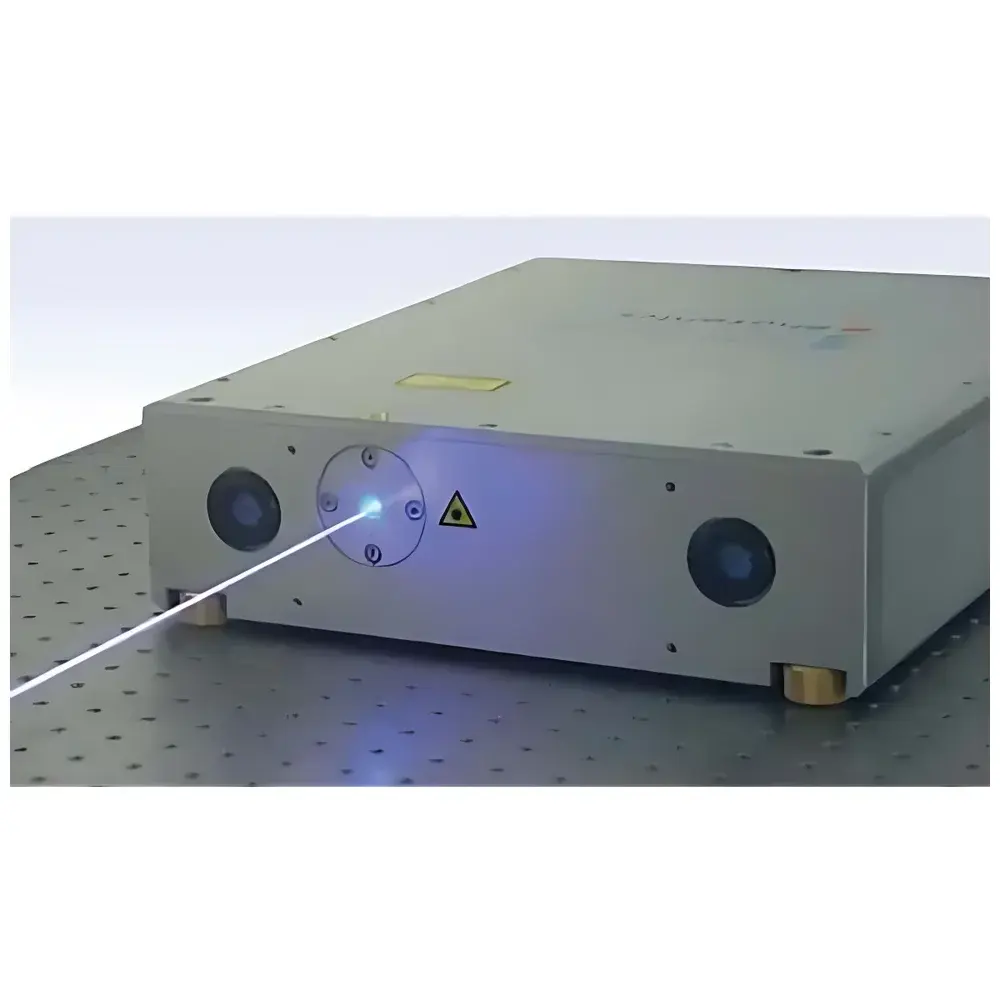
Auniontech IMPRESS 213/224 Deep-Ultraviolet Nanosecond Solid-State Laser System
| Brand | Auniontech |
|---|---|
| Origin | Shanghai, China |
| Model | IMPRESS Series |
| Wavelength | 213 nm / 224 nm |
| Average Power | 150 mW (213 nm) / 300 mW (224 nm) |
| Pulse Width | 6–8 ns (213 nm) / <9 ns (224 nm) |
| Pulse Energy | 15 µJ (213 nm) / >30 µJ (224 nm) |
| Repetition Rate | 1–30 kHz (213 nm) / 0.1–30 kHz (224 nm) |
| Beam Quality (M²) | <1.6 (both) |
Overview
The Auniontech IMPRESS 213/224 is a compact, air-cooled, diode-pumped solid-state (DPSS) deep-ultraviolet (DUV) nanosecond laser system engineered for high-precision photonic manufacturing and metrology applications requiring short-wavelength coherence and spatial fidelity. Operating at fixed wavelengths of 213 nm and 224 nm—generated via fourth- and fifth-harmonic generation from a Nd:YAG or Nd:YVO₄ fundamental source—the system delivers TEM₀₀ Gaussian beam profiles with M² < 1.6, enabling diffraction-limited focusing to sub-micron spot sizes. Unlike gas-based alternatives such as frequency-doubled argon-ion lasers, the IMPRESS platform eliminates plasma tube degradation, reduces thermal drift, and achieves superior long-term power stability (10,000 hours MTBF). Its all-solid-state architecture, combined with integrated pulse monitoring and active temperature stabilization, ensures robust operation in continuous 7×24 industrial environments—including cleanroom-integrated interferometric alignment systems and automated FBG inscription platforms.
Key Features
- Two discrete DUV output options: 213 nm (IMPRESS 213) and 224 nm (IMPRESS 224), both generated via nonlinear harmonic conversion in BBO or CLBO crystals
- High beam quality: M² < 1.6, enabling <0.8 µm focused spot diameter (at 213 nm, f = 100 mm lens)
- Nanosecond pulse control: Adjustable repetition rate (1–30 kHz for 213 nm; 0.1–30 kHz for 224 nm) with jitter <500 ps RMS
- Stable average power output: 150 mW @ 213 nm (15 µJ/pulse @ 10 kHz); 300 mW @ 224 nm (>30 µJ/pulse @ 10 kHz)
- Integrated digital interface (RS-232, USB, TTL sync I/O) for external triggering, power modulation, and real-time diagnostics
- Compliance with IEC 60825-1:2014 Class 4 laser safety standards; includes interlock-ready shutter and key-switch enable circuitry
Sample Compatibility & Compliance
The IMPRESS series is optimized for interaction with wide-bandgap materials—such as fused silica, sapphire, diamond, and silicon carbide—where photon energy exceeds bandgap thresholds (e.g., 5.8 eV at 213 nm), enabling direct photochemical ablation without significant thermal diffusion. Its wavelength-specific absorption profiles support traceable calibration in laser-based interferometry setups compliant with ISO 230-6 (test of positioning accuracy using laser interferometers) and VDI/VDE 2634 Part 2 (optical 3D measurement systems). The system meets CE marking requirements for electromagnetic compatibility (EN 61326-1) and low-voltage directive (2014/35/EU). For regulated environments, optional audit-trail logging and user-access control firmware modules are available to support GLP/GMP-aligned validation protocols.
Software & Data Management
Auniontech provides the IMPRESS Control Suite—a Windows-based application supporting remote parameter configuration, pulse energy profiling, shot-count logging, and real-time thermal feedback visualization. All operational parameters (pulse energy, repetition rate, internal cavity temperature, diode current) are timestamped and exportable in CSV or HDF5 format for integration into LabVIEW, MATLAB, or Python-based metrology pipelines. Firmware supports SCPI command set compliance, enabling seamless incorporation into automated test sequences governed by ASTM E2911 (standard guide for laser-based dimensional measurement). Optional API libraries (C/C++, .NET, Python) facilitate custom integration with motion controllers and interferometric position feedback loops.
Applications
- Fiber Bragg grating (FBG) inscription via phase-mask or point-by-point methods, leveraging high photon energy for Type-I/II index modification in photosensitive germanosilicate fibers
- Micromachining of transparent dielectrics: diamond scribing, sapphire wafer dicing, and UV-fused silica waveguide writing
- Photoluminescence excitation spectroscopy of wide-bandgap semiconductors (e.g., AlN, Ga₂O₃) and quantum emitters (SiV⁻ centers in diamond)
- Raman enhancement in resonance-sensitive configurations (e.g., 224 nm excitation for nitrogen-vacancy defect analysis)
- Maskless direct-write lithography for micro-optics fabrication and MEMS patterning
- In-line semiconductor wafer inspection and defect localization using DUV scattering contrast
- Calibration source for absolute distance interferometers operating in vacuum or nitrogen-purged enclosures
FAQ
What is the typical warm-up time required to achieve spectral and power stability?
The IMPRESS system reaches thermal equilibrium and specified power stability within ≤15 minutes after cold start, verified per ISO 10110-10 Annex B protocols.
Is the laser compatible with vacuum environments?
Yes—optional vacuum-compatible housing (CF-35 flange) and outgassing-certified optical mounts are available upon request.
Can pulse energy be modulated dynamically during operation?
Yes, via analog voltage input (0–5 V) or TTL-triggered burst mode, with modulation bandwidth up to 100 kHz.
Does the system support external cavity length locking for interferometric use?
While not internally equipped with piezo-driven cavity tuning, the IMPRESS’s low-amplitude noise (<0.3% RMS, 10 Hz–10 MHz) and narrow linewidth (<0.1 pm) make it suitable for external locking to high-finesse Fabry–Pérot cavities.
What documentation is provided for regulatory validation?
Each unit ships with a Factory Calibration Report (traceable to NIM, China), EC Declaration of Conformity, and full technical manual including maintenance schedules and failure mode analysis (FMEA) summary.