
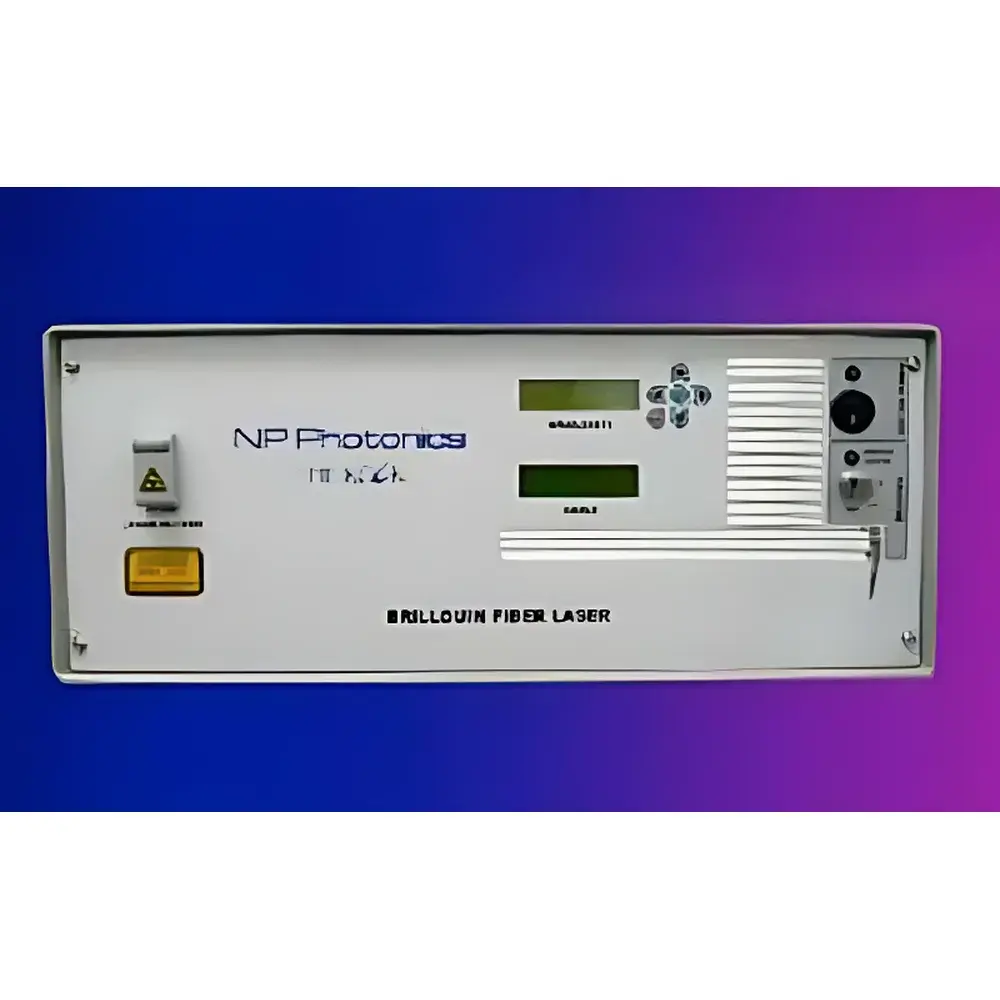
NP Photonics Rock Brillouin Single-Frequency Brillouin Fiber Laser
| Origin | USA |
|---|---|
| Manufacturer Type | Authorized Distributor |
| Origin Category | Imported |
| Model | Rock Brillouin |
| Price | Upon Request |
Overview
The NP Photonics Rock Brillouin Single-Frequency Brillouin Fiber Laser is a turnkey, high-stability narrow-linewidth laser source engineered for applications demanding exceptional spectral purity, ultra-low phase noise, and long-term frequency stability. Unlike conventional distributed feedback (DFB) or external cavity diode lasers, this system leverages stimulated Brillouin scattering (SBS) in a polarization-maintaining fiber ring cavity, seeded by NP Photonics’ proprietary Erbium-doped Microstructured Fiber (EMF) pump laser. The Brillouin gain process provides intrinsic linewidth narrowing—resulting in sub-200 Hz optical linewidths—while the monolithic all-fiber architecture ensures robustness against environmental perturbations. Operating in the C-band (1530–1565 nm), the laser delivers 25 mW of continuous-wave (CW), single longitudinal mode (SLM), linearly polarized output with >25 dB polarization extinction ratio (PER). Its design targets mission-critical photonic systems where coherence length exceeding 150 km and phase noise below −120 dBc/Hz at 1 MHz offset are essential.
Key Features
- Ultra-narrow optical linewidth: ≤200 Hz (Lorentzian full width at half maximum)
- Single longitudinal mode operation with >50 dB side-mode suppression ratio (SMSR)
- Output power: 25 mW CW, stabilized via integrated photodiode-based power feedback loop
- Linear polarization output with FC/APC connector and >25 dB PER
- Active noise suppression architecture reducing relative intensity noise (RIN) to <−120 dB/Hz at peak and <−155 dB/Hz above 50 MHz
- Optical signal-to-noise ratio (OSNR) >65 dB (measured over 50 pm resolution bandwidth)
- Wavelength tuning range: up to 30 GHz via precision thermal control (±0.01 °C stability)
- Front-panel digital interface with real-time wavelength and output power display
- RS232 serial communication for remote configuration, monitoring, and logging
- Microprocessor-controlled operation with embedded diagnostics and fault reporting
Sample Compatibility & Compliance
The Rock Brillouin laser is fully compatible with standard single-mode fiber test benches (ITU-T G.652.D compliant), interferometric sensor arrays, coherent LIDAR receivers, and RF photonics links requiring low-phase-noise optical carriers. It meets electromagnetic compatibility (EMC) requirements per FCC Part 15 Class A and IEC 61326-1 for laboratory instrumentation. While not certified as medical or aerospace-grade hardware, its design adheres to GLP-aligned operational traceability principles—including timestamped parameter logs, firmware version tracking, and configurable audit trails via RS232. The system supports integration into ISO/IEC 17025-accredited metrology labs when deployed with calibrated optical power meters and wavelength meters (e.g., NIST-traceable references).
Software & Data Management
No proprietary GUI software is bundled; instead, the laser exposes a documented ASCII command set over RS232 for seamless integration into LabVIEW, Python (PySerial), MATLAB, or custom SCADA environments. All operational parameters—including setpoint wavelength, actual output power, internal temperature, and status flags—are queryable in real time. Configuration changes (e.g., wavelength tuning step, power limit, auto-restart behavior) persist across power cycles. Data logging is performed externally by the host system; no on-board storage or cloud connectivity is implemented, preserving data sovereignty and simplifying FDA 21 CFR Part 11 compliance in regulated QA/QC workflows.
Applications
- Fiber-optic sensing: Distributed acoustic sensing (DAS), strain/temperature monitoring in oil & gas wells, and structural health monitoring of bridges and pipelines
- Coherent LIDAR: High-resolution velocity mapping, wind profiling, and atmospheric aerosol detection requiring multi-kilometer coherence length
- Photonic-assisted RF generation: Low-phase-noise microwave synthesis via optical heterodyning
- Optical metrology: Absolute distance measurement using dual-comb interferometry or swept-wavelength interferometry
- Quantum optics experiments: Pumping of nonlinear waveguides for SPDC, cavity-enhanced spectroscopy, and optical clock stabilization
- Telecom R&D: Characterization of ultra-narrowband filters, dispersion-compensating modules, and coherent receiver front-ends
FAQ
What physical mechanism enables the 200 Hz linewidth?
Stimulated Brillouin scattering in a low-loss, polarization-maintaining fiber ring cavity provides passive linewidth narrowing—distinct from active electronic linewidth reduction—and yields fundamental Lorentzian-limited linewidths.
Is the output power adjustable?
The nominal output is fixed at 25 mW; attenuation is achieved externally using variable optical attenuators (VOAs); internal power scaling is not supported to preserve SLM integrity and noise performance.
Can multiple Rock Brillouin lasers be phase-locked?
Yes—the system’s low phase noise and RS232-accessible wavelength control enable synchronization with external RF references or master oscillators for coherent array applications.
Does it support OEM integration?
Yes—custom mechanical housings, modified connectors (e.g., pigtailed PM fiber), and firmware-level API extensions are available under NP Photonics’ OEM partnership program.
What is the typical warm-up time to specification?
Full thermal stabilization and spectral convergence require ≤30 minutes after cold start, with wavelength drift <±50 MHz over subsequent 8 hours under constant ambient conditions.





