
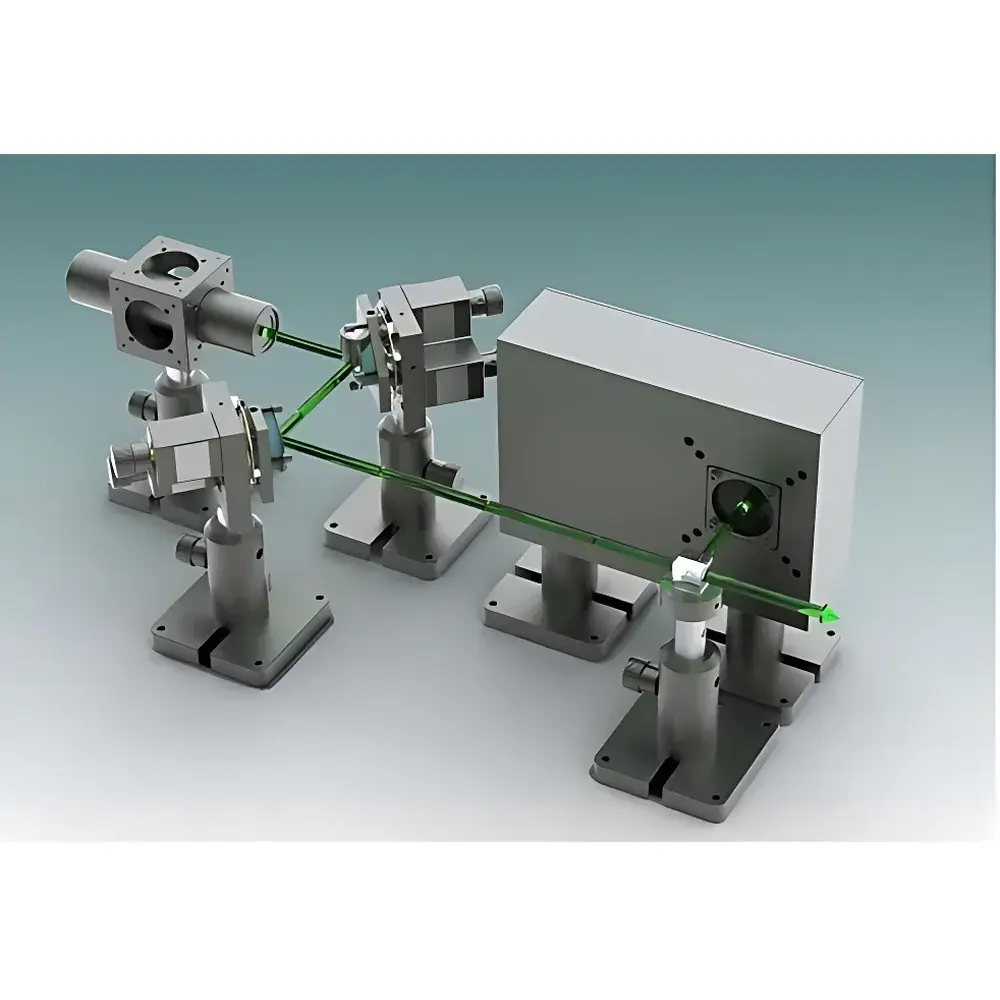
Aligna_Automated Laser Beam Pointing Stabilization System by TEM Messtechnik GmbH
| Brand | TEM Messtechnik GmbH |
|---|---|
| Origin | Germany |
| Model | Aligna_Automated |
| Detection Principle | PSD-based closed-loop feedback |
| Feedback Resolution | <10 nm, <10 nrad |
| Servo Bandwidth | >5 kHz |
| Wavelength Range | Standard 380–1100 nm (customizable from 180 nm to 10 µm and THz) |
| Beam Diameter | Variable (no fixed constraint) |
| Control Interface | USB, RS-232, Ethernet |
| Scan Range | >18° |
| Compatible Lasers | CW and pulsed (0.1 Hz – 200 MHz repetition rate) |
| Actuation | Piezo-driven tip/tilt mirror assemblies |
| Modularity | Supports 2-beam or 4-beam independent stabilization per unit |
| Compliance | Designed for GLP/GMP-aligned optical laboratories |
Overview
The Aligna_Automated Laser Beam Pointing Stabilization System is an engineered precision platform developed by TEM Messtechnik GmbH (Germany) for active suppression of angular and positional drift in free-space laser beams. It operates on a real-time closed-loop principle: a position-sensitive detector (PSD)—or optionally a quadrant photodiode or CMOS-based beam profiler—continuously monitors beam centroid displacement in two orthogonal axes (X and Y). This analog or digital error signal is processed by a low-latency servo controller, which drives piezoelectric tip/tilt mirrors to dynamically reorient the beam path. With sub-10-nanoradian angular resolution and sub-10-nanometer positional fidelity, the system achieves stabilization performance required in applications where thermal expansion, acoustic vibration, air turbulence, or mechanical creep would otherwise degrade optical alignment beyond acceptable tolerances. Its architecture is optimized for integration into high-stability optical tables, vacuum beamlines, and multi-experiment laser infrastructure.
Key Features
- Real-time closed-loop stabilization with servo bandwidth exceeding 5 kHz, enabling effective suppression of high-frequency disturbances including acoustic noise and pump-induced mechanical resonance.
- Modular design supporting simultaneous stabilization of up to four independent laser beams within a single chassis—ideal for multi-wavelength or multi-path interferometric setups.
- Wide spectral compatibility: standard calibration covers 380–1100 nm; optional configurations extend coverage from deep UV (180 nm) through mid-IR (10 µm) and into the THz regime via custom detector and mirror coatings.
- Large angular correction range (>18° total scan angle), permitting recovery from significant misalignment events without manual intervention.
- Fully programmable control interface via USB 2.0, RS-232, or Ethernet—enabling remote operation, script-driven calibration sequences, and synchronization with external triggers (e.g., laser pulses, stage motion).
- Native support for external sensor integration, including power meters, photodiodes, and fiber coupling monitors—facilitating hybrid feedback schemes such as power-normalized pointing stabilization.
Sample Compatibility & Compliance
The Aligna_Automated system accommodates both continuous-wave and pulsed laser sources across a broad operational envelope: repetition rates from 0.1 Hz to 200 MHz, average powers compatible with standard mirror damage thresholds (dependent on wavelength and beam diameter), and pulse energies within typical piezo actuator dynamic limits. It complies with electromagnetic compatibility standards per EN 61326-1 and meets CE marking requirements for laboratory instrumentation. While not certified as medical or aerospace-grade hardware, its design adheres to principles aligned with ISO/IEC 17025-accredited metrology environments. When integrated with validated host software implementing time-stamped event logging and user-access controls, the system can satisfy documentation requirements for GLP and GMP audits—including traceability of stabilization parameters, configuration changes, and operational history.
Software & Data Management
TEM provides the Aligna Control Suite—a cross-platform application (Windows/Linux/macOS) offering real-time beam trajectory visualization, PID parameter tuning, disturbance spectrum analysis, and automated alignment routines. Raw sensor data and actuator voltage logs are exportable in HDF5 and CSV formats for post-processing in MATLAB, Python (NumPy/Pandas), or LabVIEW. The system supports SCPI command syntax over TCP/IP, allowing seamless incorporation into larger automation frameworks governed by EPICS, TANGO, or custom Python-based orchestration layers. Audit-trail functionality—including user login timestamps, parameter modification records, and firmware version tracking—is available when deployed with enterprise-grade identity management backends.
Applications
- High-precision laser material processing—compensating for thermal lensing-induced beam walk-off during extended ablation or welding cycles.
- Deep-space optical communication ground terminals—maintaining diffraction-limited coupling into single-mode fibers under atmospheric turbulence and telescope pointing jitter.
- Ultrafast strong-field physics experiments—stabilizing pump-probe beam overlap at femtosecond timescales across multi-meter beam paths in vacuum chambers.
- Automated fiber coupling optimization—dynamically aligning free-space beams to SMF or hollow-core photonic crystal fibers during environmental drift or component aging.
- Multi-experiment laser infrastructure—enabling rapid reconfiguration between distinct optical benches or laboratories without recalibration overhead.
- Harmonic generation and attosecond science—preserving phase-matching geometry across cascaded nonlinear crystals subjected to ambient temperature gradients.
FAQ
What types of lasers are compatible with the Aligna_Automated system?
It supports CW and pulsed lasers operating from 180 nm to 10 µm, including Ti:sapphire, fiber, diode, OPO, and CO₂ sources—provided beam parameters fall within specified power density and spot size limits.
Can the system stabilize multiple wavelengths simultaneously?
Yes—via optional dichroic beam splitters and wavelength-specific detectors, or through sequential stabilization using fast optical switches synchronized to the control loop.
Is external triggering supported for synchronization with laser pulses?
Yes—TTL-compatible trigger inputs allow frame-locked acquisition and actuation, critical for stabilizing ultrafast systems with low-duty-cycle operation.
How is long-term drift compensated beyond the piezo’s range?
The system supports hybrid architectures: coarse alignment via motorized stages (e.g., Thorlabs K10CR1) feeds into fine stabilization via piezo mirrors, with coordinated control handled by the Aligna Control Suite.
Does the system meet FDA 21 CFR Part 11 requirements?
Out-of-the-box, it does not include electronic signature or audit trail certification—but when integrated with validated third-party software meeting Part 11 criteria, full compliance is achievable in regulated QC/QA workflows.



