
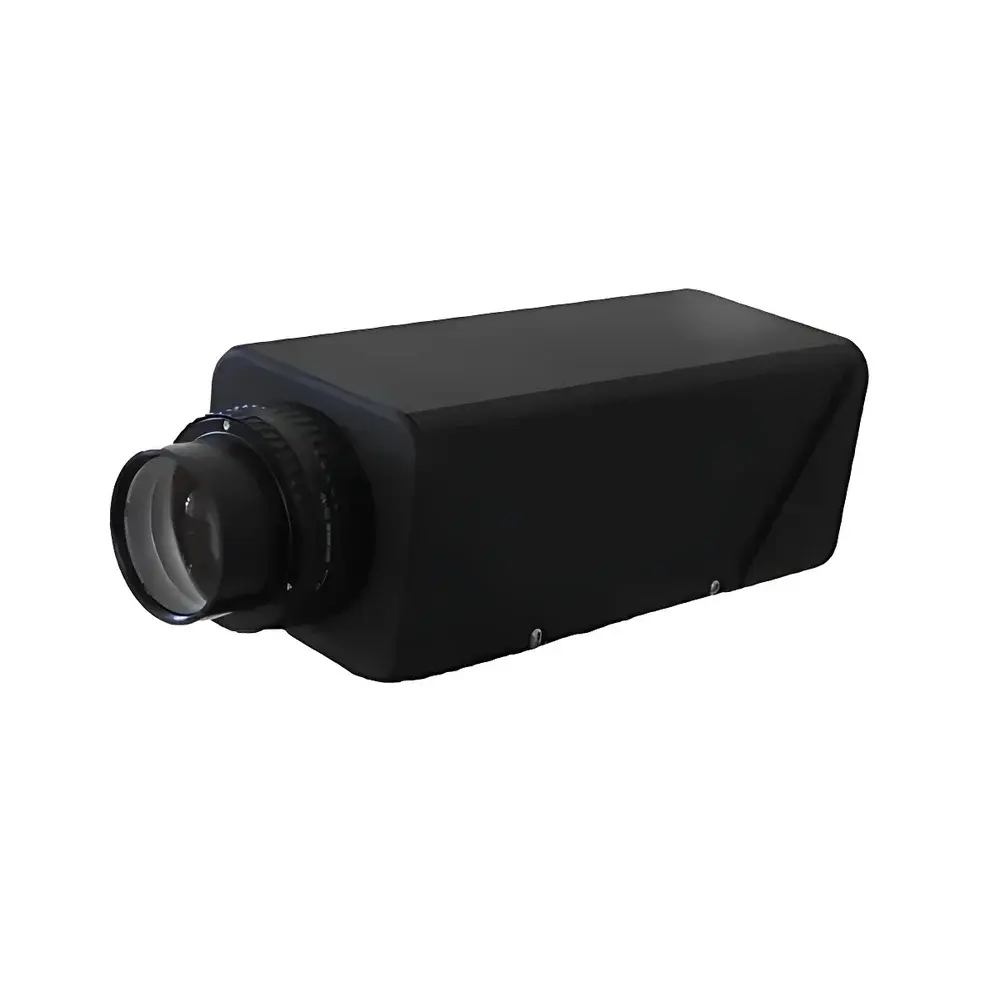
Auniontech Model 4250 VNIR凝视型高光谱成像仪(无需运动)
| Brand | Auniontech |
|---|---|
| Origin | Imported |
| Model | Model 4250 VNIR |
| Spectral Range | 400–1000 nm |
| Spectral Channels | 300 nominal |
| Spectral Resolution | 4 nm |
| Sensor Resolution | 2.3 MP |
| Interface | USB |
| Field of View Options | 15° or 30° |
| Operating Temperature | 20°C ± 10°C |
| Relative Humidity | ≤65% non-condensing |
| Dimensions | 197.7 × 81 × 78 mm |
| Weight | 1.25 kg |
Overview
The Auniontech Model 4250 VNIR Snapshot Hyperspectral Imaging Camera is a solid-state, scanning-free hyperspectral imager engineered for high-fidelity spectral-spatial data acquisition in both laboratory and field-deployable environments. Unlike push-broom or whisk-broom systems that rely on relative motion between sensor and target, this instrument employs a tunable Fabry-Perot interferometric filter placed directly in front of a monochrome CMOS sensor. This optical architecture enables full-frame, wavelength-selective image capture—each exposure yielding a complete 2D spatial frame at a discrete, electronically tuned spectral band. By sequentially stepping through up to 300 narrowband channels across the visible to near-infrared (VNIR) spectrum (400–1000 nm), the system constructs a mathematically rigorous 3D hyperspectral data cube (x, y, λ) without mechanical translation or vibration-sensitive scanning mechanisms. Its snapshot modality ensures intrinsic temporal synchronization across all spatial pixels within a given spectral band—critical for dynamic scene analysis, real-time classification, and applications where platform stability cannot be guaranteed (e.g., UAV-mounted operation or handheld inspection).
Key Features
- True snapshot acquisition: Captures full 2.3 MP spatial frames at each spectral channel—no line-by-line scanning, no motion-induced spatial misregistration.
- Electronically tunable spectral selection: Fabry-Perot filter allows rapid, repeatable, and precise wavelength stepping with sub-nanometer repeatability; supports both high-resolution hyperspectral mode (up to 300 bands) and accelerated multispectral mode (user-defined band subsets).
- Robust environmental tolerance: Operates reliably within 20°C ± 10°C ambient range and ≤65% non-condensing humidity—validated for ground-based mobile labs, outdoor surveying, and stabilized airborne payloads.
- Modular optical interface: Compatible with interchangeable C-mount lenses offering 15° or 30° horizontal field of view; supports integration with telecentric, macro, or wide-angle optics for application-specific magnification and working distance.
- Low-SWaP-C design: Compact form factor (197.7 × 81 × 78 mm) and lightweight construction (1.25 kg) facilitate integration into space-constrained platforms including UAV gimbals, robotic arms, and portable forensic kits.
Sample Compatibility & Compliance
The Model 4250 VNIR is compatible with reflective, transmissive, and semi-diffuse samples under controlled illumination (e.g., halogen, LED, or pulsed xenon sources). It does not require sample preparation for most surface-level analyses and supports standoff imaging at distances from 10 cm to several meters depending on lens configuration and illumination intensity. The system complies with CE marking requirements for electromagnetic compatibility (EN 61326-1) and safety (EN 61010-1). While not certified for medical device use, its data output format (raw 16-bit TIFF stacks with embedded wavelength metadata) conforms to ASTM E131-22 definitions for spectral data exchange and is suitable for GLP-compliant workflows when paired with validated acquisition protocols and audit-trail-enabled software.
Software & Data Management
The camera ships with Auniontech’s Hyperspectral Studio—a cross-platform application supporting real-time preview, spectral calibration (using NIST-traceable reference standards), radiometric correction, and cube export in ENVI-compatible BIL/BIP formats. Advanced tools include endmember extraction (N-FINDR, PPI), supervised/unsupervised classification (SVM, K-means), spectral angle mapper (SAM), and false-color composite generation. All processing operations are logged with timestamped metadata, enabling full traceability per FDA 21 CFR Part 11 principles when deployed in regulated QA/QC environments. SDKs (C++, Python, MATLAB) allow seamless integration into custom pipelines for automated defect detection, spectral library matching, or inline process monitoring.
Applications
- Forensic science: Non-destructive examination of ink aging, latent fingerprint enhancement, accelerant residue mapping, and document authenticity verification via spectral unmixing.
- Geospatial remote sensing: Mineral identification, vegetation stress assessment (NDVI, PRI, MCARI), and lithological mapping using field-portable or drone-mounted configurations.
- Industrial quality control: Polymer sorting, metal alloy verification, coating thickness estimation, and contaminant detection on production lines.
- Agricultural phenotyping: In-field crop health monitoring, early disease symptom detection (e.g., fungal chlorosis), and precision harvest readiness evaluation.
- Food safety inspection: Pesticide residue screening on produce surfaces, meat freshness grading via myoglobin oxidation state analysis, and foreign material detection.
- Pharmaceutical analysis: Tablet coating uniformity assessment, API distribution mapping, and counterfeit drug identification through spectral fingerprint comparison.
- Cultural heritage science: Pigment identification in paintings, parchment degradation analysis, and underdrawing visualization without UV exposure.
FAQ
How does the Model 4250 differ from push-broom hyperspectral imagers?
It acquires full 2D frames at each wavelength—eliminating motion artifacts, enabling snapshot capture of moving targets, and simplifying optical alignment.
Can it operate in real time?
Yes—multispectral modes (e.g., 8–16 user-selected bands) support video-rate acquisition (≥30 fps), while full 300-band hyperspectral capture requires sequential exposures (typically 1–5 s per cube depending on SNR requirements).
Is radiometric calibration included?
Yes—factory-calibrated using NIST-traceable integrating sphere sources; users may perform field recalibration with optional reference tiles.
What illumination sources are recommended?
Broadband halogen or quartz-tungsten-halogen lamps are preferred for maximum spectral continuity; LED arrays with known emission profiles may be used for targeted band excitation.
Does it support external triggering?
Yes—TTL-compatible trigger input/output ports enable synchronization with lighting strobes, motion stages, or other instrumentation in automated test benches.



