
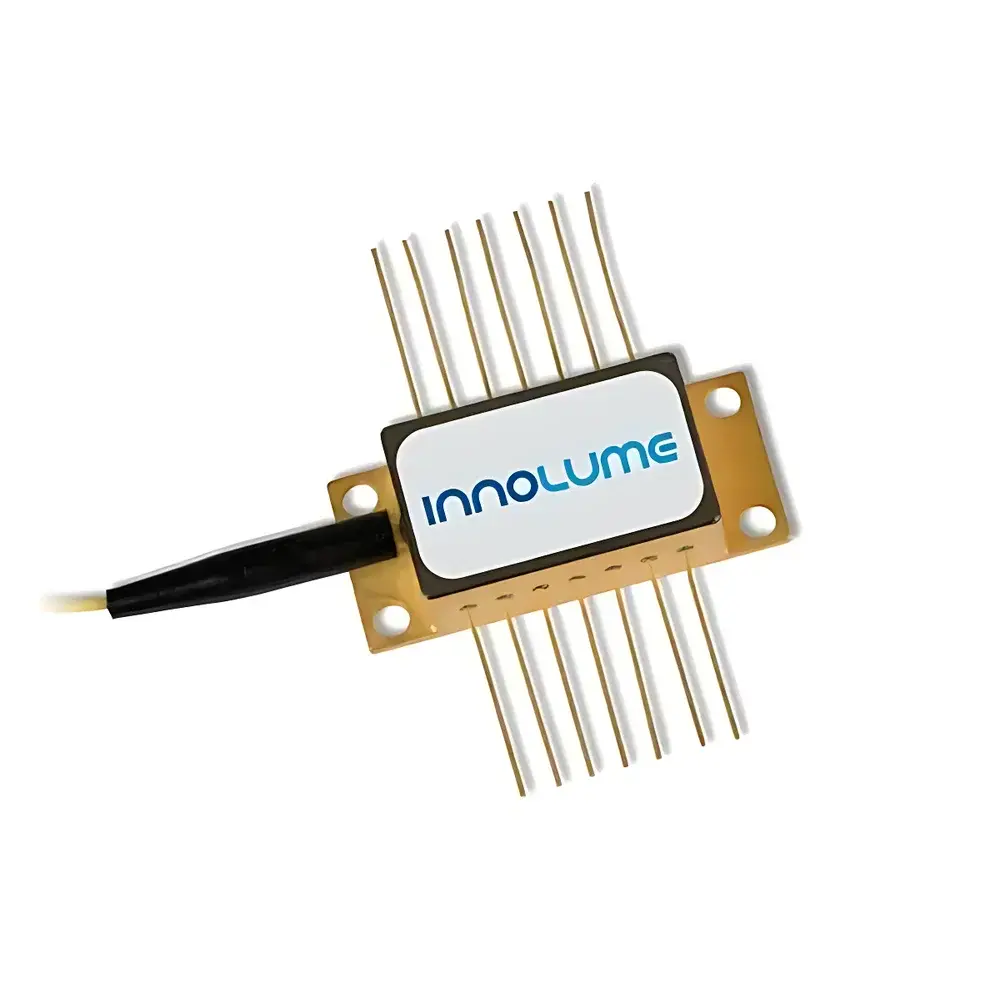
Auniontech Optical Frequency Comb Laser
| Brand | Auniontech |
|---|---|
| Type | Monolithic Quantum-Dot-Based Optical Frequency Comb Laser |
| Core Technology | InAs/InGaAs Quantum Dot Gain Medium |
| Output Format | Equidistant, Phase-Coherent Comb Lines in Frequency Domain |
| Typical Comb Spacing (f_rep) | Ranges from 10 GHz to 40 GHz (customizable) |
| Relative Intensity Noise (RIN) | < −145 dB/Hz (at 1 MHz offset, typical) |
| Linewidth per Comb Tooth | < 100 kHz (intrinsic, free-running) |
| Tuning Range | C-band (1530–1565 nm) or L-band (1565–1625 nm), configurable |
| Compliance | RoHS-compliant packaging |
| meets IEC 60825-1 | 2014 Class 1 laser safety requirements |
| Software Interface | USB 2.0 / RS-232 |
| Operating Temperature | 15–35 °C (stabilized TEC control) |
| Power Supply | 5 V DC, ≤3 W typical consumption |
| Form Factor | TO-can or butterfly package (OEM module) |
Overview
An optical frequency comb (OFC) laser is a coherent broadband light source whose spectrum consists of a series of precisely equidistant, phase-locked spectral lines—each corresponding to a longitudinal cavity mode. Unlike conventional multi-mode semiconductor lasers suffering from mode partition noise (MPN) and temporal instability, the Auniontech monolithic quantum-dot-based optical frequency comb laser leverages an InAs/InGaAs quantum dot active region to generate intrinsically stable, low-noise comb spectra. Its operation relies on four-wave mixing (FWM) and carrier dynamics engineered within the quantum dot gain medium, enabling robust self-starting comb formation without external modulation or cavity stabilization. This architecture delivers exceptional long-term phase coherence and amplitude stability—key prerequisites for metrological-grade applications including optical atomic clocks, precision spectroscopy, dual-comb interferometry, and high-capacity coherent optical communications.
Key Features
- Monolithic quantum-dot integration: Eliminates alignment sensitivity and environmental drift inherent in fiber- or bulk-optic comb systems; enables chip-scale deployment in OEM instrumentation.
- Ultra-low relative intensity noise (RIN): Typically < −145 dB/Hz at 1 MHz offset—critical for error-free high-order QAM modulation in coherent data transmission (e.g., 64-QAM, 256-QAM).
- Suppressed mode-hopping and phase jitter: Optimized facet reflectivity and quantum dot density distribution minimize transient mode competition, ensuring >100-hour continuous comb operation without active feedback locking.
- Thermally stabilized architecture: Integrated thermoelectric cooler (TEC) and monitor photodiode enable precise current- and temperature-controlled repetition rate (frep) tuning over ±500 MHz range.
- OEM-ready packaging: Available in industry-standard TO-56 can, 14-pin butterfly, or benchtop module with built-in driver, digital interface (USB/RS-232), and SCPI command support for seamless system integration.
Sample Compatibility & Compliance
The Auniontech optical frequency comb laser is designed for compatibility with standard single-mode fiber (SMF-28) pigtailing and polarization-maintaining (PM) variants. It complies with IEC 60825-1:2014 Class 1 laser safety standards when operated within specified electrical and thermal envelopes. For laboratory and industrial environments requiring regulatory traceability, the device supports GLP/GMP-aligned calibration documentation upon request—including factory-measured frep stability (Allan deviation < 1×10⁻¹² at 1 s averaging), comb line spacing uniformity (20 nm span). While not certified to FDA 21 CFR Part 11 out-of-the-box, its digital interface and logging capabilities are architecturally compatible with audit-trail-enabled software platforms used in regulated photonics R&D.
Software & Data Management
The laser module communicates via USB 2.0 or RS-232 using a standardized SCPI command set (e.g., :SOURCE:FREQ:REP? , :OUTPUT:STATE ON). AWindows/Linux-compatible SDK provides APIs in C/C++, Python, and MATLAB for automated sweep control, real-time RIN monitoring, and synchronization with external RF sources (e.g., for frep/fceo beat note acquisition). All operational parameters—including drive current, TEC setpoint, photodiode monitor output, and internal temperature—are logged with timestamped metadata at user-defined intervals (10 ms to 10 s resolution). Export formats include CSV and HDF5, facilitating post-processing in tools such as OriginLab, Igor Pro, or custom Python pipelines compliant with ISO/IEC 17025 data integrity guidelines.
Applications
- Coherent optical communications: Multi-wavelength transmitter arrays for DWDM and space-division multiplexing (SDM) systems.
- Optical frequency metrology: Absolute frequency calibration of tunable lasers against primary cesium or strontium lattice clock references.
- Dual-comb spectroscopy: Gas-phase molecular fingerprinting with 10 cm−1 spectral coverage in under 100 µs acquisition time.
- LIDAR and ranging: Time-of-flight measurements with femtosecond-level timing precision enabled by comb-tooth cross-correlation.
- Photonic analog-to-digital conversion (PADC): Leveraging optical sampling at frep rates exceeding 40 GHz for RF signal digitization beyond Nyquist limits.
FAQ
What is the typical free-running repetition rate stability over 24 hours?
Measured Allan deviation is ≤2×10⁻¹¹ at τ = 1 s and improves to ≤5×10⁻¹³ at τ = 1000 s under constant ambient conditions (23 ±0.5 °C, no air drafts). External frep locking to a GPS-disciplined oscillator reduces residual drift to <10 mHz/hour.
Can the comb spacing be customized outside the standard 10–40 GHz range?
Yes—custom designs supporting 2.5 GHz (for microwave photonics) and 100 GHz (for ultra-dense WDM channel grids) are available with lead times of 12–16 weeks and minimum order quantities of 5 units.
Is optical isolation required at the output port?
A minimum of 30 dB optical isolation is recommended to prevent back-reflection-induced linewidth broadening and comb collapse; integrated isolators are available as an option for benchtop configurations.
Does the laser support fceo detection out-of-the-box?
No—fceo (carrier-envelope offset) detection requires external nonlinear broadening (e.g., highly nonlinear fiber) and f-to-2f interferometry. The module provides a clean, amplified output suitable for such external stabilization loops.
What calibration documentation is included with shipment?
Each unit ships with a factory test report listing measured frep, average output power per comb line, RIN spectrum (10 Hz–10 GHz), and thermal tuning coefficient (MHz/°C). NIST-traceable calibration certificates are available as a paid add-on service.





