
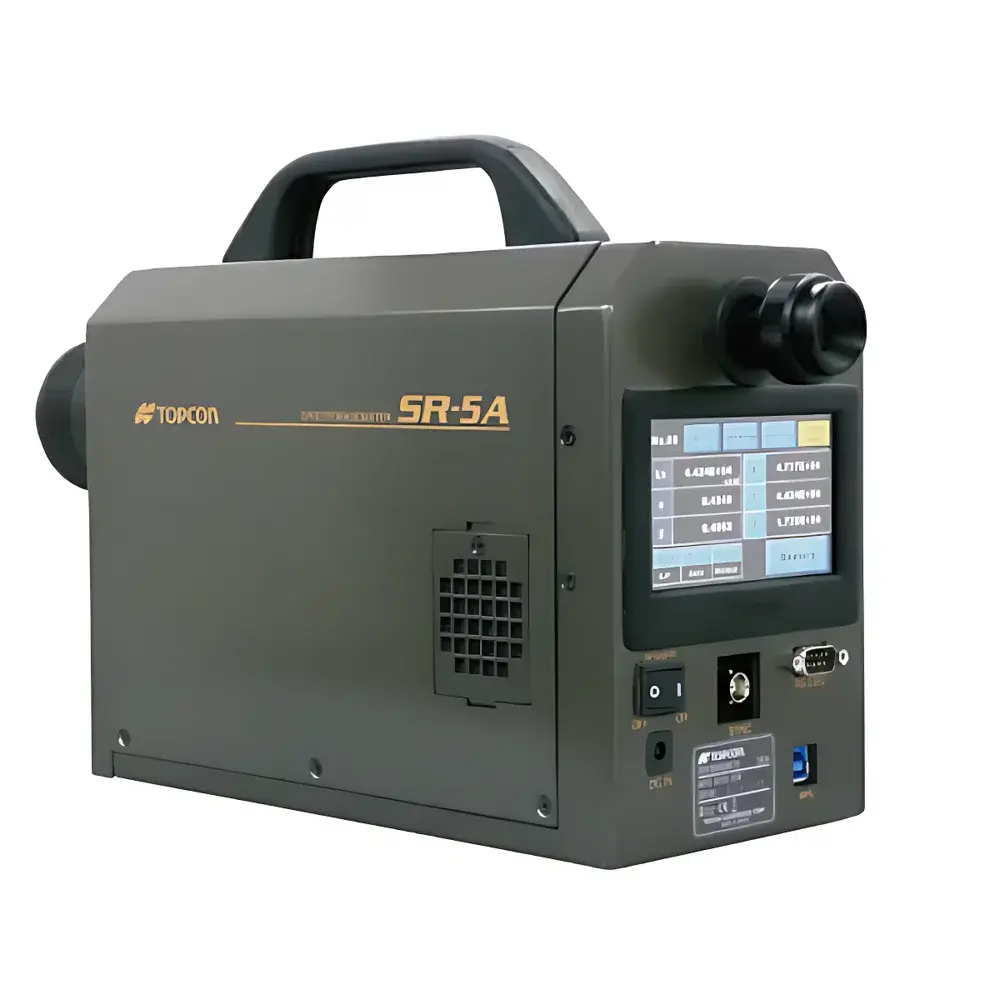
Auniontech SR-5AS Spectroradiometer
| Brand | Auniontech |
|---|---|
| Origin | Shanghai, China |
| Model | SR-5AS |
| Luminance Range (2°) | 0.0001 – 1,500,000 cd/m² |
| Luminance Range (0.1°) | 0.03 – 500,000,000 cd/m² |
| Spectral Bandwidth | 5 nm (FWHM) |
| Wavelength Accuracy | ±0.3 nm (at Hg lines) |
| Wavelength Range | 380–780 nm |
| Wavelength Resolution | 1 nm |
| Luminance Accuracy | ±2% |
| Chromaticity Accuracy (x,y) | x ±0.0015, y ±0.001 (at ≥0.0005 cd/m² for 2°) |
| Repeatability (Luminance) | 0.3% (≥0.1 cd/m²) |
| Polarization Sensitivity | <1% (luminance), <2% (spectroradiance, 400–780 nm) |
| Measurement Angles | 2°/1°/0.2°/0.1° (motorized switching) |
| Focal Distance | 250 mm to ∞ |
| Objective Lens | f = 82 mm, F2.5 |
| Field of View | 5° |
| Detector | Thermoelectrically Cooled Linear Array Sensor |
| Interface | RS-232C, USB 3.0 |
| Power | AC 100–240 V, 50/60 Hz, ~30 W |
| Dimensions (W×D×H) | 422 × 130 × 244 mm |
| Weight | ~5.5 kg |
Overview
The Auniontech SR-5AS Spectroradiometer is a high-precision, motorized-angle spectroradiometric measurement system engineered for absolute radiance and luminance characterization across an unprecedented dynamic range—from ultra-low-light emitters (0.0001 cd/m²) to extreme-brightness sources such as micro-LEDs, laser-based displays, and automotive headlamps (up to 500,000,000 cd/m² at 0.1° field). Unlike filter-based photometers or uncooled spectrometers, the SR-5AS employs a thermoelectrically cooled linear array sensor coupled with a high-fidelity Czerny-Turner optical path featuring a diffraction grating disperser and precision f/2.5 objective lens (f = 82 mm). This architecture ensures minimal thermal drift, high signal-to-noise ratio (SNR), and spectrally resolved radiance data in units of W·sr⁻¹·m⁻²·nm⁻¹—enabling traceable, SI-referenced photometric and colorimetric analysis per CIE S 026/E:2019 and ISO/CIE 19476:2014. Its HDR-capable design eliminates the need for neutral density (ND) filters during high-luminance measurements, reducing setup complexity and calibration uncertainty.
Key Features
- Ultra-wide luminance dynamic range: 0.0001–500,000,000 cd/m², selectable via motorized 2°/1°/0.2°/0.1° field-of-view optics
- High spectral fidelity: 5 nm FWHM bandwidth, ±0.3 nm wavelength accuracy (verified at Hg emission lines), 1 nm data resolution across 380–780 nm
- Thermoelectrically cooled linear array detector for low-noise, stable spectral acquisition—critical for low-light repeatability and long-term measurement integrity
- High-speed measurement modes including auto-exposure, external vertical sync triggering, and fixed-integration-time operation for integration into automated test benches
- Intuitive 7-inch color touchscreen interface with context-aware UI—designed for both standalone lab use and embedded OEM integration
- Rear-panel I/O architecture (RS-232C + USB 3.0) supporting remote command control (SCPI-compatible), real-time data streaming, and synchronization with motion stages or camera systems
Sample Compatibility & Compliance
The SR-5AS is optimized for non-contact, point-source and extended-source optical characterization of self-luminous and reflective surfaces. It supports rigorous compliance workflows in display manufacturing (VESA DisplayHDR, ISO 9241-307), LED lighting validation (IES LM-79, ENERGY STAR), and automotive lighting certification (SAE J1383, ECE R149). Its spectral data output conforms to CIE 1931 (x,y), CIE 1976 (u′,v′), XYZ tristimulus values, correlated color temperature (Tc, K), Duv, dominant wavelength, peak wavelength, and CIE standard observer angles (2° and 10°). The instrument’s polarization insensitivity (<1% luminance error, <2% spectroradiance error across 400–780 nm) ensures robustness when measuring polarized OLEDs or LCD backlights. All calibration certificates are traceable to NIM (National Institute of Metrology, China) and include uncertainty budgets compliant with ISO/IEC 17025 requirements.
Software & Data Management
The SR-5AS ships with Auniontech’s SpectraView Pro software—a Windows-based platform supporting real-time spectral plotting, batch measurement scripting, pass/fail limit testing, and export to CSV, XML, or CIE-standard .cie files. The software implements full audit trail functionality per FDA 21 CFR Part 11 requirements, including user authentication, electronic signatures, and immutable measurement history logs. Raw spectral data is stored with metadata (timestamp, FOV, integration time, ambient temperature/humidity), enabling retrospective GLP/GMP-compliant analysis. API support (DLL and Python bindings) allows seamless integration into LabVIEW, MATLAB, or custom MES/QMS environments. Firmware updates are delivered via secure HTTPS with cryptographic signature verification.
Applications
- Quantitative evaluation of micro-LED and Mini-LED backlight uniformity, luminance roll-off, and chromaticity shift under varying drive currents
- Full optical characterization of OLED and QD-OLED displays—including black-level leakage, viewing angle dependence, and temporal response via synchronized external trigger mode
- Automotive lighting validation: headlamp glare assessment, tail lamp chromaticity binning, and adaptive driving beam (ADB) pixel-level radiance mapping
- In-line quality control of AR/VR microdisplays where sub-cd/m² dark-state performance directly impacts contrast ratio and perceived image quality
- Reference-grade calibration of imaging colorimeters and photometers using spectral irradiance transfer standards
- Research applications in human visual modeling, circadian photometry (CIE S 026), and non-visual light exposure dosimetry
FAQ
What is the minimum measurable luminance at 2° field of view?
0.0001 cd/m², validated under controlled darkroom conditions with thermally stabilized detector operation.
Does the SR-5AS require external calibration for routine use?
No—each unit ships with a NIM-traceable calibration certificate valid for 12 months. Optional annual recalibration services include spectral responsivity verification and geometric alignment checks.
Can the SR-5AS be integrated into an automated production test station?
Yes. Motorized FOV switching, USB 3.0 high-throughput data transfer, SCPI command set, and rear-panel TTL sync I/O enable deterministic integration with PLCs, robotic handlers, and vision-guided positioning systems.
How is measurement repeatability maintained across temperature fluctuations?
Through active thermoelectric cooling of the sensor array and internal reference channel monitoring—ensuring <0.0005 ΔE*uv drift over 8-hour continuous operation at 25°C ambient.
Is the device compliant with international photometric standards?
Yes. Optical design and calibration methodology adhere to CIE Publication 127:2007 (measurement of LEDs), CIE S 026/E:2019 (photobiological safety), and ISO/CIE 19476:2014 (spectroradiometric measurement of optical radiation).



