
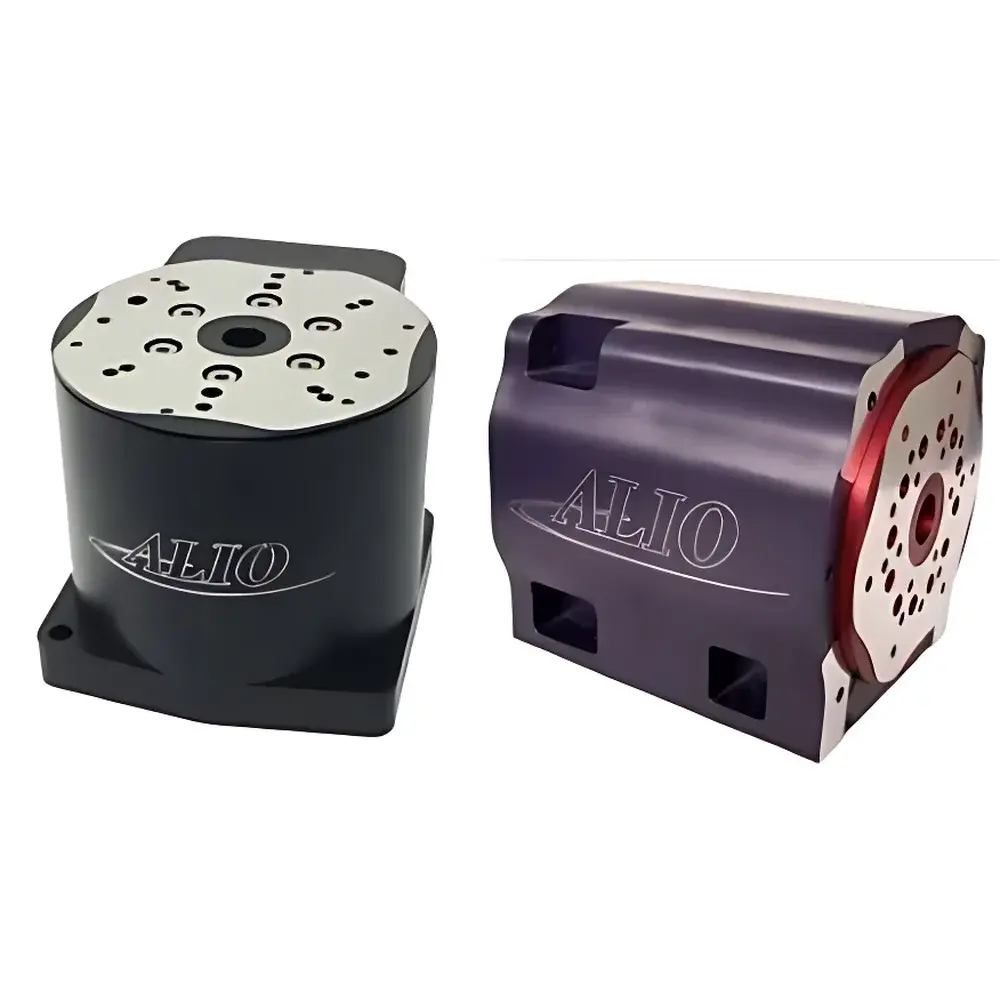
ALIO Nano-Grade High-Load Motorized Rotary Stage
| Origin | Imported |
|---|---|
| Manufacturer Type | Authorized Distributor |
| Model | ALIO |
| Product Category | Motorized Rotary Stage |
| Key Specifications | Repeatability ≤ 0.2 arcsec |
| Bearing Architecture | Crossed-Roller or Angular Contact |
| Motor Integration | Frameless Torque Servo / Coreless Servo |
| Diameter Range | 80 mm – 300 mm |
| Environmental Options | Standard & Vacuum-Compatible Versions |
| Compliance | Designed for ISO 9001-certified manufacturing |
Overview
The ALIO Nano-Grade High-Load Motorized Rotary Stage is an ultra-precision motion platform engineered for applications demanding sub-arcsecond angular repeatability, high moment-load capacity, and deterministic nanoscale positioning in rotational degrees of freedom. Based on a rigid monolithic mechanical architecture and precision-ground crossed-roller or angular-contact bearing systems, this stage operates on the principle of direct-drive torque motor actuation—eliminating gear backlash, hysteresis, and compliance inherent in belt- or worm-driven alternatives. Its core design philosophy aligns with ALIO’s proprietary Nano Point Precision™ 6-D metrology framework, which quantifies all six degrees of freedom (three translational + three rotational) at a defined reference point in 3D space—enabling traceable, NIST-aligned angular accuracy assessment. This makes the stage particularly suitable for photonic alignment, synchrotron beamline instrumentation, interferometric calibration, and semiconductor metrology where thermal drift compensation, long-term stability, and bidirectional repeatability are mission-critical.
Key Features
- Sub-arcsecond angular repeatability: Standard performance guaranteed at ≤ 0.2 arcsec (RMS), validated under controlled environmental conditions per ISO 230-2.
- High-load capability: Engineered to support inertial loads up to 50 kg and moment loads exceeding 25 N·m, depending on diameter variant (80 mm to 300 mm).
- Bearing options: Two mechanically optimized configurations—crossed-roller bearing stages for maximum stiffness under off-center loading, and compact angular-contact bearing variants for minimized profile and high-speed small-angle scanning.
- Direct-drive motor integration: Frameless torque servo motors (for high-torque, low-speed precision) or coreless servo motors (for high-bandwidth, low-inertia response), both enabling zero-backlash, high-resolution closed-loop control.
- Vacuum compatibility: Optional UHV-rated versions (10⁻⁹ mbar) available with stainless-steel construction, vacuum-compatible lubricants, and non-outgassing cabling.
- Modular interface: Standard M4/M6 tapped holes on top plate; optional spindle-mounting kits, encoder brackets, and kinematic mounting bases for OEM integration.
Sample Compatibility & Compliance
The ALIO rotary stage accommodates optical components (lenses, mirrors, gratings), semiconductor wafers, MEMS test substrates, and metrology artifacts—provided mass distribution remains within specified dynamic balance limits. All stages are assembled and tested in ISO Class 7 cleanroom environments and conform to RoHS 2011/65/EU directives. Mechanical design complies with ISO 10100 (general principles for precision machinery) and supports integration into systems requiring FDA 21 CFR Part 11–compliant data integrity (when paired with ALIO’s certified motion controller firmware). Traceable calibration reports—including bidirectional repeatability, positional deviation maps, and thermal coefficient characterization—are provided per unit upon request.
Software & Data Management
ALIO stages operate natively with the ALIO Motion Control Suite (AMCS), a Windows-based application supporting real-time trajectory generation, multi-axis synchronization, and automated calibration routines. The suite exports position/time logs in CSV and HDF5 formats, includes built-in FFT analysis for vibration diagnostics, and enables scripting via Python API (PyALIO). For regulated environments, optional firmware modules provide electronic signatures, audit trails, and user-role-based access control—fully compliant with GLP and GMP documentation requirements. Encoder feedback resolution supports interpolation down to 0.001 arcsec (with 20-bit Sin/Cos encoders), and all motion profiles are stored with timestamped metadata for full experimental reproducibility.
Applications
- Laser beam steering and cavity alignment in ultrafast and quantum optics laboratories
- High-resolution angular scanning in X-ray diffraction (XRD) and small-angle neutron scattering (SANS) end stations
- Nanopositioning for atomic force microscope (AFM) sample rotation and tip calibration rigs
- Photomask and reticle inspection platforms requiring <10 nm overlay error at wafer-scale rotation
- Calibration of autocollimators, angle encoders, and laser interferometers per ISO 230-1 Annex D
- OEM integration into vacuum-compatible thin-film deposition systems and cryogenic probe stations
FAQ
What is the difference between crossed-roller and angular-contact bearing configurations?
Crossed-roller designs maximize radial and axial stiffness for heavy, eccentrically loaded optics; angular-contact variants prioritize minimal height and high acceleration for compact, fast-scanning metrology heads.
Can the stage be operated in a cleanroom or vacuum environment?
Yes—standard versions meet ISO Class 7 cleanroom requirements; vacuum-compatible models are rated for UHV (10⁻⁹ mbar) with custom sealing and material selection.
Is NIST-traceable calibration included with purchase?
A factory calibration certificate (including repeatability, hysteresis, and thermal drift data) is standard; full NIST-traceable certification is available as a value-added service.
How is encoder resolution related to achievable angular resolution?
While encoder interpolation enables sub-arcsecond command resolution, actual system resolution is governed by mechanical stability, thermal management, and control loop bandwidth—not solely encoder count.
Does ALIO offer custom mechanical or electrical interfaces?
Yes—custom flange geometries, cable routing paths, encoder types (incremental/absolute, analog/digital), and controller I/O protocols (EtherCAT, RS-422, USB-C) are routinely implemented for OEM projects.




