
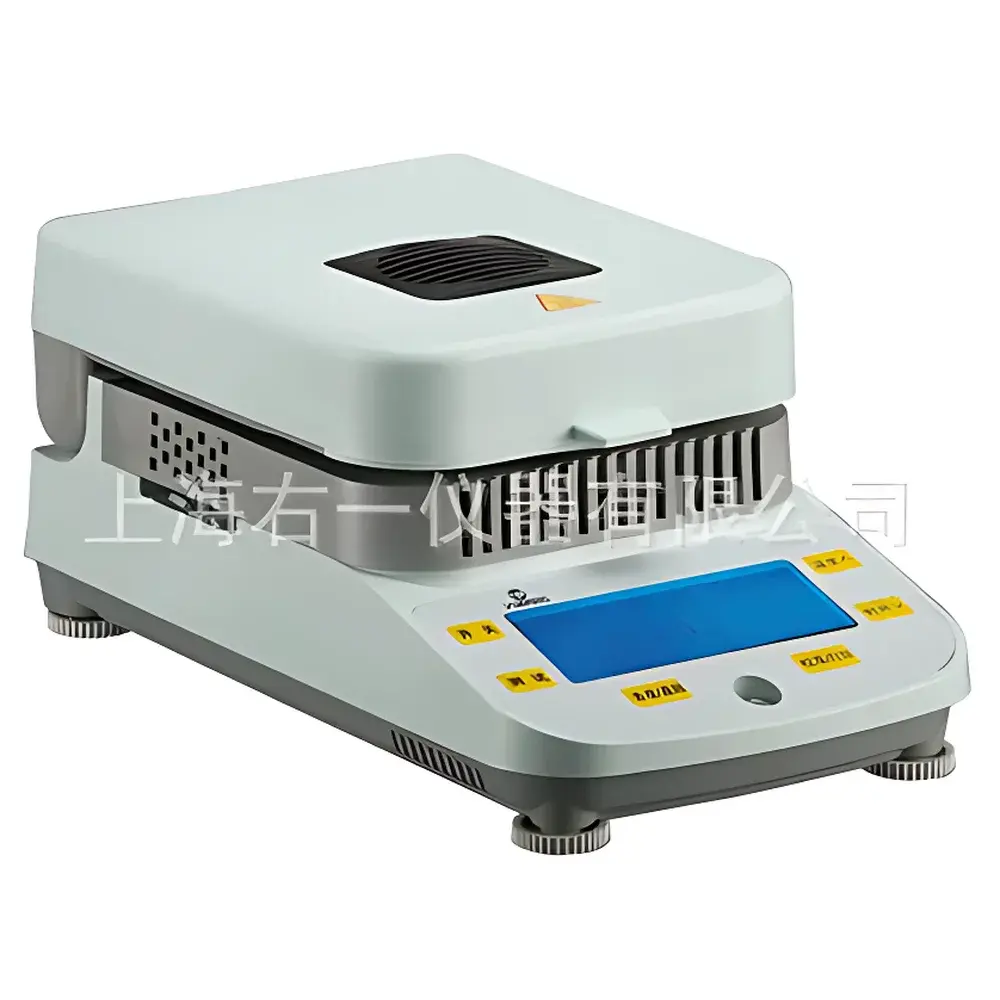
SHYP DSH-50-1 Halogen Moisture Analyzer
| Brand | SHYP |
|---|---|
| Origin | Shanghai, China |
| Model | DSH-50-1 |
| Maximum Capacity | 50 g |
| Readability | 1 mg |
| Repeatability (3 g sample) | ±0.2% |
| Minimum Sample Mass | 0.5 g |
| Recommended Sample Mass | 3–10 g |
| Heating Source | Halogen Lamp |
| Temperature Range | 50–180 °C (adjustable in 1 °C increments) |
| Heating Duration | 1–99 min (adjustable in 10 s increments) |
| Display | Backlit dot-matrix LCD |
| Interface | RS232 serial port |
| Pan Diameter | 100 mm |
| Dimensions (L×W×H) | 285 × 160 × 150 mm |
| Net Weight | 3.0 kg |
| Operating Ambient | 10–30 °C |
| End-point Modes | Timed & Automatic (based on weight change rate) |
Overview
The SHYP DSH-50-1 Halogen Moisture Analyzer is a precision thermal gravimetric instrument engineered for rapid, reliable quantification of moisture content in solid and semi-solid materials. It operates on the principle of loss-on-drying (LOD), where sample mass loss upon controlled halogen lamp heating is measured in real time using a high-stability, thermally isolated electromagnetic force compensation sensor. Unlike conventional infrared systems with broad spectral emission, the DSH-50-1 employs a focused halogen heating element delivering uniform radiant energy across the sample surface—enabling faster thermal response, improved temperature reproducibility, and reduced risk of localized overheating or charring. Designed for routine QC/QA laboratories in food, pharmaceuticals, chemicals, agriculture, and materials science, the analyzer delivers results typically within 3–15 minutes, significantly accelerating batch release workflows without compromising measurement integrity.
Key Features
- High-resolution backlit dot-matrix LCD display with adjustable contrast—optimized for low-light environments and extended operator use.
- Electromagnetic force restoration weighing system with 1 mg readability and <0.2% repeatability (tested at 3 g load), featuring zero-point drift correction and automatic tare functionality.
- Halogen lamp heating module with precise digital temperature control (50–180 °C, 1 °C resolution) and programmable ramp profiles to accommodate thermally sensitive or heterogeneous samples.
- Dual endpoint detection: user-defined timer mode or automatic termination based on dynamic weight stabilization criteria (e.g., Δm ≤ 1 mg/30 s).
- RS232 serial interface compliant with standard EIA/TIA-232 specifications, enabling direct data export to LIMS, Excel, or validated laboratory software platforms.
- Robust mechanical architecture with 100 mm diameter stainless-steel weighing pan, integrated draft shield, and compact footprint (285 × 160 × 150 mm) suitable for benchtop deployment in regulated environments.
Sample Compatibility & Compliance
The DSH-50-1 supports a wide range of non-volatile, non-hygroscopic, and moderately volatile matrices—including granular polymers, milled botanicals, powdered APIs, cereal grains, mineral ores, filter papers, and lyophilized biologics. Its LOD methodology aligns with ASTM D4442 (Standard Test Methods for Direct Moisture Content of Wood and Wood-Based Materials), ISO 712:2022 (Cereals and cereal products — Determination of moisture content — Reference method), and USP <921> (Water Determination). While not intrinsically 21 CFR Part 11 compliant, the device supports audit-ready documentation when paired with validated third-party data acquisition software that implements electronic signatures, user access controls, and immutable audit trails—making it deployable in GLP and GMP contexts where procedural validation is performed per internal SOPs.
Software & Data Management
Data output via RS232 follows ASCII-based protocol with configurable baud rates (default 9600 bps), transmitting timestamped records containing moisture %, solids %, initial/final mass, drying temperature, duration, and endpoint status. Raw data streams are compatible with common laboratory informatics systems (e.g., LabWare LIMS, Thermo Fisher SampleManager) and can be parsed using Python, MATLAB, or custom .NET applications. The analyzer stores no internal memory beyond active method parameters; all measurement history must be captured externally to satisfy ALCOA+ data integrity principles. Optional Windows-compatible PC software (sold separately) provides method library management, statistical reporting (mean, SD, RSD), trend charting, and PDF report generation with embedded calibration certificates.
Applications
- Pharmaceutical manufacturing: Moisture verification of excipients (e.g., microcrystalline cellulose, lactose monohydrate) prior to tablet compression per ICH Q5C stability guidelines.
- Food quality control: Rapid assessment of moisture in flour, coffee beans, spices, and pet food to ensure compliance with shelf-life predictive models.
- Chemical raw material release: Quantification of residual solvent or hydration water in catalysts, pigments, and inorganic salts.
- Agricultural testing labs: Field-to-lab moisture profiling of rice, wheat, corn, and soybeans for storage and trade specification adherence (e.g., USDA FGIS standards).
- Research settings: Method development for alternative drying protocols (e.g., comparative studies vs. Karl Fischer titration or vacuum oven methods).
FAQ
What standards does the DSH-50-1 comply with for moisture determination?
It supports methodologies referenced in ASTM D4442, ISO 712:2022, and USP <921>, though final method validation remains the responsibility of the end-user laboratory.
Can the DSH-50-1 be used for volatile organic compounds?
No—it measures total volatile loss as “moisture” and cannot distinguish water from solvents or low-boiling impurities; confirm analyte volatility profile before implementation.
Is calibration traceable to national standards?
Yes—weight calibration uses certified Class M2 weights (traceable to NIM or equivalent); temperature verification requires external calibrated PT100 probe per ISO/IEC 17025 requirements.
Does the unit support multi-step heating programs?
No—the DSH-50-1 implements single-stage heating only; multi-ramp protocols require higher-tier models (e.g., DSH-50-10 with programmable temperature gradients).
How often should maintenance be performed?
Daily cleaning of pan and chamber; quarterly inspection of halogen lamp intensity and sensor thermal isolation; annual full metrological verification recommended for regulated use.
Related Products







