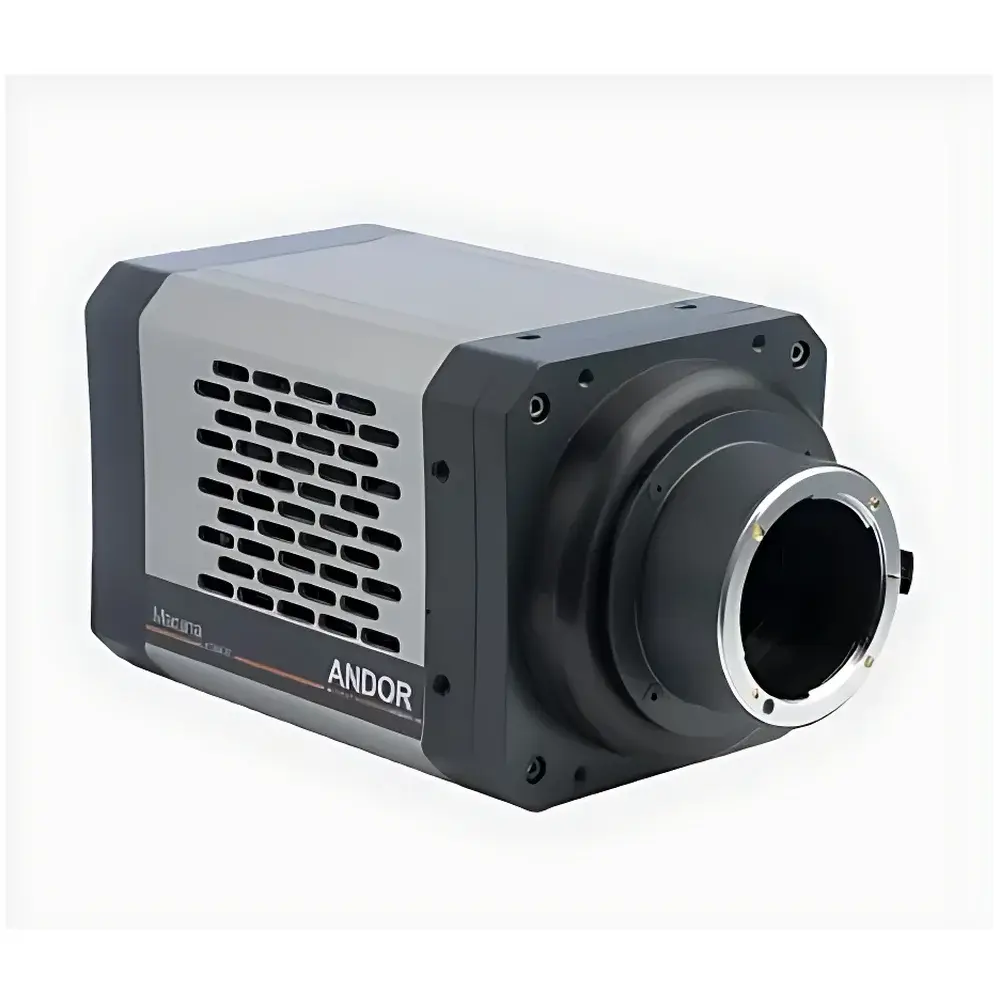
Andor Marana 4.2B-11 Back-Illuminated sCMOS Camera
| Brand | Oxford Instruments |
|---|---|
| Origin | United Kingdom |
| Manufacturer Type | Authorized Distributor |
| Origin Category | Imported |
| Model | Marana 4.2B-11 |
| Image Resolution | 4.2 MP (2048 × 2048) |
| Pixel Size | 11 µm |
| Sensor Format | 22.5 mm × 22.5 mm (32 mm diagonal) |
| Readout Speed | 100 MHz (16-bit mode) |
| Dynamic Range | 53,000:1 |
| Quantum Efficiency | 95% @ peak (600 nm) |
| Cooling | -45 °C (thermo-electric vacuum-sealed) |
Overview
The Andor Marana 4.2B-11 is a high-performance, back-illuminated scientific CMOS (sCMOS) camera engineered for demanding low-light applications in astronomy, quantum optics, single-molecule imaging, and time-resolved physical sciences. Built upon Andor’s proprietary vacuum-sealed sensor architecture and leveraging deep-depletion, back-illuminated silicon technology, the Marana delivers exceptional photon detection efficiency across the visible to near-ultraviolet spectrum (300–1000 nm). Its core measurement principle relies on high-fidelity photoelectron conversion within a thermally stabilized, ultra-low-noise pixel array—enabling quantitative intensity mapping with minimal read noise (<1.3 e⁻ rms), negligible dark current (<0.0005 e⁻/pix/s at -45 °C), and sub-electron effective noise floor performance. The camera operates as a precision photon-counting-capable imaging sensor—not a counting device per se—but achieves photon-limited signal fidelity through optimized analog-to-digital conversion, linear response calibration, and hardware-level correlated double sampling (CDS).
Key Features
- 95% peak quantum efficiency: Achieved via anti-reflection coating and monolithic back-illumination—maximizing signal capture at critical wavelengths (e.g., Hα, Na D, and common fluorescence excitation bands).
- Vacuum-sealed thermo-electric cooling to -45 °C: Maintains long-term QE stability and suppresses thermally generated dark current without requiring liquid nitrogen or external chillers.
- 4.2 megapixel sensor (2048 × 2048) with 11 µm pixels: Provides optimal balance between field-of-view coverage (22.5 mm × 22.5 mm active area) and spatial resolution for telescope focal planes and microspectroscopy setups.
- Full-frame readout at 48 fps: Sustained high-speed acquisition without image lag or smearing—critical for tracking fast-moving celestial objects or transient plasma events.
- Linearity >99.7% across full dynamic range: Validated per ISO 15739:2013 methodology; ensures traceable radiometric accuracy for photometric calibration and quantitative flux analysis.
- 16-bit digitization at 100 MHz: Delivers 53,000:1 dynamic range with <1.3 e⁻ read noise—enabling simultaneous detection of faint and bright features in a single exposure.
Sample Compatibility & Compliance
The Marana 4.2B-11 is compatible with standard C-mount and F-mount optical interfaces, and integrates seamlessly into vacuum-compatible cryostats, vacuum chambers, and multi-axis motion stages via its rigid aluminum housing and low-outgassing construction. It complies with CE, UKCA, and RoHS directives. Firmware and driver stacks support Windows and Linux environments and are validated for use in GLP-compliant laboratories under audit-ready configurations. While not FDA-regulated (as a research-grade instrument), its data integrity features—including hardware timestamping, frame counter synchronization, and non-volatile error logging—align with principles outlined in 21 CFR Part 11 for electronic records in regulated R&D settings.
Software & Data Management
Controlled via Andor’s SDK2 and Solis® software suite, the Marana supports real-time image preview, region-of-interest (ROI) binning, hardware-triggered acquisition sequences, and synchronized multi-camera operation. All raw frames are saved in FITS (Flexible Image Transport System) format by default—ensuring interoperability with IRAF, DS9, AstroPy, and MATLAB-based reduction pipelines. Metadata embedding includes exposure time, temperature, gain setting, sensor ID, and UTC-synchronized timestamps. For automated workflows, the SDK provides Python, C++, and LabVIEW APIs with full access to low-level register control and asynchronous buffer management—facilitating integration into custom observatory control systems or closed-loop adaptive optics platforms.
Applications
- Astronomical imaging: Wide-field survey telescopes, lucky imaging, exoplanet transit photometry, and solar corona monitoring.
- Quantum optics: Hanbury Brown–Twiss experiments, photon correlation spectroscopy, and entangled photon pair detection.
- Ultrafast science: Pump-probe microscopy, streak camera coupling, and laser-induced breakdown spectroscopy (LIBS) gated imaging.
- Biophysics: Total internal reflection fluorescence (TIRF), fluorescence resonance energy transfer (FRET), and super-resolution localization microscopy (e.g., PALM/STORM).
- Industrial metrology: High-dynamic-range inspection of semiconductor wafers, thin-film interference analysis, and laser beam profiling.
FAQ
Is the Marana 4.2B-11 suitable for vacuum chamber integration?
Yes—the sensor is hermetically sealed under vacuum during manufacturing, eliminating risk of moisture ingress or QE degradation in low-pressure environments.
Does the camera support hardware triggering and external synchronization?
Yes—it features TTL-compatible input/output trigger ports with programmable delay, pulse width, and edge sensitivity for precise timing control in multi-instrument setups.
What is the calibrated linearity range and how is it verified?
Linearity exceeds 99.7% from 100 e⁻ to full well (100,000 e⁻); verification follows ISO 15739:2013 using incremental neutral density filters and photon-transfer curve analysis.
Can the Marana be used for photon counting applications?
While not a single-photon counter, its ultra-low noise floor and high QE enable reliable photon-limited imaging down to ~0.1 photons/pixel/frame—making it ideal for EMCCD-replacement applications where excess noise factor must be avoided.
Is firmware update support available post-purchase?
Yes—Andor provides free firmware updates via the customer portal, including enhancements to timing precision, noise suppression algorithms, and compatibility with new host OS versions.