
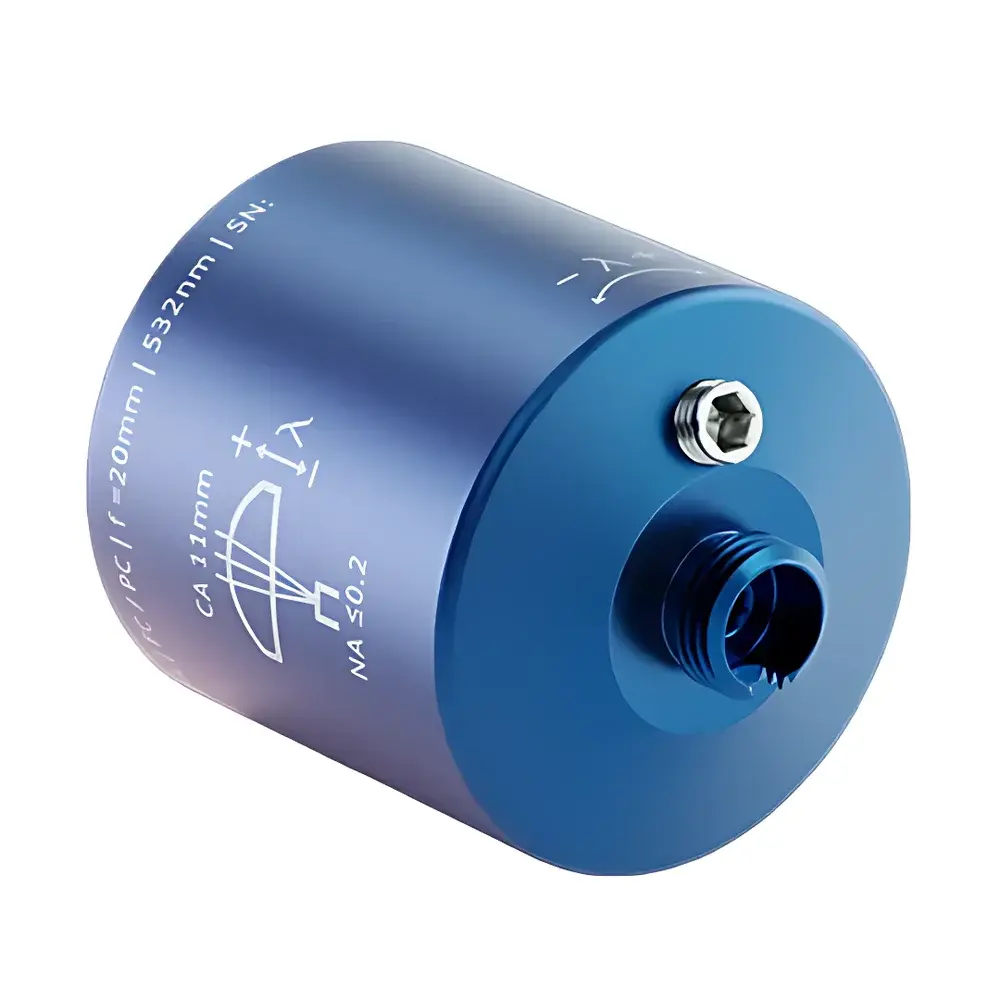
Auniontech AspheriColl Adjustable Fiber Collimator/Coupler
| Brand | Auniontech |
|---|---|
| Origin | Shanghai, China |
| Manufacturer Type | Authorized Distributor |
| Product Category | Optical Instrument Component |
| Model | AspheriColl (Aspheric Lens-Based) |
| Optical Design | Diffraction-Limited Achromatic Aspheric Collimation |
| Wavelength Ranges | 350–405 nm (355-design), 500–620 nm (532-design), 600–760 nm (632-design), 700–1050 nm (780-design), 1000–1600 nm (1064-design) |
| Numerical Aperture Support | Up to NA = 0.275 |
| Focal Length | f = 20 mm |
| Effective Clear Aperture | Øe = 11.5 mm |
| Strehl Ratio | >0.95 (with FC/PC single-mode fiber, diffraction-limited performance) |
| Beam Diameter | Determined by fiber NA and mode field diameter (MFD), no beam truncation |
| Mechanical Housing Diameter | 30 mm |
| Compatibility | FC/PC and optional APC via adapter |
| Adjustment Mechanism | Precision SW2 hex-key tunable focus & collimation |
| Compliance | Designed for ISO 10110 optical surface standards, compatible with GLP-aligned lab environments requiring traceable beam characterization |
Overview
The Auniontech AspheriColl Adjustable Fiber Collimator/Coupler is a high-precision, aspheric-lens-based optical component engineered for diffraction-limited collimation and coupling of single-mode optical fibers. Unlike conventional ball-lens or GRIN-based collimators, the AspheriColl employs a custom-designed aspheric lens optimized for minimal wavefront error across discrete laser wavelength bands (355, 532, 632, 780, and 1064 nm). Its optical architecture follows the principles of aberration-corrected paraxial collimation—where the aspheric surface compensates for spherical aberration induced by the finite numerical aperture (NA ≤ 0.275) and mode field diameter (MFD) of standard SMF-28, HI1060, or similar single-mode fibers. The device operates on a mechanical translation principle: axial adjustment of the lens relative to the fiber ferrule enables precise tuning of collimation quality and divergence over its specified wavelength range. With a Strehl ratio exceeding 0.95 when paired with FC/PC-terminated fibers, it meets the stringent wavefront fidelity requirements of interferometric alignment, quantum optics setups, and ultrafast laser beam delivery systems.
Key Features
- Diffraction-limited performance (Strehl > 0.95) validated at 632 nm with standard SMF-28 fiber
- Five pre-aligned wavelength variants: 355 nm (350–405 nm UV-VIS), 532 nm (500–620 nm), 632 nm (600–760 nm), 780 nm (700–1050 nm), and 1064 nm (1000–1600 nm NIR)
- Aspheric lens design eliminates beam truncation—enabling full utilization of fiber MFD without spatial clipping
- Compact 30 mm outer diameter housing compatible with OWIS, Thorlabs, and Newport standard kinematic mounts
- Manual SW2 hex-key fine-tuning mechanism for wavelength-specific focus optimization and divergence control
- FC/PC interface as standard; APC compatibility available via optional precision-machined adapter sleeve
- No internal apertures or field stops—preserves beam homogeneity and enables seamless integration into multi-element beam paths
Sample Compatibility & Compliance
The AspheriColl is designed for use with industry-standard single-mode fibers including Corning SMF-28, Nufern 780-HP, and Thorlabs 780HP. It maintains diffraction-limited performance only when used with fibers whose MFD and NA fall within manufacturer-specified tolerances. The device complies with ISO 10110-3 surface quality specifications for aspheric optics and adheres to RoHS Directive 2011/65/EU for hazardous substance restrictions. While not certified to IEC 61340 (ESD) or MIL-STD-810G out-of-box, its metal housing and hermetic fiber interface support stable operation in Class 1000 cleanroom environments. For regulated applications (e.g., medical laser systems or aerospace photonics), users are advised to perform in-house verification per ANSI Z80.10 (ophthalmic optics) or IEC 60825-1 (laser product safety) where applicable.
Software & Data Management
The AspheriColl is a passive optical component and requires no firmware, drivers, or proprietary software. However, its performance parameters—including measured wavefront error (Zernike decomposition), MFD-dependent beam diameter, and NA-limited divergence—are fully documented in the included calibration report (traceable to NIST-traceable interferometric measurement at 632.8 nm HeNe wavelength). Users integrating the AspheriColl into automated alignment platforms may leverage its mechanical repeatability (±1.5 µm axial positioning reproducibility) for closed-loop beam steering calibration. All dimensional drawings, tolerance stacks, and mounting interface specifications conform to STEP AP214 format and are supplied upon request for CAD-integrated optical system modeling (e.g., Zemax OpticStudio, CODE V, or FRED).
Applications
- Free-space coupling in ultrafast Ti:sapphire and Yb:fiber laser systems requiring high Strehl-ratio beam delivery
- Quantum optics experiments involving heralded photon sources, where wavefront fidelity directly impacts Hong-Ou-Mandel visibility
- Fiber-to-waveguide coupling in photonic integrated circuit (PIC) testing rigs
- Confocal and multiphoton microscopy beam conditioning stages demanding low-aberration collimation
- LIDAR transmitter modules operating in eye-safe NIR bands (1064/1550 nm), where beam uniformity affects ranging accuracy
- Optical coherence tomography (OCT) reference arm stabilization using adjustable collimated return paths
FAQ
Is the AspheriColl suitable for multimode fiber coupling?
No. It is specifically designed and optimized for single-mode fibers with NA ≤ 0.275. Multimode fibers introduce significant higher-order mode content that cannot be accurately collimated to diffraction-limited quality using this aspheric configuration.
Can I use the same AspheriColl unit across multiple wavelengths?
Only within its designated band (e.g., the 780-design unit supports 700–1050 nm). Cross-band operation degrades wavefront error and reduces Strehl ratio below 0.9 due to chromatic focal shift; dedicated units per wavelength band are recommended for metrology-grade applications.
Does it support polarization-maintaining (PM) fiber?
Yes—mechanically, but alignment of the slow/fast axis must be performed externally using a rotationally adjustable fiber ferrule mount. The AspheriColl itself does not preserve or manipulate polarization state.
What is the maximum input power handling capability?
For continuous-wave operation, the lens coating and epoxy-free fiber interface support up to 500 mW at 1064 nm (ISO 21254 damage threshold compliant). Pulsed operation requires user validation based on pulse duration, repetition rate, and spot size.
Is there a version with motorized focus adjustment?
Auniontech offers OEM customization; standard AspheriColl units feature manual SW2 tuning. Motorized variants with stepper-motor actuation and RS-485/USB interface are available under separate part numbers (e.g., AspheriColl-MOT-xx) for automated production environments.



