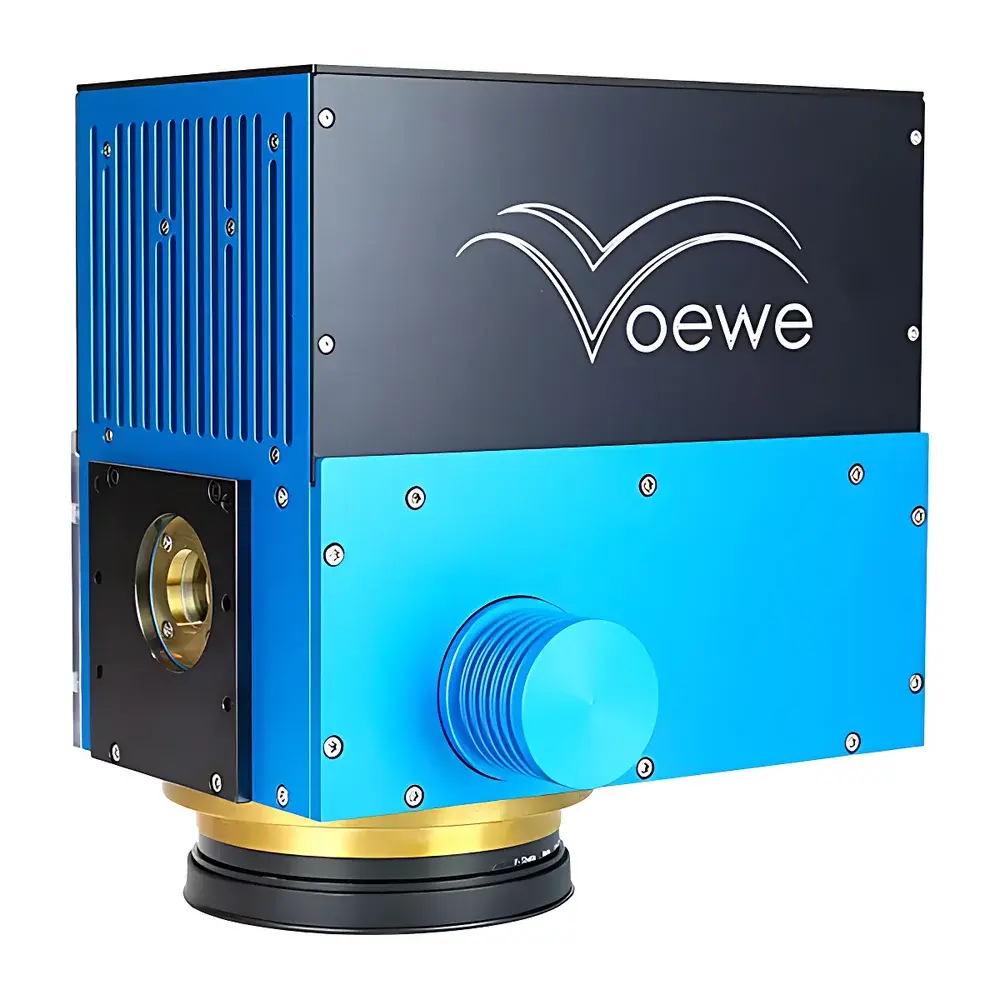
Auniontech MOEWE Dual-Polygon High-Speed Laser Scanning System
| Brand | Auniontech |
|---|---|
| Origin | Shanghai, China |
| Manufacturer Type | Authorized Distributor |
| Country of Origin | China |
| Model | MOEWE Dual-Polygon Scanner |
| Instrument Category | Laser-Based 3D Scanning System |
| Optical Aperture | 30 mm |
| Max. Polygon Rotation Speed | 10,000–100,000 rpm |
| Scan Velocity (at focal plane) | >1,000 m/s |
| Beam Re-Direction Latency | <5 ns |
| Laser Power Handling | >1,000 W (average) |
| Control Architecture | Integrated FPGA + Dual ARM Processors |
| Real-Time Slicing Capability | Supports 2D, 2.5D, and 3D CAD model streaming |
| Laser Utilization Efficiency | Up to 60% (multi-scanner synchronized operation) |
Overview
The Auniontech MOEWE Dual-Polygon High-Speed Laser Scanning System is a precision optomechanical instrument engineered for ultra-high-speed beam steering in industrial laser processing, LIDAR beam management, and high-throughput optical metrology applications. Unlike galvanometric or MEMS-based scanners, this system employs two synchronized rotating polygon mirrors operating in tandem—enabling double reflection of the incident laser beam. This dual-polygon architecture eliminates first-order field curvature and systematic scan distortion inherent in single-mirror configurations, while simultaneously suppressing back-reflection and minimizing optical pivot point displacement during scanning. The system operates on the principle of angular velocity modulation: as each facet of the polygon rotates into the beam path, it deflects the collimated laser beam across the F-theta corrected focal plane at velocities exceeding 1,000 m/s. Its mechanical design integrates thermal-stable aluminum alloy housings and vacuum-compatible bearing assemblies, ensuring long-term repeatability under sustained high-RPM operation.
Key Features
- Dual-polygon mirror configuration with real-time phase synchronization for distortion-free raster and vector scanning
- 30 mm clear optical aperture supporting high-power laser integration (≥1 kW average power)
- FPGA-driven closed-loop control with sub-5 ns latency for dynamic position correction and motion tracking
- Integrated dual ARM processors enabling on-device preprocessing of 3D CAD models and real-time slice generation
- Native support for synchronized multi-scanner orchestration—enabling up to 60% aggregate laser source utilization efficiency
- F-theta lens compatibility across UV, visible, and NIR spectral bands (193 nm – 10.6 µm)
- Robust mechanical architecture rated for continuous operation at rotational speeds from 10,000 to 100,000 rpm
Sample Compatibility & Compliance
The MOEWE system is compatible with standard industrial laser sources including CO₂, fiber, disk, and ultrafast pulsed lasers. It interfaces seamlessly with OEM motion platforms via TTL, analog voltage, and EtherCAT protocols. From a regulatory standpoint, the system complies with IEC 60825-1:2014 (Laser Product Safety), EN 61000-6-4 (EMC Emission), and EN 61000-6-2 (EMC Immunity). Its control firmware supports audit-trail logging and user-access-level permissions aligned with ISO 9001 quality management requirements. While not certified for medical or aerospace-specific standards out-of-the-box, the hardware architecture permits customization for FDA 21 CFR Part 11-compliant environments when integrated with validated host software and procedural controls.
Software & Data Management
The system ships with Auniontech’s ScanControl SDK—a cross-platform C++/Python API supporting Windows, Linux, and real-time OS deployments. The SDK provides low-level access to polygon phase locking, facet indexing, trigger timing, and real-time feedback from integrated position encoders. Data output includes timestamped scan coordinates (X/Y in µm resolution), facet ID, and encoder phase angle—formatted in HDF5 and CSV for downstream analysis in MATLAB, Python (NumPy/Pandas), or metrology software such as PolyWorks or GOM Inspect. Firmware updates are delivered via signed OTA packages; all configuration changes are logged with ISO 8601 timestamps and operator IDs, satisfying GLP/GMP traceability requirements for regulated manufacturing environments.
Applications
- High-speed selective laser melting (SLM) and laser powder bed fusion (LPBF) additive manufacturing
- Real-time surface topography mapping in inline production inspection systems
- Beam steering for solid-state LIDAR systems requiring >1 MHz line rate capability
- Ultrafast laser ablation of thin-film photovoltaic materials and display substrates
- Dynamic focus compensation in multi-axis laser welding and cladding
- Optical coherence tomography (OCT) light source scanning in research-grade biomedical imaging setups
FAQ
What is the minimum achievable spot size at the focal plane?
Spot size depends on input beam quality (M²), wavelength, and F-theta lens focal length. With a diffraction-limited 1064 nm beam (M² ≤ 1.1) and a 160 mm f-theta lens, typical focused spot diameters range from 25–40 µm (1/e² intensity).
Can the system be integrated with third-party motion controllers?
Yes—ScanControl SDK supports EtherCAT master/slave mode and provides register-level memory mapping for seamless integration with Beckhoff, Siemens, and Delta Tau motion platforms.
Is calibration data provided for geometric distortion correction?
Each unit ships with factory-measured distortion maps (radial and tangential coefficients) referenced to ISO 10360-8, along with Python scripts for applying polynomial correction in real time.
Does the system support pulse-on-the-fly (POF) triggering?
Yes—the FPGA logic includes programmable delay generators with 1 ns resolution, enabling precise synchronization between laser pulses and facet transit timing.
What environmental conditions are recommended for stable operation?
Ambient temperature: 18–28 °C (±0.5 °C/h stability); relative humidity: 30–60% non-condensing; vibration isolation recommended below 5 Hz (ISO 2372 Class A).