
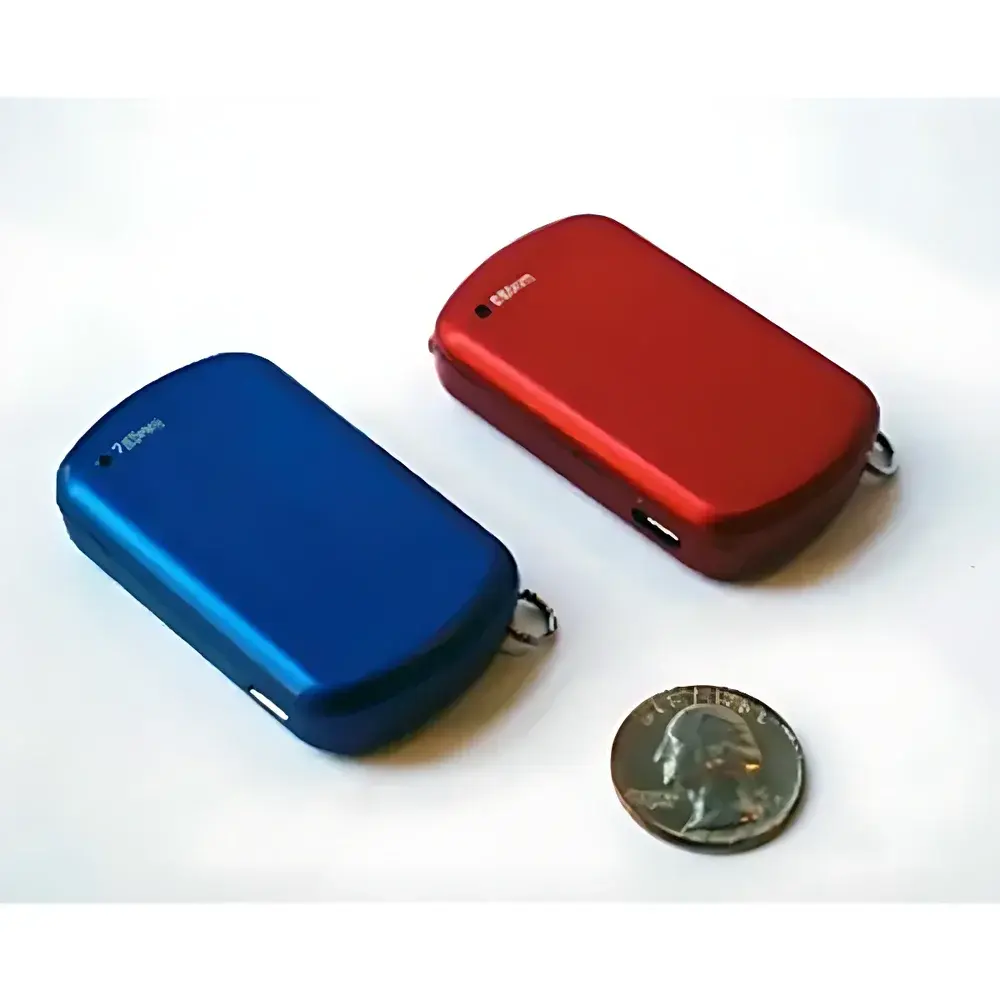
Auniontech Nano-LBTMBelt-Wearable SERS Micro-Raman Spectrometer
| Brand | Auniontech |
|---|---|
| Origin | Shanghai, China |
| Manufacturer Type | Authorized Distributor |
| Product Category | Domestic |
| Model | Nano-LBTMBelt-Wearable™ |
| Optical Components Subcategory | SERS Sensor Module |
| Laser Wavelengths | 532 nm, 633 nm, 785 nm, 830 nm |
| Max Laser Power | <100 mW |
| Spectral Range | 450–2300 cm⁻¹ or 300–2500 cm⁻¹ |
| Spectral Resolution | 15–19 cm⁻¹ (Rayleigh criterion) |
| Dimensions | 63 mm × 39 mm × 17 mm / 57 mm × 52 mm × 21 mm |
| Weight | 49 g / 79 g |
| Power Supply | Rechargeable Li-ion battery, >1 hour continuous operation |
| Connectivity | Bluetooth 5.0 |
| Control Interface | LightSpec mobile app (iOS/Android) |
| Measurement Modes | Software-triggered or hardware-button-initiated |
Overview
The Auniontech Nano-LBTMBelt-Wearable SERS Micro-Raman Spectrometer is a compact, field-deployable analytical instrument engineered for rapid, label-free molecular identification via surface-enhanced Raman scattering (SERS). Unlike conventional benchtop Raman systems, this device integrates a miniaturized spectrometer core with tunable laser excitation (532 nm to 830 nm), optimized optical path design, and real-time spectral acquisition capability—enabling direct in-situ analysis without sample preparation or laboratory infrastructure. Its operational principle relies on coupling incident laser photons with vibrational modes of analyte molecules adsorbed onto engineered SERS-active substrates. Critically, the system is designed to interface with non-metallic, porous carbon-based SERS substrates—leveraging charge-transfer resonance enhancement rather than plasmonic electromagnetic hotspots. This eliminates spatial heterogeneity in signal intensity, suppresses substrate oxidation, and ensures high spectral reproducibility across the entire sensing surface—a fundamental limitation in traditional Au/Ag nanoparticle-based platforms.
Key Features
- Multi-wavelength laser excitation (532 nm, 633 nm, 785 nm, 830 nm) optimized for minimizing fluorescence interference and maximizing Raman cross-section for diverse analytes
- High-fidelity spectral acquisition over broad ranges (300–2500 cm⁻¹ or 450–2300 cm⁻¹) with resolution compliant with Rayleigh criterion (15–19 cm⁻¹)
- Ultra-compact form factor (<79 g, footprint under 63 × 39 mm) enabling handheld, belt-mounted, or wearable deployment in constrained environments
- Integrated rechargeable lithium-ion battery supporting >60 minutes of continuous spectral acquisition and real-time processing
- Bluetooth 5.0 wireless communication with low-latency data streaming to iOS and Android devices via LightSpec application
- Hardware-triggered measurement mode for hands-free operation in safety-critical or glove-required scenarios
- Optimized optical architecture minimizing stray light and thermal drift—critical for stable baseline performance during extended field use
Sample Compatibility & Compliance
The Nano-LBTMBelt-Wearable spectrometer is compatible with a range of SERS substrates—including proprietary porous carbon chips supplied by Auniontech—designed for high chemical stability, uniform enhancement, and intrinsic fluorescence quenching. These substrates exhibit negligible batch-to-batch variation and retain activity after repeated solvent exposure or ambient storage, supporting GLP-aligned workflows. The system’s spectral output format complies with ASTM E1840-22 (Standard Guide for Raman Spectroscopy Data Exchange) and supports metadata tagging per ISO/IEC 17025:2017 requirements for traceable calibration records. While not certified as intrinsically safe (ATEX/IECEx), its low-power laser configuration (<100 mW) meets Class 3R safety limits per IEC 60825-1:2014, enabling use in controlled industrial or first-responder settings under appropriate procedural controls.
Software & Data Management
LightSpec mobile application provides intuitive spectral acquisition, real-time peak identification, and comparative library matching against embedded reference databases (e.g., narcotics, explosives, chemical warfare agent simulants, environmental pollutants). Raw spectra are stored in vendor-neutral .spc and .csv formats with embedded timestamp, laser wavelength, integration time, and substrate ID metadata. The app supports offline operation and encrypted local storage—ensuring chain-of-custody integrity for forensic or regulatory applications. For integration into enterprise QA/QC systems, Auniontech provides documented RESTful API endpoints for automated spectral ingestion into LIMS or ELN platforms compliant with FDA 21 CFR Part 11 audit trail requirements.
Applications
- Rapid screening of illicit substances (e.g., fentanyl analogues, synthetic cannabinoids) at border checkpoints or correctional facilities
- In-field detection of explosive residues (TNT, RDX, PETN) on surfaces or in trace vapor condensates
- Point-of-need verification of pharmaceutical raw materials and counterfeit drug identification per USP
- Environmental monitoring of persistent organic pollutants (POPs) and pesticide residues in water or soil extracts
- Biomedical research applications including label-free detection of biomarkers in saliva or serum using carbon-SERS substrates with inherent biocompatibility
- Process analytical technology (PAT) support for real-time reaction monitoring in fine chemical synthesis
FAQ
What SERS substrates are compatible with this instrument?
The Nano-LBTMBelt-Wearable is optimized for Auniontech’s proprietary porous carbon SERS chips, which provide uniform enhancement, long-term stability, and minimal fluorescence interference. Custom substrate integration is supported upon request with optical coupling validation.
Is spectral calibration traceable to NIST standards?
Yes—each unit ships with factory calibration certificates referencing NIST-traceable polystyrene and silicon standards. Users may perform field recalibration using included reference chips.
Can the device operate in hazardous environments?
It is not rated for Zone 0/1 explosive atmospheres. Operation requires adherence to local laser safety protocols and environmental IP rating limitations (IP52 standard).
Does the LightSpec app support multi-user access control?
The current version supports role-based user profiles (Operator, Supervisor, Administrator) with configurable permissions for method editing, database updates, and report export.
What is the typical signal-to-noise ratio (SNR) for sub-ppm analyte detection?
Under optimal conditions (e.g., 785 nm excitation, 10 s integration, carbon-SERS chip), SNR > 120:1 is achievable for crystalline cocaine HCl at 500 pg on substrate—validated per ISO 11843-2:2019 decision threshold methodology.




