
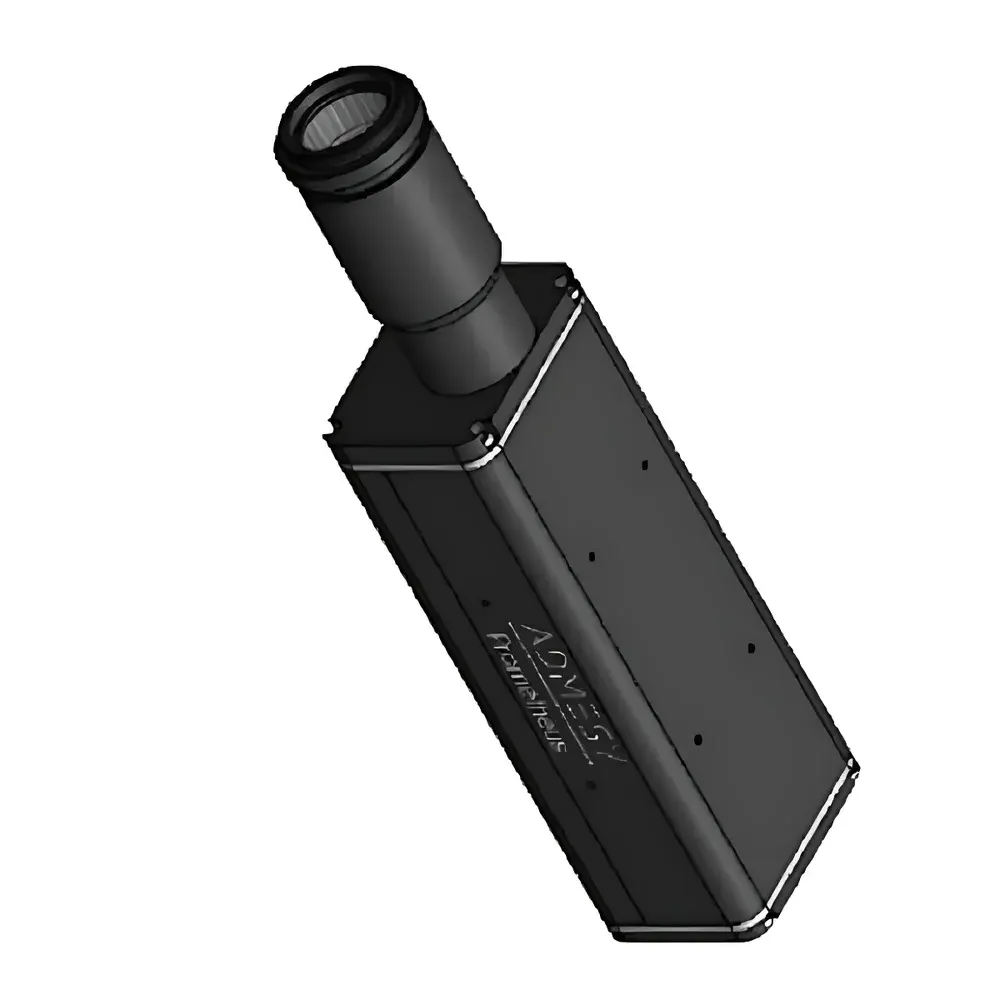
Admesy Prometheus-2.1mm Chroma Meter
| Brand | Admesy |
|---|---|
| Origin | Netherlands |
| Model | Prometheus-2.1mm |
| Spot Size | 2.1 mm |
| Dynamic Range | Up to several million cd/m² (customizable) |
| Sampling Rate | Up to 3125 samples/sec (Y flicker mode) |
| CIE Standard Observer | 1931 2° |
| Compliance | USBTMC 1.0, IEEE 488.2 |
| Operating Systems | Windows, Linux (x86_64, i686, ARM), macOS |
| Software Integration | NI-VISA, LabVIEW, LabWindows CVI, Visual Studio |
| Detector Type | High-sensitivity, ultra-low-noise photodiode array |
| Features | Auto-ranging, mechanical shutter, integrated LED alignment pointer, JEITA-compliant flicker calculation engine |
| Filter Accuracy | Enhanced spectral match to CIE 1931 tristimulus curves vs. Hyperion series |
Overview
The Admesy Prometheus-2.1mm Chroma Meter is a high-performance, research-grade color measurement instrument engineered for precision luminance and chromaticity characterization of emissive displays, micro-LEDs, OLEDs, and other optoelectronic sources. Built upon Admesy’s proprietary optical filter architecture and low-noise analog front-end design, it implements CIE 1931 2° standard observer spectral response with significantly improved filter fidelity compared to earlier-generation instruments such as the Hyperion series. Its core measurement principle relies on spectrally resolved photometric detection using matched tristimulus filters and calibrated silicon photodiodes, enabling traceable, NIST-aligned colorimetric data acquisition. The 2.1 mm measurement spot size is optimized for high-resolution spatial sampling of small-area emitters—including sub-pixel-level evaluation in next-generation display metrology—while maintaining full compliance with ISO/CIE photometric geometry standards (f/2.8 effective aperture, cosine-corrected field of view). Designed for integration into automated test environments, the Prometheus-2.1mm delivers deterministic timing, hardware-triggered acquisition, and real-time flicker analysis without host CPU dependency.
Key Features
- Ultra-precise CIE 1931 2° color matching via advanced interference filter stack with <±0.5% spectral deviation from ideal CIE curves
- 2.1 mm fixed-spot optical configuration—ideal for micro-display, AR/VR waveguide, and mini-LED binning applications
- High-speed photometric sampling: up to 3125 Hz in Y (luminance) flicker mode; 2000 Hz in full XYZ mode
- Extended dynamic range: 0.001–>1,000,000 cd/m² (configurable upper limit via custom attenuation optics)
- Integrated mechanical shutter for zero-reference dark calibration and thermal drift compensation
- Onboard MCU executing JEITA TR-001 compliant flicker metrics (FPFM, SVM, percent flicker) in real time
- USB-TMC 1.0 compliant interface ensuring plug-and-play compatibility with automated test systems and SCPI command support
- Embedded LED alignment pointer with coaxial collimation—enables rapid, repeatable positioning without external targeting aids
- Auto-ranging functionality with seamless gain switching and overflow recovery
Sample Compatibility & Compliance
The Prometheus-2.1mm supports direct measurement of self-luminous devices including OLED panels, micro-LED arrays, AMOLED smartphone screens, automotive HUDs, and signage modules. Its optical design conforms to CIE Publication 127:2007 (Measurement of LEDs) and ISO 13406-2 (Ergonomic requirements for work with visual displays). All factory calibrations are performed against NIST-traceable reference standards and documented per ISO/IEC 17025 requirements. The instrument meets electromagnetic compatibility (EMC) directives EN 61326-1 and safety standard EN 61010-1. For regulated environments, its USB-TMC implementation supports audit-ready operation under FDA 21 CFR Part 11 when paired with validated VISA drivers and timestamped data logging protocols. Calibration certificates include uncertainty budgets derived from GUM (Guide to the Expression of Uncertainty in Measurement) methodology.
Software & Data Management
Admesy provides native SDKs for Windows, Linux (x86_64, i686, ARMv7/ARM64), and macOS, all supporting VISA-compliant communication layers. The instrument is fully compatible with National Instruments LabVIEW (2015 SP1 and later), LabWindows/CVI, and Microsoft Visual Studio (C/C++, C#, Python via PyVISA). Raw XYZ, Yxy, L*a*b*, and flicker metric data streams are delivered with microsecond-accurate timestamps. Optional Admesy Spectra software enables automated test sequencing, pass/fail thresholding, statistical process control (SPC) charting, and CSV/HDF5 export. All firmware updates preserve backward compatibility with existing SCPI command sets and maintain binary data format consistency across generations.
Applications
- Micro-display R&D: Sub-pixel uniformity mapping and gamma verification on RGB micro-LED arrays
- OLED manufacturing QC: Mura detection, lifetime degradation tracking, and white-point stability monitoring
- AR/VR optical testing: Waveguide exit pupil characterization and eyebox luminance profiling
- Flicker compliance validation: JEITA TR-001, IEEE 1789, and ENERGY STAR V2.0 testing workflows
- Automotive display certification: AEC-Q200-aligned environmental stress testing with synchronized thermal chamber control
- Academic photometry labs: Teaching CIE fundamentals, spectral mismatch error analysis, and detector linearity studies
FAQ
Is the 2.1 mm spot size fixed or interchangeable?
The Prometheus-2.1mm variant features a permanently integrated 2.1 mm field-of-view lens assembly. Interchangeable optics are available in the broader Prometheus platform (e.g., 5 mm, 10 mm, 27 mm), but the 2.1 mm model is optimized for permanent micro-spot deployment.
Can the instrument measure below 0.001 cd/m²?
No—0.001 cd/m² is the specified lower limit for guaranteed accuracy. For ultra-low-light applications (<10⁻³ cd/m²), Admesy recommends the Prometheus-LF variant with cryo-cooled detector option.
Does the USB-TMC interface support remote programming over Ethernet?
Yes—when used with a USB-to-Ethernet gateway certified for USB-TMC class compliance (e.g., National Instruments USB-8451 or equivalent), full SCPI command execution and streaming are supported over TCP/IP.
Is GLP/GMP-compliant audit trail functionality included?
The base firmware logs all calibration events, user commands, and system errors with UTC timestamps. Full 21 CFR Part 11 compliance requires integration with third-party ELN/LIMS systems using Admesy’s open API and digital signature-enabled data export modules.
Are custom spectral filters available?
Admesy offers OEM filter redesign services for non-standard color spaces (e.g., DCI-P3, Rec.2020, or application-specific metameric indices), subject to minimum order quantities and optical feasibility review.





