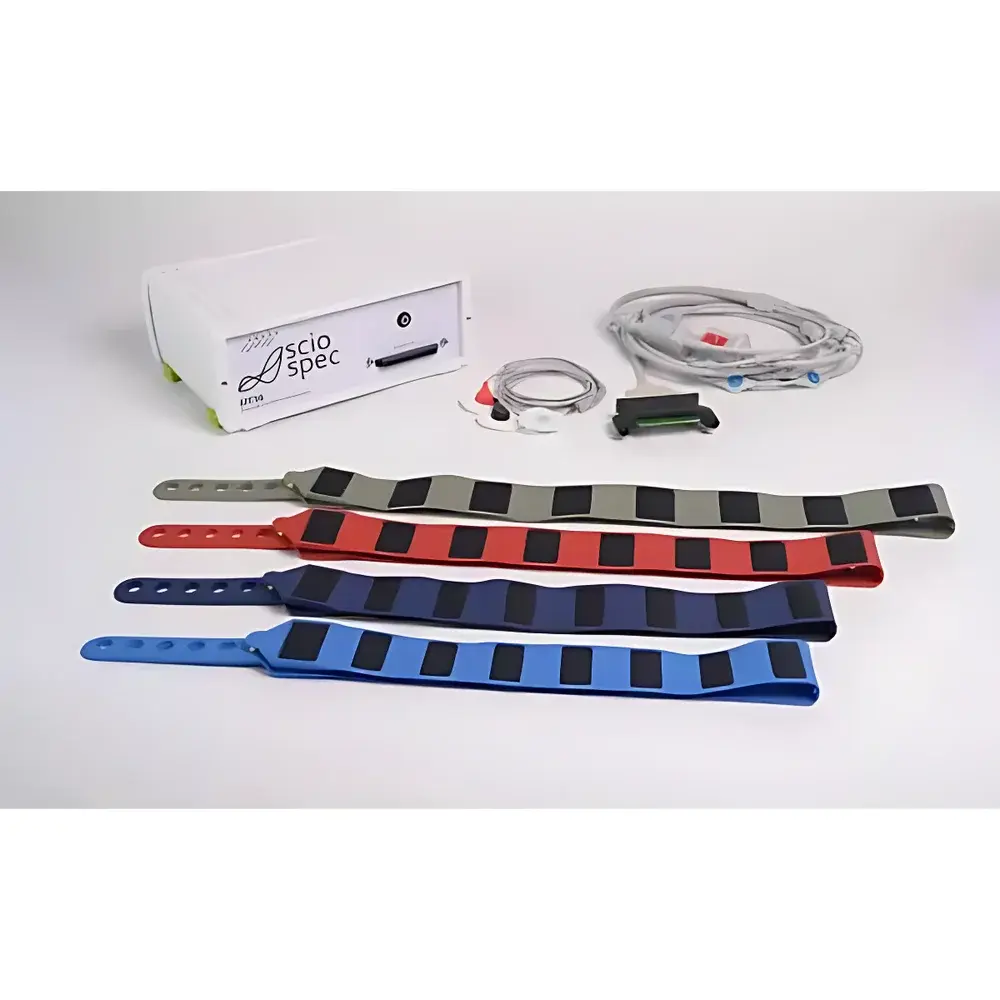
Sciospec LungEIT Research-Grade Thoracic Electrical Impedance Tomography System
| Brand | Sciospec |
|---|---|
| Origin | Germany |
| Model | LungEIT Research Kit |
| Frequency Range | 100 Hz – 1 MHz |
| Frame Rate | up to 100 fps |
| Electrode Channels | 16–256 configurable |
| Compliance | ISO 60601-1 (Medical Electrical Equipment Safety), IEC 62304 Class B (Software Lifecycle), FDA 21 CFR Part 11 Ready (Audit Trail & Electronic Signatures) |
| Interface Options | Isolated Full-Speed USB, RJ45 Ethernet (with optional medical-grade network isolator), IsoIO module (UART/SPI/I2C/programmable GPIO) |
| Power | 12 V DC (medical-grade isolated AC/DC adapter or rechargeable Li-ion battery) |
| Signal Coupling | AC-coupled front-end with galvanic isolation and high-pass filtering (>100 Hz cutoff) |
| Data Export | Raw time-series voltage/current, calibrated boundary data, EIDORS-compatible MAT/CSV formats |
| Software | Sciospec EIT Suite (GUI for acquisition, real-time reconstruction, ECG-synchronized gating, lung ventilation visualization), SDK for MATLAB/Python/C++ integration |
Overview
The Sciospec LungEIT Research-Grade Thoracic Electrical Impedance Tomography System is a precision-engineered platform designed for non-invasive, radiation-free functional lung imaging in preclinical and translational research environments. Based on the well-established principle of electrical impedance tomography (EIT), the system applies small-amplitude, multi-frequency alternating currents (100 Hz–1 MHz) via surface electrodes arranged circumferentially around the thorax. Boundary voltage measurements are acquired at high temporal resolution (up to 100 frames per second), enabling dynamic reconstruction of regional conductivity changes associated with tidal breathing, ventilation distribution, and pulmonary perfusion shifts. Unlike static anatomical modalities, LungEIT delivers functional, time-resolved maps of intrathoracic impedance variation—making it uniquely suited for longitudinal studies of respiratory mechanics, ventilator-induced lung injury (VILI), aerosol deposition kinetics, and regional alveolar recruitment.
Key Features
- Configurable electrode architecture supporting 16-, 32-, 64-, 128-, or 256-channel measurement topologies—enabling optimization between spatial resolution, acquisition speed, and experimental scalability.
- Medical-grade hardware safety architecture compliant with ISO 60601-1:2012+A1:2020, including double-insulated power supply, galvanically isolated signal paths, and reinforced mechanical enclosure with IP2X-rated access protection.
- AC-coupled front-end with integrated high-pass filtering (cutoff ≥100 Hz) to eliminate electrode polarization artifacts and ensure patient safety by blocking DC current pathways.
- Dual-mode connectivity: Isolated full-speed USB 2.0 for local control and real-time data streaming; standard RJ45 Ethernet port (compatible with external medical-grade network isolators, included upon request) for remote instrument orchestration in distributed lab environments.
- IsoIO expansion interface providing hardware-synchronized trigger I/O, programmable GPIO, and native support for UART, SPI, and I2C protocols—facilitating tight integration with ECG monitors, spirometers, ventilators, and custom stimulus delivery systems.
- Real-time impedance spectroscopy engine capable of sweeping across 100 Hz–1 MHz with user-defined frequency lists, logarithmic spacing, or adaptive band selection—critical for dispersion analysis and Cole-Cole modeling of lung tissue.
Sample Compatibility & Compliance
LungEIT is validated for use with human volunteers, large-animal models (porcine, ovine), and rodent preparations under controlled laboratory conditions. All hardware components meet biocompatibility requirements per ISO 10993-1 for short-term skin contact. The system supports ASTM F2967-23-compliant electrode placement protocols and integrates seamlessly with standard Ag/AgCl ECG electrode arrays. Regulatory documentation—including design history file (DHF), risk management file (RMF) per ISO 14971:2019, and software validation reports aligned with IEC 62304 Class B—is available upon request for institutional review board (IRB) submissions and GLP-compliant study planning. The embedded firmware implements audit-trail logging, user authentication, and electronic signature workflows compatible with FDA 21 CFR Part 11 and EU Annex 11 requirements when deployed in regulated research settings.
Software & Data Management
The Sciospec EIT Suite provides a modular, open-architecture software environment built on Qt and optimized for scientific reproducibility. The graphical interface enables rapid protocol definition—including ECG-gated acquisition windows, breath-hold triggers, and multi-frequency sweep sequences—with immediate visualization of raw voltages, amplitude-phase spectra, and reconstructed conductivity difference images. Reconstruction algorithms include GREIT, JAC, and D-bar implementations, all configurable via intuitive parameter sliders. For advanced users, the SDK delivers low-level access to raw excitation waveforms, synchronized boundary measurements, and calibrated complex impedance matrices. Data export conforms to FAIR principles: time-stamped MAT files (MATLAB), structured CSV bundles, and EIDORS v3.10+ compatible formats support third-party algorithm development and cross-platform validation. All software modules undergo version-controlled release cycles with documented change logs and backward-compatible binary interfaces.
Applications
- Quantitative assessment of regional ventilation heterogeneity in healthy subjects and patients with COPD, asthma, or ARDS—supporting NIH R01- and ERC-funded mechanistic studies.
- Preclinical evaluation of novel ventilator modes (e.g., PEEP titration, APRV, neurally adjusted ventilatory assist) using real-time impedance-based compliance mapping.
- Validation of computational fluid dynamics (CFD) and finite element models of pulmonary airflow and aerosol deposition.
- Longitudinal monitoring of lung rehabilitation interventions—including inspiratory muscle training, postural drainage, and bronchodilator response—via serial functional EIT metrics (center-of-ventilation, global inhomogeneity index, ventilation delay maps).
- Integration into closed-loop respiratory support systems via IsoIO-triggered feedback control of pressure or flow actuators.
FAQ
Is the LungEIT system approved for clinical diagnostic use?
No—it is designated exclusively for research use under ISO 13485-manufactured quality systems and carries a “For Research Use Only” label per FDA guidance. Clinical deployment requires additional regulatory clearance specific to intended use and jurisdiction.
Can I import my own reconstruction algorithm?
Yes. The system exports fully calibrated boundary data (voltage/current pairs with timestamp and excitation metadata) in open formats. EIDORS compatibility ensures seamless integration with custom MATLAB or Python-based solvers.
What level of technical support is provided for algorithm development?
Sciospec offers application engineering consultations, SDK documentation (including API reference, example code, and debugging utilities), and optional on-site integration workshops for academic and industrial research teams.
Does the system support simultaneous ECG and impedance acquisition?
Yes—hardware-level synchronization is achieved via TTL triggers from external ECG amplifiers or internal R-wave detection. ECG-gated averaging and breath-cycle alignment are implemented in firmware.
How is data security and traceability ensured in multi-user labs?
Role-based access control, encrypted local storage, immutable audit trails (user actions, parameter changes, calibration events), and exportable electronic signatures comply with GLP/GCP data integrity standards.
Related Products