
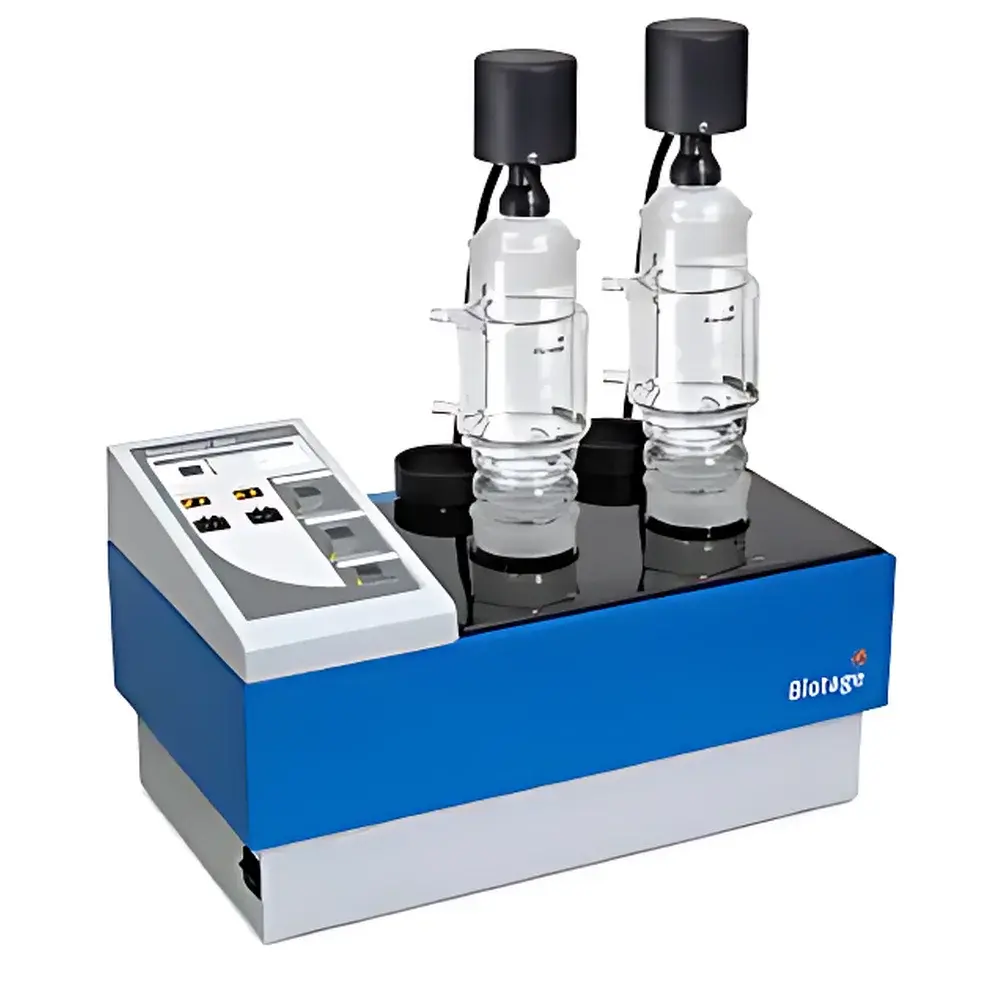
Biotage TurboVap 500 Automated Nitrogen Evaporator
| Brand | Biotage |
|---|---|
| Origin | USA |
| Model | TurboVap 500 |
| Sample Capacity | 500 mL (2 positions) |
| Temperature Range | Ambient to 99 °C |
| Evaporation Method | Patented Vortex Gas Flow |
| Solvent Recovery | Integrated Condensate Collection |
| Endpoint Detection | Optical + Level Sensing |
| Alarm | Audible & Visual |
Overview
The Biotage TurboVap 500 is an automated nitrogen evaporation system engineered for precision, reproducibility, and hands-free operation in regulated analytical laboratories. Unlike conventional rotary evaporators, Kuderna-Danish (K-D) concentrators, or vacuum-based systems, the TurboVap 500 employs Biotage’s proprietary vortex gas flow technology—a controlled, laminar stream of nitrogen directed tangentially across the solvent surface within a vertically oriented sample tube. This method induces efficient surface evaporation without boiling, foaming, or splashing, thereby preserving thermolabile analytes and maximizing recovery of semi-volatile compounds (e.g., PAHs, organochlorine pesticides, pharmaceutical metabolites). The system operates under ambient pressure and eliminates the need for vacuum pumps or fume hoods—reducing infrastructure dependency while maintaining compliance with GLP/GMP environmental control requirements. Designed for integration into high-throughput workflows—including EPA Method 508/525, ASTM D7066, and USP , the TurboVap 500 delivers consistent endpoint accuracy at final volumes of 0.5 mL or 1.0 mL, verified via optical detection and bottom-constricted collection tube geometry.
Key Features
- Patented vortex gas flow technology ensures uniform nitrogen dispersion, enabling rapid solvent removal without thermal degradation or analyte loss.
- Automated endpoint detection using dual-sensor logic: optical beam interruption combined with physical liquid level sensing in tapered-bottom collection tubes.
- Programmable water bath heating (ambient to 99 °C in 0.1 °C increments), independently controlled per position for method flexibility.
- Integrated condensate recovery manifold captures >95% of evaporated solvent vapor, minimizing lab exposure and supporting EPA-compliant waste handling.
- Two-position configuration supports simultaneous processing of up to 500 mL total volume (e.g., two 250-mL tubes), with independent parameter control per station.
- No-boil operation eliminates bumping, foaming, or sample rework—critical for regulatory submissions requiring documented method robustness.
- Front-access, top-opening tube design enables rapid tube loading/unloading and compatibility with standard 13 × 100 mm, 16 × 150 mm, and custom borosilicate glassware.
- Audible and visual alarms activate upon reaching user-defined final volume, allowing unattended overnight operation without supervision.
Sample Compatibility & Compliance
The TurboVap 500 accommodates a broad range of solvents—including dichloromethane, ethyl acetate, hexane, acetonitrile, and methanol—across diverse sample matrices (aqueous extracts, biological fluids, soil leachates, and food homogenates). Its non-vacuum, low-temperature evaporation profile maintains integrity of compounds with boiling points up to 250 °C and vapor pressures as low as 0.1 mmHg at 25 °C. The system meets essential regulatory expectations for analytical instrumentation: full audit trail capability (when paired with Biotage Instrument Control Software), alignment with FDA 21 CFR Part 11 electronic record requirements, and mechanical design conforming to IEC 61010-1 safety standards. Routine use supports compliance with ISO/IEC 17025 clause 5.5.2 (equipment verification) and ASTM D5845-22 (standard practice for solvent evaporation in environmental analysis).
Software & Data Management
While the TurboVap 500 operates via intuitive front-panel controls, optional integration with Biotage Instrument Control Software (ICS) enables method storage, execution logging, and electronic signature support. Each run records timestamped parameters—including bath temperature, nitrogen flow rate (calibrated via mass flow controller), elapsed time, and endpoint confirmation—exportable as CSV or PDF reports. All data entries are immutable post-run, satisfying ALCOA+ principles (Attributable, Legible, Contemporaneous, Original, Accurate) required in GLP audits. No cloud connectivity or external network dependency is required; local USB export preserves data sovereignty and network security.
Applications
- Environmental testing labs performing EPA SW-846 Methods 3510C (separatory funnel extraction), 3520C (solid-phase extraction), and 3550C (sonication extraction), where quantitative recovery of trace-level contaminants is mandatory.
- Clinical toxicology units concentrating urine or plasma samples prior to GC-MS/MS analysis of benzodiazepines, opioids, or synthetic cannabinoids.
- Pharmaceutical QC laboratories executing residual solvent testing per ICH Q3C guidelines, particularly for Class 2 solvents requiring precise endpoint control.
- Food safety labs applying AOAC 2007.01 or EN 15662 for multiresidue pesticide analysis, where matrix effects demand high analyte retention.
- Forensic chemistry workflows involving blood alcohol or drug quantification, where procedural consistency directly impacts evidentiary validity.
FAQ
Does the TurboVap 500 require connection to a laboratory ventilation system?
No. Its sealed condensate recovery and ambient-pressure operation eliminate volatile organic compound (VOC) release, permitting safe use on standard lab benches without fume hood dependence.
Can it handle viscous or high-salt-content extracts?
Yes—vortex gas flow minimizes surface crusting and residue adhesion; however, pre-filtration or dilution is recommended for samples exceeding 5% total dissolved solids.
What maintenance is required for long-term reliability?
Annual calibration of temperature sensors and nitrogen mass flow controllers is advised; routine cleaning of the condensate manifold and gas distribution nozzles every 200 runs ensures optimal performance.
Is method validation support available from Biotage?
Yes—Biotage provides application notes, IQ/OQ documentation templates, and on-site qualification services aligned with ISO/IEC 17025 and GxP requirements.
How does it compare to centrifugal evaporation systems?
Unlike centrifugal concentrators, the TurboVap 500 imposes no rotational shear stress on analytes, avoids tube breakage risks, and delivers superior reproducibility for low-volume endpoints (≤1.0 mL) due to deterministic fluid geometry.



