
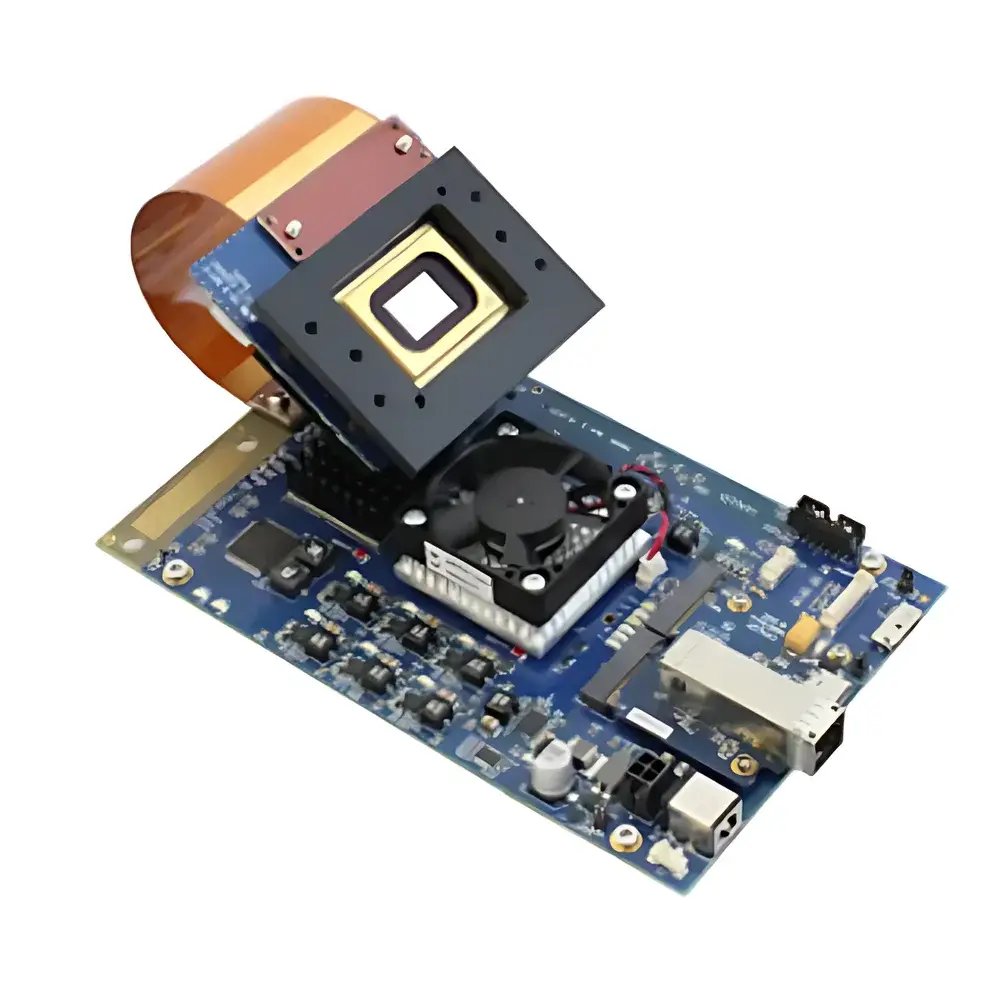
Vialux UltraSpeed UV DMD Spatial Light Modulator (PCIe Interface, 355–420 nm)
| Brand | Vialux |
|---|---|
| Origin | Germany |
| Interface | PCIe x4 Gen3 |
| Wavelength Range | 355–420 nm (UV) |
| DMD Chipsets | DLP7000/DLPC410, DLP9500/DLPC410, DLP9000X/DLPC910 |
| Native Resolutions | 1024×768, 1920×1080, 2560×1600 |
| Micromirror Pitch | 13.7 µm / 10.8 µm / 7.6 µm |
| Onboard DDR4 Memory | 16 GB (up to 32 GB optional) |
| Max Frame Rate (1-bit) | up to 22.7 kHz |
| Max Frame Rate (8-bit grayscale) | up to 303 Hz |
| Trigger Mode | Master/Slave |
| Software APIs | C++, C#, MATLAB, Python, LabVIEW, Visual Basic (.NET) |
Overview
The Vialux UltraSpeed UV DMD Spatial Light Modulator is a high-performance, industrial-grade optical modulation platform engineered for precision patterning and real-time dynamic illumination in the ultraviolet spectral range (355–420 nm). Based on Texas Instruments’ Digital Micromirror Device (DMD) architecture, this system leverages electrostatic actuation of micromirror arrays to achieve binary or multilevel spatial light modulation with nanosecond-scale switching fidelity. Unlike conventional liquid-crystal SLMs, DMD-based modulators deliver exceptional optical throughput, polarization independence, and long-term stability—critical attributes for demanding photolithography, structured illumination microscopy, and maskless direct-write applications. The integration of PCIe x4 Gen3 interface and onboard DDR4 SDRAM enables deterministic, low-latency data streaming directly from host memory or SSD storage—eliminating USB bottlenecks and supporting sustained frame rates exceeding 23,000 fps at full 1-bit resolution. Designed for integration into automated optical workstations, it operates as a deterministic pixel-addressable light engine—not merely a display device—but a programmable optical component compliant with rigorous timing and synchronization requirements in scientific instrumentation.
Key Features
- UV-optimized DMD chipsets: V-7002 UV (DLP7000), V-9502 UV (DLP9500), and V-9002 UV (DLP9000X), each calibrated for peak reflectivity and damage threshold across 355–420 nm
- PCIe x4 Gen3 host interface delivering up to ~23,000 fps (1-bit) with sub-microsecond latency and deterministic transfer scheduling
- Onboard DDR4 SDRAM: standard 16 GB (expandable to 32 GB), enabling local buffering of >349,000 monochrome patterns (at 16-bit depth)
- ALP-5 control firmware suite with real-time pattern sequencing, hardware-triggered exposure synchronization, and multi-exposure temporal dithering
- ViALUX Direct Link Sensor (DLS) architecture: FPGA-synchronized projection and image acquisition via integrated camera interface—supporting precise lock-step operation between DMD illumination and sensor readout
- Multi-language API support (C++, C#, MATLAB, Python, LabVIEW, VB.NET) with comprehensive documentation and production-ready example projects
- Industrial-grade control board (V5095) featuring ESD-hardened I/O, isolated trigger lines, and conformal coating for stable operation in laboratory and cleanroom environments
Sample Compatibility & Compliance
The UltraSpeed UV SLM is compatible with standard UV-transmissive optics, including fused silica lenses, reflective beam expanders, and broadband anti-reflection coatings optimized for 355–420 nm. Its mechanical design conforms to DIN 45720 mounting standards and supports integration into ISO-classified cleanrooms (ISO 5–7). While not certified as medical or safety-critical equipment per se, the system complies with CE marking directives (EMC 2014/30/EU, RoHS 2011/65/EU) and meets IEC 61000-4 immunity requirements for laboratory instrumentation. When deployed in regulated environments (e.g., photomask inspection, EUV pre-characterization, or GMP-aligned biofabrication workflows), the ALP-5 software supports audit-trail logging and timestamped pattern execution—facilitating traceability in GLP/GMP-compliant processes. No FDA 21 CFR Part 11 certification is provided out-of-the-box; however, customers may implement supplementary validation protocols using ALP-5’s deterministic API and hardware-triggered event logging.
Software & Data Management
The ALP-5 control software package provides a modular, extensible framework for pattern generation, sequence orchestration, and hardware abstraction. Core components include the EasyProj GUI for rapid prototyping, a dynamic-link library (DLL) for embedded integration, and language-specific wrappers ensuring thread-safe access to real-time frame queues. All pattern uploads are validated for bit-depth alignment, resolution compatibility, and memory boundary constraints prior to DMA transfer. The PCIe driver implements scatter-gather DMA and ring-buffer management to sustain continuous streaming without CPU polling. For time-critical applications, ALP-5 supports hardware-triggered pattern advances with jitter < 50 ns (measured RMS), enabling sub-frame synchronization with external detectors or laser sources. Optional DLS-SDK extends functionality to bidirectional sensor-DMD coordination—including exposure-gated projection, motion-compensated scanning, and closed-loop adaptive optics feedback loops.
Applications
- Maskless Photolithography: High-throughput UV patterning of photoresists (e.g., SU-8, AZ series) without physical masks—ideal for rapid prototyping of microfluidic devices and MEMS structures
- Structured Illumination Microscopy (SIM): Real-time generation of sinusoidal, grid, or arbitrary illumination patterns in UV-excitable fluorophores (e.g., DAPI, Hoechst) for super-resolution imaging
- 3D Microfabrication & Two-Photon Polymerization: Dynamic voxel-by-voxel exposure control in UV-curable resins, enabling topology-optimized lattice structures and biomimetic scaffolds
- Machine Vision & Optical Metrology: High-speed fringe projection for real-time 3D surface reconstruction, defect detection, and dimensional metrology in semiconductor packaging
- Quantum Optics & Cold Atom Trapping: Programmable optical dipole traps and lattice potentials using UV-compatible beam shaping—compatible with 355 nm Nd:YAG and frequency-tripled Ti:Sapphire sources
- Dynamic Holography & Beam Steering: Binary-phase hologram encoding for multi-spot trapping, adaptive wavefront correction, and non-mechanical beam multiplexing
FAQ
What UV wavelength ranges are supported by each model?
The V-7002 UV and V-9502 UV operate optimally between 363–420 nm; the V-9002 UV extends usable response down to 355 nm.
Is the PCIe interface compatible with standard desktop motherboards?
Yes—the V5095 control board requires a PCIe x4 Gen3 slot and is compatible with Windows 10/11 (64-bit), Linux (kernel ≥5.4), and real-time OS variants when using kernel-mode drivers.
Can I synchronize the DMD with an external camera that does not support DLS?
Yes—standard TTL trigger inputs/outputs enable master-slave synchronization with third-party cameras, though sub-microsecond jitter requires careful cabling and impedance matching.
What is the maximum sustainable frame rate for 8-bit grayscale patterns?
Sustained 8-bit grayscale performance depends on resolution and memory bandwidth: up to 303 Hz at 2560×1600 (V-9002 UV), 266 Hz at 1920×1080 (V-9502 UV), and 290 Hz at 1024×768 (V-7002 UV).
Does ALP-5 support scripting for automated calibration routines?
Yes—ALP-5 includes a Python-based script engine with access to all low-level registers, pattern memory mapping, and hardware status reporting—enabling custom gamma calibration, mirror stuck-pixel detection, and thermal drift compensation sequences.






