
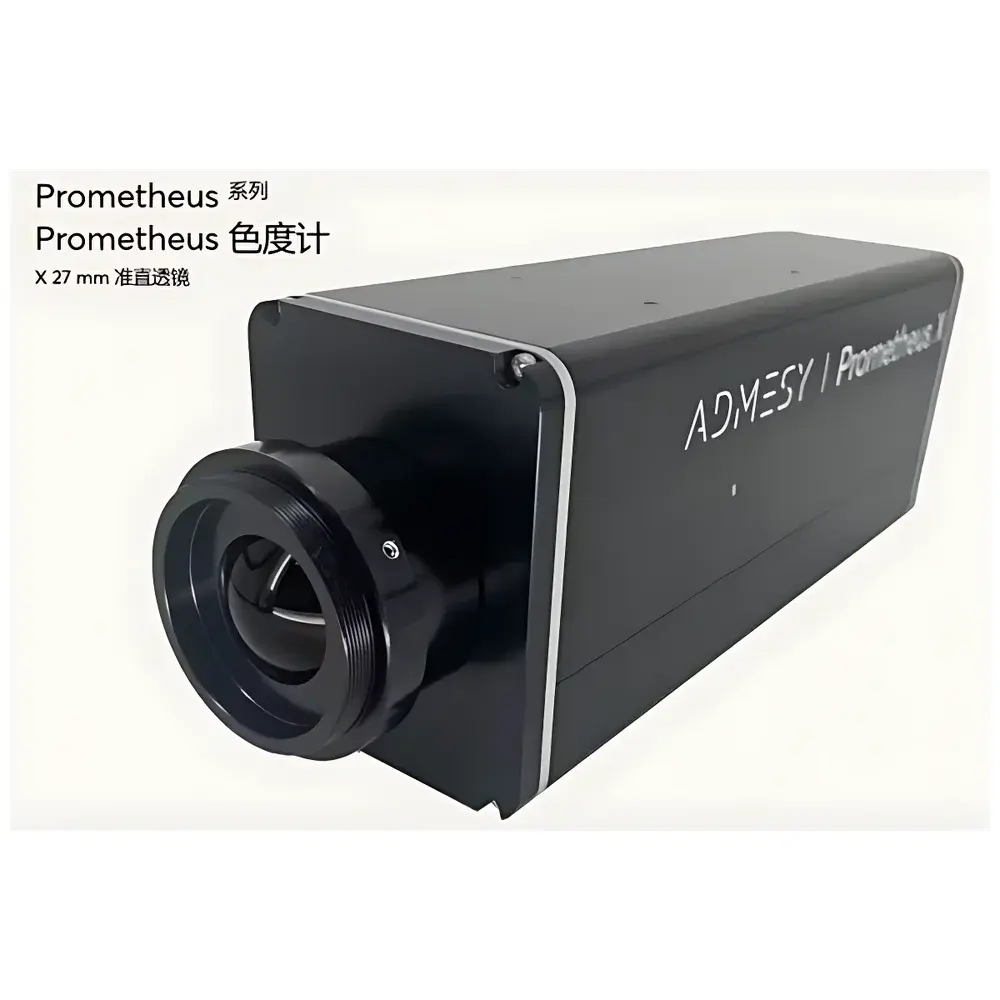
Admesy Prometheus X27 Colorimeter
| Brand | Admesy |
|---|---|
| Origin | Netherlands |
| Model | Prometheus X27 |
| Measurement Principle | CIE 1931 / CIE 170.2:2015-compliant photopic luminance and tristimulus colorimetry |
| Luminance Range | 0.0001–20,000 cd/m² |
| Minimum Measurement Time | 1 s (at 0.0001 cd/m²) |
| Y-Channel Sampling Rates | 3.125 kS/s, 2 kS/s, or 800 kS/s |
| Filter Accuracy | Factory-calibrated interference filters matching CIE standard observer functions |
| Compliance | CIE 1931, CIE 170.2:2015, JEITA TR-006 (flicker), USB Device Class MTC v1.0 |
| OS Compatibility | Windows, Linux, macOS |
| API Support | Native SDK for C#, C++, VB.NET, LabVIEW, MATLAB, Python |
Overview
The Admesy Prometheus X27 is a high-performance, research-grade colorimeter engineered for precision photometric and colorimetric characterization of emissive displays, LED lighting systems, automotive HUDs, microLED arrays, and other dynamic light sources. Unlike conventional colorimeters relying on sequential RGB filter switching or slow CCD integration, the Prometheus X27 employs a parallel optical architecture with three independently optimized photodiode channels—each equipped with factory-traceable, spectrally matched interference filters conforming strictly to the CIE 1931 2° standard observer and updated CIE 170.2:2015 photopic luminosity function. Its dedicated Y-channel operates as a high-bandwidth radiometric sensor, decoupled from chromatic measurement, enabling simultaneous acquisition of luminance waveforms at up to 800 kS/s—making it uniquely suited for flicker analysis, temporal stability assessment, and pulse-width modulation (PWM) characterization under real-world drive conditions.
Key Features
- True parallel tristimulus detection with CIE 1931 and CIE 170.2:2015 spectral compliance, verified via NIST-traceable calibration certificates supplied with each unit.
- Ultra-wide dynamic luminance range: 0.0001 to 20,000 cd/m², achieved through hardware-level auto-ranging and adaptive gain control—no manual range selection required during low-light OLED or microLED testing.
- Dedicated high-speed Y-channel supporting three selectable sampling modes: 3.125 kS/s (for JEITA TR-006 flicker compliance testing), 2 kS/s (for general waveform capture), and 800 kS/s (for sub-microsecond transient analysis).
- Integrated mechanical shutter for zero-reference dark calibration—eliminating thermal drift effects and ensuring long-term measurement stability across temperature gradients (operating range: 15–35 °C).
- Onboard MCU performing real-time JEITA TR-006 flicker metrics (FMA, SVM, Percent Flicker) without host CPU dependency—critical for production-line throughput and embedded test systems.
- Fully compliant with USB Device Class MTC v1.0, enabling plug-and-play operation without proprietary drivers; supports hot-plug detection and device enumeration under all major OS kernels.
Sample Compatibility & Compliance
The Prometheus X27 is designed for direct measurement of self-luminous surfaces including OLED, QD-OLED, AMOLED, microLED, Mini-LED backlit LCDs, and automotive interior lighting modules. Its 1° field-of-view optics (with optional 0.1° and 2° apertures available) ensure spatially resolved measurements aligned with ISO 13406-2 and IEC 62341-6-3 display evaluation standards. All photometric data output adheres to CIE S 014-2/E:2022 metadata conventions. Calibration traceability follows ISO/IEC 17025:2017 requirements, with annual recalibration recommended per GLP practices. The instrument meets electromagnetic compatibility (EMC) requirements per EN 61326-1:2013 and safety standards per IEC 61010-1:2010.
Software & Data Management
Admesy provides a comprehensive, open-architecture software development kit (SDK) supporting native integration into industrial test environments. The SDK includes fully documented APIs for C#, C++, Visual Basic .NET, LabVIEW (NI-VISA compatible), MATLAB (via DLL wrappers), and Python (PyPI package with NumPy/Pandas interoperability). All communication uses binary-packed USB-MTC packets—ensuring deterministic latency (< 200 µs round-trip jitter) and enabling synchronization with external triggers (TTL input/output). Data logging supports HDF5 and CSV export with embedded metadata (timestamp, integration time, aperture setting, calibration ID, ambient temperature). Audit trails comply with FDA 21 CFR Part 11 requirements when deployed with validated third-party LIMS or MES platforms.
Applications
- Display manufacturing: Pixel-level uniformity mapping, grayscale tracking, white point drift monitoring over burn-in cycles.
- Automotive electronics: HUD brightness homogeneity verification, headlamp adaptive beam pattern validation, interior ambient lighting spectral stability under PWM dimming.
- R&D labs: Temporal color shift analysis in quantum-dot LEDs, microsecond-scale response characterization of ferroelectric liquid crystal (FLC) modulators.
- Standards laboratories: Verification of CIE 170.2:2015 conformance for new display technologies, reference instrumentation for inter-laboratory comparison studies.
- AR/VR headset development: Near-eye display luminance linearity, chromaticity shift vs. viewing angle, and temporal artifacts induced by eye-tracking latency compensation.
FAQ
Does the Prometheus X27 require external calibration after initial setup?
No—each unit ships with a factory-applied, NIST-traceable calibration certificate valid for 12 months. Field recalibration is performed using Admesy’s certified reference lamps and requires return to an authorized service center.
Can the 800 kS/s Y-channel be used simultaneously with XYZ color measurement?
Yes—the Y-channel operates independently and continuously; XYZ integration occurs synchronously within the same exposure window, preserving temporal correlation between luminance transients and chromatic shifts.
Is the instrument suitable for measuring non-steady-state sources such as pulsed lasers or strobed LEDs?
Yes—its minimum integration time is 1 µs, and the 800 kS/s mode captures full waveform envelopes with 1.25 µs sampling intervals, enabling reconstruction of pulse shape, rise/fall times, and duty-cycle-dependent chromaticity drift.
How is compliance with JEITA TR-006 ensured in firmware?
The onboard MCU implements the exact weighting functions and statistical algorithms defined in JEITA TR-006 Annex B, including FMA (Flicker Modulation Amplitude), SVM (Stroboscopic Effect Visibility Measure), and Percent Flicker—all computed in real time without post-processing.
What operating system versions are officially supported?
Windows 10/11 (64-bit), Ubuntu 20.04 LTS and later, and macOS 12 Monterey through 14 Sonoma—with kernel-mode USB-MTC support verified on all platforms.




