
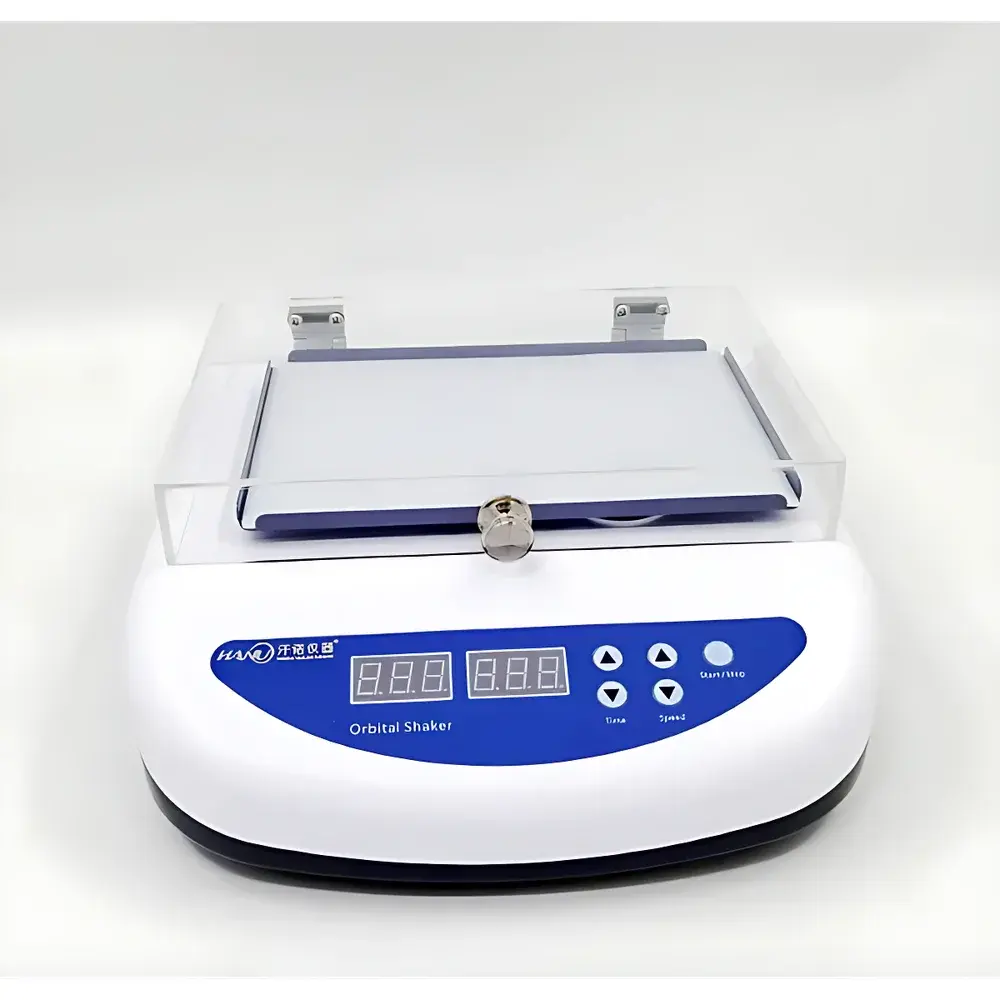
Hanuo HZD-320S Horizontal Rotary Shaker for Syphilis Serology Testing
| Brand | Hanuo |
|---|---|
| Origin | Shanghai, China |
| Model | HZD-320S |
| Timer Range | 0–999 min |
| Oscillation Frequency | 20–230 rpm |
| Orbit Diameter | 19 ± 1 mm |
| Speed Accuracy at 100 rpm | ±2 rpm |
| Time Accuracy | ±1 s/min |
| Operating Mode | Timed or Continuous |
| Platform Dimensions | 245 × 167 mm |
| Power Supply | AC 110–240 V, 50–60 Hz |
| Motor Power | 10 W |
| Enclosure | Transparent Acrylic Cover with Humidity Retention Trough |
| IP Rating | IP21 |
| Overall Dimensions | 335 × 320 × 145 mm |
| Standard Configuration | Fixed Transparent Cover, Silicone Anti-Slip Mat, Magnetic Clamp Bar |
| Compliance | WS/T 491–2017 (Chinese Health Industry Standard for Syphilis Serological Testing) |
Overview
The Hanuo HZD-320S Horizontal Rotary Shaker is a purpose-engineered laboratory instrument designed specifically for standardized serological testing of syphilis, including Rapid Plasma Reagin (RPR), Toluidine Red Unheated Serum Test (TRUST), and Venereal Disease Research Laboratory (VDRL) assays. It operates on the principle of controlled horizontal orbital rotation—generating uniform, low-shear mixing across flat-bottom reaction surfaces such as glass slides, plastic-coated cards, microtiter plates, and enzyme-linked immunosorbent assay (ELISA) plates. Unlike general-purpose shakers, the HZD-320S implements clinically validated rotational parameters aligned with WS/T 491–2017, the Chinese health industry standard governing syphilis screening methodology. Its mechanical architecture ensures consistent angular velocity and minimal torque fluctuation across the full speed range (20–230 rpm), critical for reproducible antigen–antibody agglutination kinetics in qualitative and semi-quantitative immunoassays.
Key Features
- Digital precision control of both rotational speed and timer duration, with real-time LED display for immediate verification of setpoints and elapsed time.
- Pre-programmed one-touch assay protocols compliant with WS/T 491–2017: RPR/TRUST mode (100 ± 2 rpm, 8 ± 0.13 min); VDRL-CSF mode (180 ± 2 rpm, 8 ± 0.13 min); VDRL-serum mode (180 ± 2 rpm, 4 ± 0.07 min).
- Wide-input voltage design (AC 110–240 V, 50–60 Hz) mitigates performance drift caused by line voltage fluctuations common in multi-instrument clinical laboratories.
- Integrated humidity retention trough beneath the transparent acrylic cover minimizes evaporative loss and thermal gradient effects during extended incubation-mixing cycles—particularly essential for CSF-based VDRL testing where sample volume is limited and evaporation alters titer interpretation.
- Platform equipped with medical-grade silicone anti-slip mat and magnetically secured pressure bar to prevent lateral displacement or warping of rigid test cards and shallow-well microplates under dynamic loading.
- IP21-rated enclosure provides protection against vertically falling solid objects and limited ingress of moisture—suitable for use in clinical diagnostic environments adhering to IEC 61000-6-3 EMC requirements.
Sample Compatibility & Compliance
The HZD-320S accommodates standard syphilis testing formats: circular or rectangular card-based assays (e.g., Macro-VDRL cards), 96-well ELISA plates (flat-bottom only), Petri dishes (up to 150 mm diameter), and custom slide carriers. Its 19 mm orbit diameter ensures homogeneous fluid motion without vortex formation or edge turbulence—critical for preserving macroscopic agglutinate morphology. The device conforms to WS/T 491–2017 clause 5.3.2 regarding mechanical agitation specifications for non-treponemal tests. While not certified to ISO/IEC 17025 or CLIA standards as a standalone unit, its operational repeatability supports GLP-aligned documentation when integrated into validated laboratory workflows. Traceability of speed and time settings is enabled via front-panel digital readout; manual logbook entries or external timestamped video recording may be used for audit readiness.
Software & Data Management
The HZD-320S is a stand-alone electromechanical instrument with no embedded firmware, network interface, or data export capability. All operational parameters are set and monitored locally via physical push-button controls and dual seven-segment LED displays (rpm and minutes:seconds). This architecture eliminates cybersecurity risks associated with connected lab devices and ensures deterministic behavior under electromagnetic interference conditions typical in hospital utility rooms. For laboratories requiring electronic recordkeeping per FDA 21 CFR Part 11 or ISO 15189, integration with external LIMS or ELN systems must be achieved through operator-initiated manual entry or synchronized external timing hardware (e.g., USB-connected chronometers with CSV export).
Applications
- Routine syphilis screening in clinical microbiology and serology laboratories, including blood banks and STD clinics.
- Quality control mixing of calibration standards and positive/negative controls in immunoassay validation studies.
- Uniform dispersion of suspended antigens or latex particles in rapid diagnostic test development.
- Low-shear homogenization of viscous biological matrices (e.g., cerebrospinal fluid, synovial fluid) prior to centrifugation or filtration.
- Supporting educational training in clinical laboratory science programs where standardized, repeatable agitation protocols are required for competency assessment.
FAQ
Is the HZD-320S suitable for use with microcentrifuge tubes or conical tubes?
No. The platform is engineered exclusively for flat-surface vessels: slides, cards, plates, and dishes. Tube holders are not supported, and centrifugal forces generated during orbital motion would compromise tube stability.
Does the instrument meet international regulatory requirements such as ISO 13485 or CE marking?
The HZD-320S is manufactured to GB/T 14710 (Chinese environmental testing standard for electrical medical equipment) and complies with basic safety clauses of GB 4793.1–2007 (equivalent to IEC 61010-1). It does not carry CE marking or ISO 13485 certification, as it is classified as a Class I laboratory support device under Chinese NMPA guidelines.
Can the transparent cover be removed during operation?
Yes, but removal disables the humidity retention function and voids compliance with WS/T 491–2017 clause 6.2.2, which mandates covered operation for all VDRL-CSF procedures. Uncovered use is permissible only for non-CSF applications where evaporation is not analytically consequential.
What maintenance is required for long-term reliability?
Annual inspection of motor brush wear (if applicable), verification of speed calibration using an optical tachometer, and cleaning of the silicone mat and acrylic cover with 70% ethanol. No lubrication or internal adjustment is specified by the manufacturer.
Is third-party calibration service available outside China?
Hanuo authorizes calibration through designated regional distributors in Southeast Asia and the Middle East. In North America and the EU, users must engage ISO/IEC 17025-accredited metrology labs using traceable rotational speed and time standards (e.g., NIST-traceable tachometers and atomic clocks).





