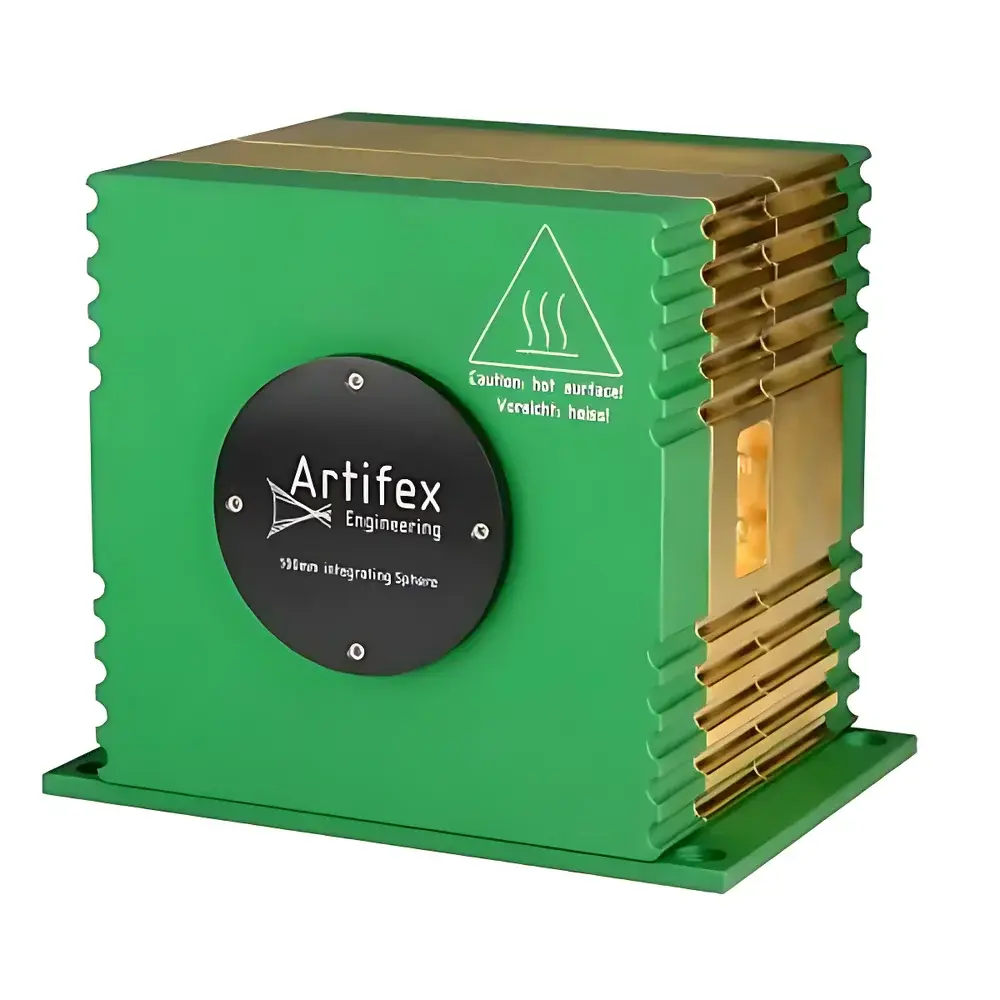
Artifex Auniontech High-Power Gold-Coated Integrating Sphere Power Meter
| Key Features | Gold-coated integrating sphere |
|---|---|
| Power handling | 40 W (65 mm air-cooled), 4000 W (100 mm water-cooled), up to 12 kW (gold-coated sphere) |
| Power density tolerance | 5000 W/cm² |
| Wavelength range | 650 nm – 20 µm |
| Input port aperture | 10–200 mm |
| Standard fiber interface | SMA/FC |
| Configurable port count | 2 or 4 ports |
| Detector compatibility | Si, Ge, VIS-enhanced InGaAs, IR-extended InGaAs, standard InGaAs |
| Uniformity | <1% at 25 mm output port under side illumination |
| Cooling options | Convection-cooled (with ground-backplate for cold-plate mounting) or liquid-cooled |
Overview
The Artifex Auniontech High-Power Gold-Coated Integrating Sphere Power Meter is engineered for real-time, high-bandwidth optical power measurement in demanding industrial and scientific laser applications. Unlike conventional thermopile-based power meters—whose thermal inertia limits temporal resolution to ~1 s response times—this system leverages the intrinsic speed of photodiode detectors coupled with a precision gold-coated integrating sphere to achieve microsecond-scale dynamic power monitoring. The core measurement principle relies on spatial homogenization of incident laser radiation within the sphere cavity, followed by sampling of the diffuse, Lambertian light field at a dedicated detector port. This architecture decouples thermal load from the photodetector (which remains external and temperature-stable), enabling accurate, high-fidelity capture of rapid power transients—including mode-locking instabilities, Q-switch jitter, pulsed laser envelope distortion, and feedback-induced fluctuations in kW-class CW and quasi-CW systems.
Key Features
- Gold-coated interior surface ensures >97% reflectivity across 650 nm–20 µm, maintaining spectral neutrality and minimizing absorption-induced heating in high-flux environments.
- Scalable sphere diameters (25 mm, 65 mm, 100 mm) optimized for specific power ranges: 40 W (65 mm, passive convection), 4000 W (100 mm, water-cooled), and up to 12 kW (custom gold-sphere variants).
- Standard dual-port configuration (SMA/FC) supports simultaneous connection to an OPM150-series photodiode power meter and auxiliary instrumentation such as spectrometers or beam profilers; optional 4-port versions accommodate multi-channel diagnostics.
- Input aperture configurable from 10 mm to 200 mm to match beam divergence and spatial profile while preserving sphere efficiency and uniformity.
- Thermally robust mechanical design includes ground-backplate mounting surfaces for integration into active cooling assemblies, enabling stable operation under sustained irradiation at ≤5000 W/cm² power density.
- No internal photodiodes in 65 mm and 100 mm models—eliminating thermal drift and responsivity drift caused by localized heating—ensuring long-term measurement stability required for GLP/GMP-compliant laser qualification protocols.
Sample Compatibility & Compliance
The system accommodates free-space beams and fiber-coupled sources across UV-VIS-NIR-MIR spectral bands. Its gold-coated spheres meet ISO 11554 (laser beam parameter measurements) and ASTM E275 (spectral bandpass characterization) geometrical and reflectance requirements when used with NIST-traceable calibration. Optional factory calibration certificates include uncertainty budgets per ISO/IEC 17025:2017. For regulated environments (e.g., medical laser manufacturing, aerospace component testing), the modular port architecture and external detector topology support audit-ready configurations compliant with FDA 21 CFR Part 11 data integrity requirements when paired with validated OPM150 firmware and secure logging software.
Software & Data Management
Fully compatible with Auniontech’s OPM Control Suite v3.x, the system delivers synchronized time-stamped power traces at up to 1 MS/s sampling rate (dependent on connected photodiode amplifier bandwidth). Raw data export supports HDF5, CSV, and MATLAB .mat formats. Built-in trigger input/output enables hardware synchronization with oscilloscopes, pulse generators, or laser controllers. Audit trail functionality logs all calibration events, user actions, and configuration changes—meeting ALCOA+ principles for data reliability in quality-critical workflows.
Applications
- Real-time monitoring of kW-level fiber and disk laser output stability during cutting, welding, and cladding processes.
- Characterization of transient behavior in ultrafast amplifier chains (e.g., Yb-doped fiber amplifiers, OPCPA systems).
- Beam uniformity validation for lithography illumination systems and EUV source metrology.
- Feedback loop optimization in adaptive optics and resonant cavity control systems.
- Power stability certification per IEC 60825-1 for Class 4 laser safety compliance testing.
- Integration into automated test benches for laser diode burn-in and lifetime evaluation.
FAQ
Can this system measure pulsed lasers with nanosecond pulse widths?
Yes—when paired with fast-response photodiodes (e.g., Si or InGaAs with ≤1 ns rise time) and appropriate amplification, the sphere enables pulse-resolved energy-per-pulse and peak-power analysis.
Is NIST-traceable calibration included by default?
Calibration is optional and performed at Auniontech’s ISO/IEC 17025-accredited lab; certificates include spectral responsivity curves, linearity verification, and expanded uncertainty statements.
What cooling infrastructure is required for 12 kW operation?
The 12 kW gold-sphere variant requires closed-loop deionized water cooling at ≥8 L/min flow rate and ΔT ≤ 5 °C; detailed thermal interface specifications are provided in the mechanical integration manual.
Can I use third-party photodiode power meters with this sphere?
Yes—any power meter with SMA/FC input and compatible spectral/dynamic range may be interfaced; however, full synchronization and firmware-level features (e.g., auto-ranging, zero-tracking) are guaranteed only with OPM150-series instruments.
How is sphere uniformity verified?
Uniformity is measured per ISO 13694 using a scanning slit profiler and calibrated photodiode array; typical results show <0.8% spatial non-uniformity across the 25 mm output port under standardized side-illumination conditions.