English Product Name
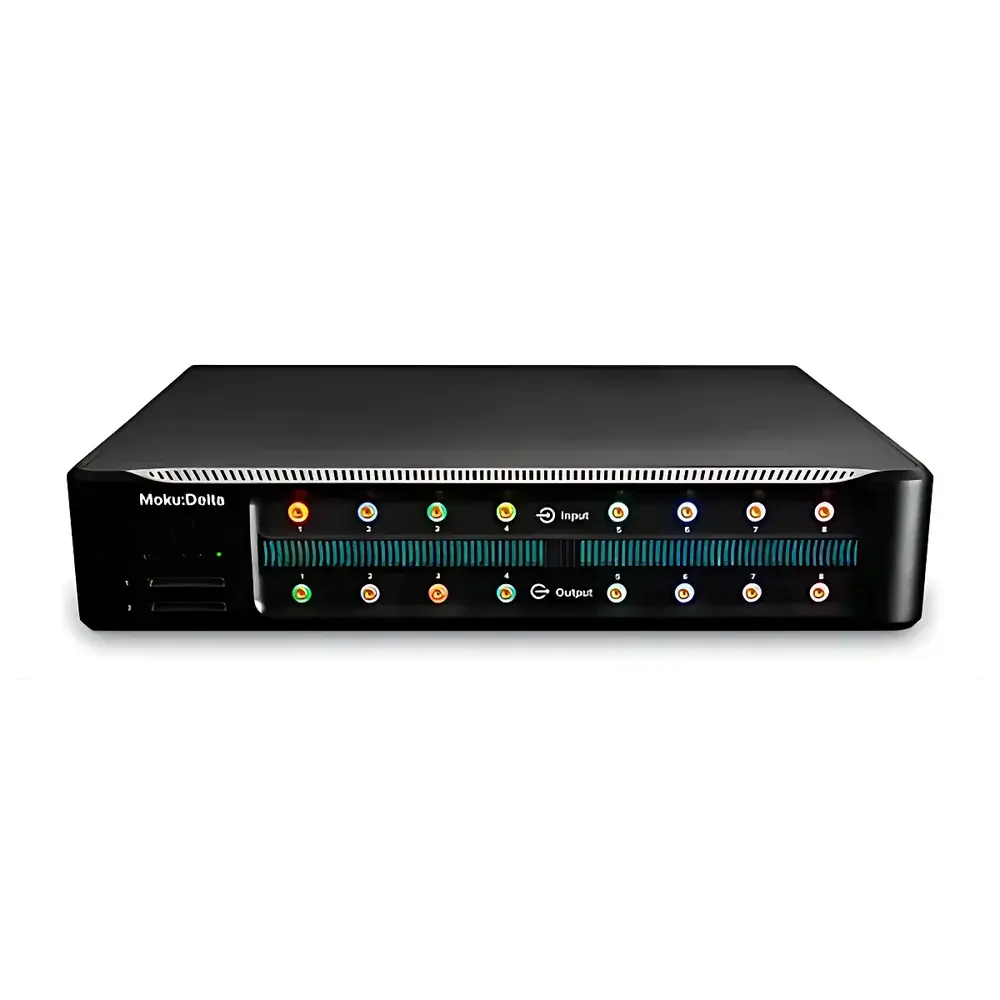
| Auniontech Moku | Delta Multi-Instrument Platform (Lock-in Amplifier) |
|---|---|
| Brand | Auniontech |
| Origin | Shanghai, China |
| Manufacturer Type | Authorized Distributor |
| Country of Origin | China |
| Model | Moku:Delta Lock-in Amplifier |
| Pricing | Available Upon Request |
Overview
The Auniontech Moku:Delta is a high-performance, software-defined test and measurement platform engineered for precision metrology, real-time signal analysis, and multi-domain instrumentation in advanced research and industrial R&D environments. At its core, the Moku:Delta implements lock-in amplification using digital signal processing (DSP) techniques executed directly on an Xilinx® UltraScale+™ RFSoC FPGA—enabling sub-nanovolt sensitivity, ultra-low phase noise, and deterministic latency. Unlike traditional analog lock-in amplifiers, the Moku:Delta performs synchronous demodulation, harmonic analysis, and filter synthesis in hardware-accelerated logic, delivering exceptional dynamic reserve (>120 dB), frequency resolution down to 1 µHz, and phase accuracy better than ±0.001° across its full 2 GHz bandwidth. Its architecture supports simultaneous deployment of up to eight independent instruments—including lock-in amplifier, oscilloscope, spectrum analyzer, PID controller, and arbitrary waveform generator—within a single 2U chassis, making it ideal for quantum sensing, low-noise electronics characterization, optical interferometry, and closed-loop control systems requiring nanoscale stability.
Key Features
- 8-channel 2 GHz analog input with hybrid 14-bit + 20-bit ADC architecture for optimized wideband noise performance (<10 nV/√Hz typical input noise density)
- 8-channel 2 GHz analog output with 14-bit resolution and programmable gain/offset calibration
- 32-channel bidirectional digital I/O supporting LVDS, CMOS, and user-defined timing protocols
- Ultra-stable onboard reference clock with ±1 ppb long-term stability; supports 10 MHz, 100 MHz, GPS-disciplined, and external reference inputs
- Real-time FPGA-based signal processing with partial reconfiguration capability—enabling hardware-level customization without compromising latency or throughput
- Simultaneous operation of up to 8 instrument types from a library of 15 pre-validated tools, all accessible via intuitive web-based GUI or Python API
- Moku Cloud Compile integration for deploying user-defined HDL or HLS algorithms directly onto the RFSoC fabric with minimal overhead
Sample Compatibility & Compliance
The Moku:Delta is compatible with standard BNC, SMA, and LEMO interfaces for seamless integration into existing test benches, cryogenic setups, vacuum chambers, and optical tables. Its modular firmware design ensures compliance with laboratory quality assurance frameworks including ISO/IEC 17025 traceability requirements for measurement uncertainty reporting. While not certified for medical or safety-critical applications, the platform supports audit-ready data logging with timestamped metadata, enabling alignment with GLP and GMP documentation practices. All firmware updates undergo rigorous regression testing against IEEE 1057-compliant signal integrity benchmarks and adhere to electromagnetic compatibility standards per CISPR 11 Class A.
Software & Data Management
The Moku:Delta operates exclusively through a browser-based interface compatible with Chrome, Firefox, and Edge—eliminating host OS dependencies and ensuring consistent behavior across Windows, macOS, and Linux workstations. Instrument configurations are saved as portable JSON files containing full parameter sets, calibration coefficients, and trigger definitions. Raw time-series and spectral data export in HDF5 format includes embedded provenance metadata (e.g., sampling rate, filter settings, clock source ID), facilitating reproducible analysis in MATLAB, Python (NumPy/Pandas), or LabVIEW. Optional Moku:Pro Server enables centralized fleet management, remote monitoring, and role-based access control compliant with NIST SP 800-53 authentication guidelines.
Applications
- Quantum device characterization: spin resonance detection, superconducting qubit readout, and Josephson junction noise spectroscopy
- Low-frequency impedance spectroscopy of electrochemical cells and MEMS sensors
- Optical heterodyne detection in gravitational wave interferometers and atomic force microscopy
- Phase-sensitive measurements in magneto-optic Kerr effect (MOKE) and pump-probe experiments
- Real-time adaptive feedback control in laser frequency stabilization and cavity locking loops
- Multi-tone harmonic distortion analysis for RF front-end validation under modulated excitation
FAQ
What is the minimum detectable signal level in lock-in mode?
The system achieves a typical input-referred noise floor of <10 nV/√Hz at 1 kHz, translating to sub-100 pV RMS sensitivity for 1-second integration times with appropriate filtering.
Can multiple Moku:Delta units be synchronized?
Yes—via shared 10 MHz or PPS signals, or through GPS-disciplined OCXOs, enabling phase-coherent multi-node measurements with sub-picosecond jitter alignment.
Is FPGA source code accessible for custom algorithm development?
Users retain full ownership of their HDL/HLS designs deployed via Moku Cloud Compile; however, the underlying RFSoC boot firmware and instrument IP cores remain proprietary.
Does the platform support third-party driver integration (e.g., LabVIEW, MATLAB)?
Native Python SDK is provided; official LabVIEW and MATLAB wrappers are available through the Auniontech Developer Portal with full API documentation and example VIs/scripts.
What calibration options are available?
Factory calibration covers DC gain, offset, frequency response, and phase linearity across all analog paths; users may perform field recalibration using built-in self-test signals and NIST-traceable reference sources.