
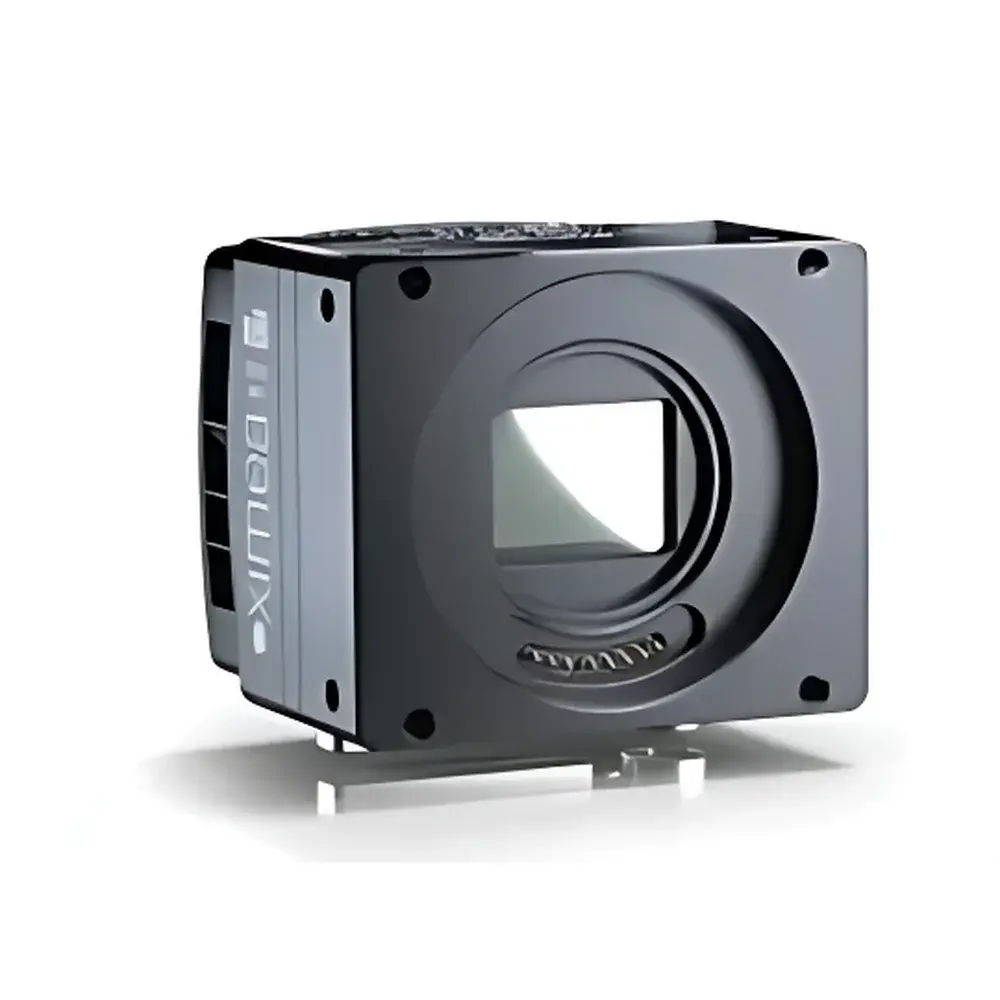
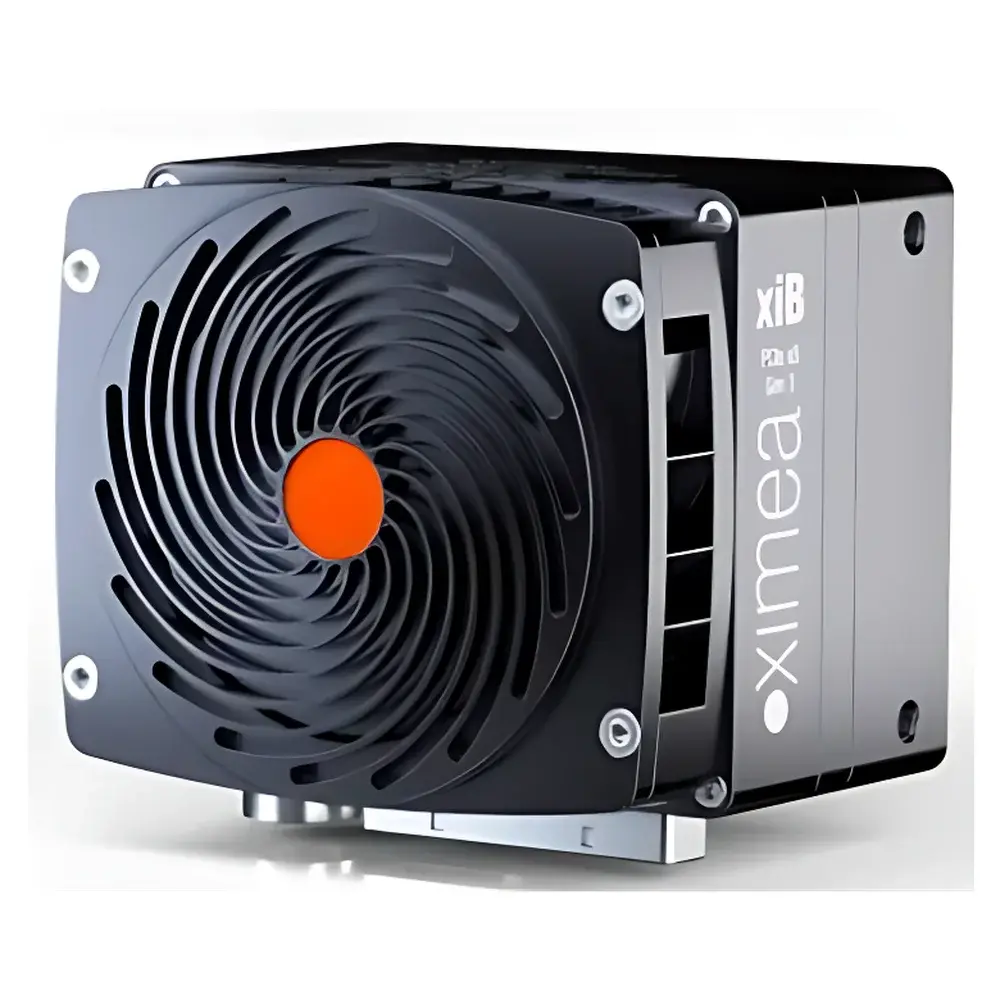
XIMEA xiB Series PCIe Gen3 High-Speed High-Resolution CMOS Camera
| Brand | XIMEA |
|---|---|
| Origin | Germany |
| Model | xiB Series |
| Image Resolution | 12 MP to 65 MP |
| Max Frame Rate | up to 3500 fps (at reduced resolution) |
| Interface | PCIe x8 Gen3 |
| Bandwidth | up to 64 Gbit/s (theoretical), ~7000 MB/s (sustained) |
| Dimensions | 60 × 60 × 36 mm |
| Weight | 160 g |
| Power Consumption | 6 W |
| Cooling | Passive heatsink or optional fan |
| Lens Mount | EF-mount with electronic aperture/focus control |
| GPIO | 2× isolated GPI/GPO, 4× bidirectional non-isolated GPIO |
| OS Support | Windows 7/10, Linux, macOS, ARM, NVIDIA Jetson |
| Compliance | PCI-SIG PCIe External Cabling Specification, RoHS, CE |
Overview
The XIMEA xiB Series represents a class of high-performance, board-level PCIe Gen3 CMOS cameras engineered for demanding scientific imaging, industrial inspection, and embedded vision applications requiring simultaneous high spatial resolution and extreme temporal fidelity. Leveraging the PCIe x8 Gen3 interface, the xiB architecture delivers sustained data throughput of up to ~7000 MB/s—enabling real-time capture of ultra-high-resolution image sequences without frame loss or host memory bottlenecks. Unlike legacy interfaces such as Camera Link or CoaXPress—which rely on dedicated frame grabbers and proprietary cabling—the xiB integrates directly into the host PC’s memory space via DMA (Direct Memory Access), eliminating intermediate hardware and reducing system latency to sub-millisecond levels. The camera utilizes global-shutter CMOS sensors with pixel architectures optimized for low noise, high quantum efficiency, and linearity across dynamic ranges. Its design adheres to the PCI-SIG External Cabling Specification, ensuring mechanical robustness and electromagnetic compatibility in laboratory and factory-floor environments.
Key Features
- PCIe x8 Gen3 interface delivering up to 64 Gbit/s theoretical bandwidth and sustained 7000 MB/s data transfer—17× faster than USB 3.2 Gen2 and 7× faster than 10 GigE Vision.
- Selectable sensor configurations spanning 12 megapixels (MP) to 65 MP, supporting both monochrome and color variants with global shutter operation.
- Frame rates up to 3500 fps at 1 MP resolution; 333 fps at full 12 MP resolution—achievable without binning or region-of-interest cropping.
- Compact form factor: 60 × 60 × 36 mm footprint and 160 g mass—optimized for space-constrained integration in OEM systems, robotic platforms, and portable instrumentation.
- Low-power architecture consuming only 6 W—enabling passive thermal management via integrated heatsink or active cooling via optional fan module.
- EF-mount lens interface with full electronic control of iris, focus, and image stabilization—supporting motorized cine lenses and precision optical alignment.
- Industrial-grade I/O: two isolated GPI/GPO lines and four bidirectional non-isolated GPIOs for hardware triggering, synchronization, and peripheral coordination.
- Cross-platform driver support for Windows (7/10), Linux (x86_64, ARM64), macOS (Intel & Apple Silicon), and NVIDIA Jetson modules—ensuring reproducibility across development and deployment environments.
Sample Compatibility & Compliance
The xiB series is designed for use with standard C-mount and EF-mount optics, including telecentric, macro, and NIR-optimized lenses. Its global-shutter sensors ensure distortion-free imaging of fast-moving objects and pulsed light sources—critical for metrology, ballistics analysis, and laser-induced fluorescence studies. The camera complies with RoHS Directive 2011/65/EU and carries CE marking for electromagnetic compatibility (EMC) and low-voltage safety. It conforms to the PCI-SIG External Cabling Specification v1.0, enabling reliable operation over extended distances using certified optical PCIe extension cables (up to 300 m). While not inherently FDA-regulated, its deterministic timing, audit-ready metadata logging, and deterministic trigger response make it suitable for GLP-compliant test benches and ISO/IEC 17025-accredited calibration laboratories when integrated with validated software stacks.
Software & Data Management
XIMEA provides the open-source xiAPI SDK—a C/C++, Python, MATLAB, and LabVIEW-compatible library supporting zero-copy memory mapping and real-time buffer management. All captured frames are timestamped with hardware-synchronized precision (<100 ns jitter) and include embedded sensor metadata (exposure time, gain, temperature, trigger source). The SDK supports configurable ROI, pixel binning, LUT application, and on-the-fly image compression (lossless JPEG-XR). For regulatory environments, third-party middleware (e.g., HALCON, OpenCV with custom plugins) can be configured to enforce 21 CFR Part 11-compliant audit trails—including user authentication, parameter change logs, and immutable frame provenance. Raw image buffers are accessible via standard memory-mapped I/O, facilitating integration with GPU-accelerated deep learning pipelines on NVIDIA CUDA or AMD ROCm platforms.
Applications
- High-speed scientific imaging: Shockwave propagation, droplet dynamics, MEMS actuation, and plasma diagnostics where microsecond-scale temporal resolution is required alongside multi-megapixel spatial fidelity.
- Automated optical inspection (AOI): PCB trace verification, semiconductor wafer defect mapping, and battery electrode coating uniformity assessment at production-line speeds.
- Embedded machine vision: Integration into autonomous mobile robots, UAV-based survey systems, and edge AI inference nodes leveraging NVIDIA Jetson Orin AGX modules.
- Biomedical imaging: Confocal microscopy synchronization, intravital fluorescence tracking, and optogenetic stimulation feedback loops requiring precise hardware-triggered acquisition.
- Defense & aerospace testing: Munitions trajectory analysis, turbine blade vibration monitoring, and hypersonic flow visualization under constrained SWaP-C (Size, Weight, Power, and Cost) requirements.
FAQ
What PCIe generation and lane configuration does the xiB camera require?
The xiB series requires a PCIe x8 Gen3 slot (or higher) for full bandwidth utilization. It operates at reduced performance on x4 Gen3 or x8 Gen2 slots, with automatic negotiation of link width and speed.
Can the camera operate without a frame grabber?
Yes—unlike Camera Link or CoaXPress systems, the xiB connects directly to the host motherboard via PCIe, eliminating the need for external frame grabbers or intermediate interface cards.
Is NIR sensitivity supported?
Standard models use silicon-based CMOS sensors with native sensitivity from 370 nm to 1000 nm. Optional NIR-optimized variants with enhanced QE beyond 900 nm are available upon request.
How is synchronization handled across multiple xiB cameras?
Hardware triggering via isolated GPI/GPO enables sub-microsecond inter-camera sync; optional PTP (IEEE 1588) support is available through host-side time-stamping and external grandmaster clock integration.
Does the camera support GenICam compliance?
While xiB uses the proprietary xiAPI for maximum performance, GenICam-compliant wrappers are provided for HALCON, Common Vision Blox, and other GenTL-conformant frameworks—ensuring interoperability in heterogeneous vision ecosystems.




