
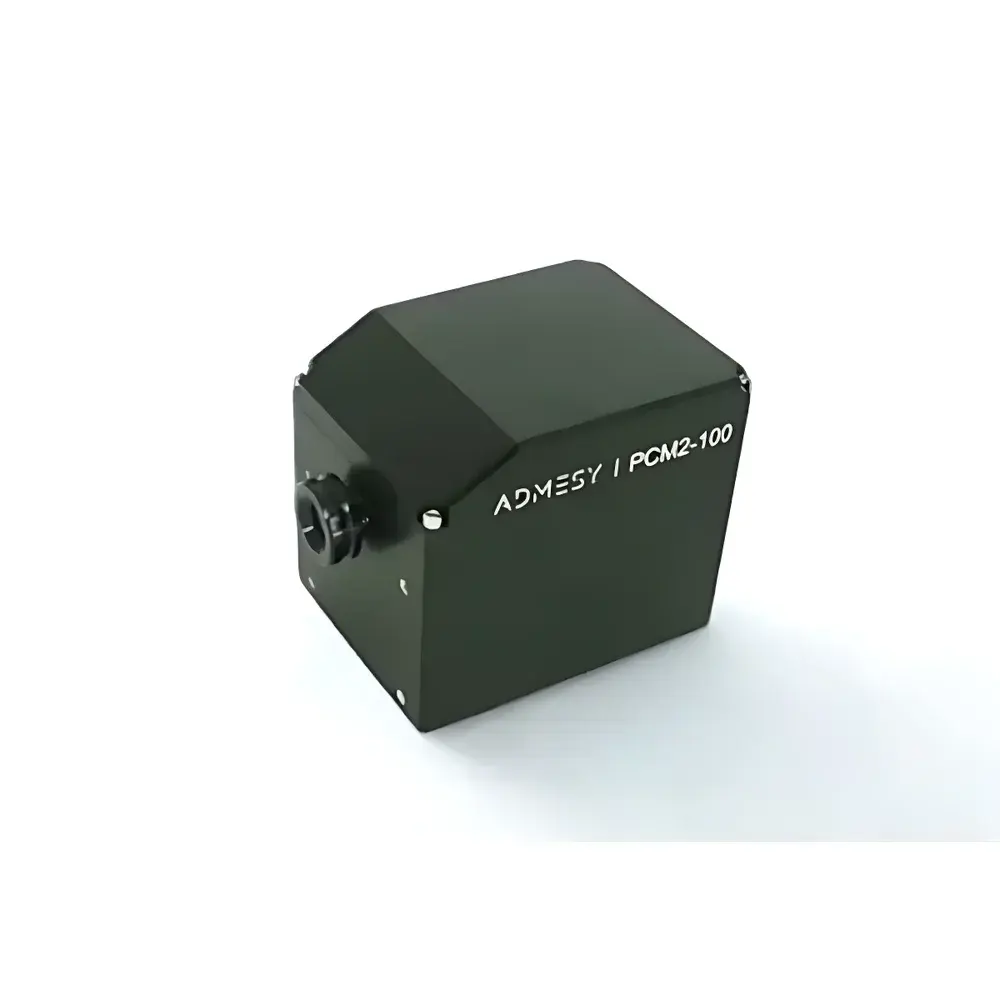
Admesy PCM2-100 Precision Colorimeter
| Brand | Admesy |
|---|---|
| Model | PCM2-100 |
| Measurement Principle | CIE 1931 / CIE 170-2:2015 Tristimulus Matching |
| Luminance Range | 0.0003–15,000 cd/m² (UHL Mode up to 95,000 cd/m²) |
| Chromaticity Accuracy | ±0.003 Δu'v' (typ.) |
| Luminance Accuracy | ±2% (≥0.01 cd/m²), ±5% (0.0003–0.01 cd/m²) |
| Aperture Angle | 5° (±2.5°) |
| Spot Size | 18.7 mm @ 100 mm WD |
| Sampling Rate | Up to 3125 Hz (flicker mode) |
| Interface | USB 2.0 compliant with USBTMC |
| OS Support | Windows, Linux, macOS |
| Software SDK | VISA-compatible (LabVIEW, LabWindows/CVI, Visual Studio) |
| Internal Flicker Calculation | JEITA-compliant, customizable algorithm |
| Mechanical Shutter | Integrated, TTL-controlled |
| Compliance | USBTMC 1.0, CIE S 014-2/E:2016, ISO/CIE 11664-3:2018, IEC 62341-6-3 (OLED display testing) |
Overview
The Admesy PCM2-100 Precision Colorimeter is a high-sensitivity, research-grade optical measurement instrument engineered for photometric and colorimetric characterization of emissive displays—including OLED, microLED, LCD, and quantum-dot panels—under ultra-low luminance conditions. Operating on the fundamental principles of CIE 1931 2° standard observer spectral sensitivity and fully aligned with the updated CIE 170-2:2015 colorimetric framework, the PCM2-100 delivers traceable tristimulus (X, Y, Z) values with calibrated spectral response matching human photopic vision. Its core architecture integrates a thermally stabilized silicon photodiode array with precision interference filters and an integrated mechanical shutter to eliminate dark-current drift and ambient light contamination—critical for sub-millicandela measurements down to 0.0003 cd/m². Designed for integration into automated test benches and R&D labs, the PCM2-100 meets the metrological rigor required for display calibration, flicker analysis, temporal uniformity assessment, and conformance verification against ISO, IEC, and JEITA standards.
Key Features
- Ultra-low luminance capability: validated measurement floor of 0.0003 cd/m² with <±5% uncertainty in near-threshold conditions
- High-speed photometric sampling: configurable acquisition rates up to 3125 Hz for dynamic flicker and temporal stability analysis
- Dual-mode luminance operation: standard range (0.0003–15,000 cd/m²) and Ultra-High-Luminance (UHL) mode extending to 95,000 cd/m² via automatic gain switching
- CIE-compliant optical geometry: fixed 5° field-of-view (±2.5° tolerance) with defined 18.7 mm spot diameter at 100 mm working distance—ensuring repeatable spatial sampling per IEC 61747-7-1
- Onboard JEITA flicker calculation engine: real-time computation of flicker percentage (FP), flicker index (FI), and frequency-domain harmonics without host dependency
- USBTMC 1.0 compliance: enables plug-and-play SCPI command control and IEEE 488.2-style instrumentation interoperability across operating systems
- Embedded MCU with firmware-upgradable architecture: supports custom flicker algorithms, user-defined trigger logic, and asynchronous data buffering
Sample Compatibility & Compliance
The PCM2-100 is optimized for flat-panel emissive sources with Lambertian or near-Lambertian emission profiles. Its 5° acceptance angle ensures compatibility with industry-standard display test geometries defined in ISO 13406-2, IEC 62341-6-3, and VESA DisplayHDR™ validation protocols. The device conforms to photometric traceability requirements outlined in CIE S 014-2/E:2016 (Colorimetry — Part 2: CIE standard illuminants) and ISO/CIE 11664-3:2018 (Colorimetry — Part 3: CIE tristimulus values). All factory calibrations are performed using NIST-traceable reference standards under controlled environmental conditions (23°C ±1°C, RH <60%), with full calibration certificates provided per ISO/IEC 17025-accredited procedures. Mechanical shutter operation satisfies dark-current suppression requirements specified in ASTM E308-22 Annex A4 for low-light photometry.
Software & Data Management
The PCM2-100 operates natively via VISA-compliant drivers, enabling direct integration into LabVIEW, LabWindows/CVI, MATLAB, Python (PyVISA), and Visual Studio environments without proprietary middleware. Admesy provides a comprehensive SDK including SCPI command reference, callback-based event handling, and binary data streaming APIs for high-throughput applications. Raw measurement data—comprising time-stamped XYZ, Yxy, u’v’, CCT, Duv, and flicker metrics—is output in IEEE 754 double-precision format with optional CSV or HDF5 serialization. Audit trails, user-defined metadata tagging, and timestamp synchronization with external triggers support GLP/GMP-aligned workflows. Firmware updates are delivered via signed hex packages with SHA-256 integrity verification, ensuring secure lifecycle management in regulated environments.
Applications
- Display manufacturing QA: pixel-level uniformity mapping, grayscale tracking, and white-point stability validation
- OLED burn-in and aging studies: long-term luminance decay profiling under constant-current drive conditions
- AR/VR microdisplay characterization: near-eye luminance and chromaticity verification at sub-degree angular resolution
- Flicker-sensitive product development: medical monitors, automotive HUDs, and aviation displays requiring JEITA TR-001 or IEEE 1789-2015 compliance
- Research in visual perception: psychophysical experiments requiring calibrated low-luminance stimuli below scotopic threshold
- Calibration transfer between integrating spheres and imaging colorimeters in display metrology labs
FAQ
What is the minimum measurable luminance, and how is accuracy maintained at such low levels?
The PCM2-100 achieves a verified lower limit of 0.0003 cd/m² through thermally stabilized detector electronics, synchronized mechanical shuttering, and multi-point dark-reference compensation. Uncertainty budgets follow CIE TN 006:2021 guidelines for ultra-low-light photometry.
Does the instrument support automated calibration verification against reference standards?
Yes—the built-in shutter enables routine dark-reference acquisition, and the SCPI interface supports scheduled self-check routines with pass/fail logging per ISO/IEC 17025 clause 7.7.
Can the PCM2-100 be used for non-display light sources such as LEDs or laser diodes?
It is optimized for extended-area emissive surfaces; point-source measurements require collimating optics and geometric correction per CIE 127:2007, which is outside the default configuration.
Is firmware update capability available in production environments without interrupting measurement sequences?
Firmware updates are performed offline via bootloader mode; active measurements pause during update but resume automatically upon completion with no configuration loss.
How does the PCM2-100 ensure long-term stability during extended unattended operation?
Internal temperature monitoring feeds back to the ADC offset correction loop, and all critical analog paths undergo periodic zero-gain recalibration—enabling >8-hour continuous drift <±0.5% in Y channel under stable ambient conditions.




