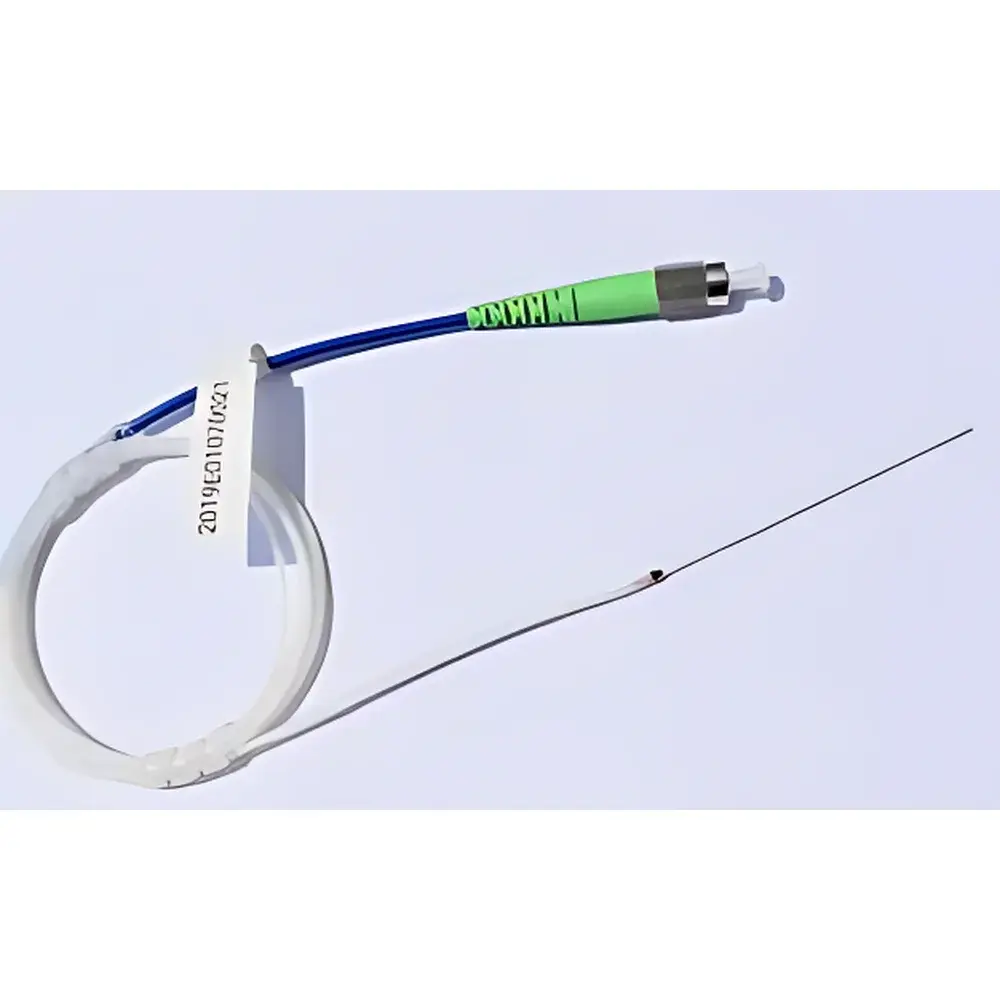
Auniontech Aut-S300 Fiber Bragg Grating (FBG) Temperature Sensor
| Brand | Auniontech |
|---|---|
| Model | Aut-S300 |
| Operating Temperature Range | -40 to 300 °C |
| Accuracy | ±0.5 °C |
| Resolution | 0.1 °C |
| Sensitivity | 10 pm/°C |
| Center Wavelength | 1528–1568 nm (±0.1 nm) |
| Full Width at Half Maximum (FWHM) | <0.3 nm |
| Side Mode Suppression Ratio (SMSR) | >12 dB |
| Peak Reflectivity | >70% |
| Fitting Method | Polynomial Calibration |
| Connector Type | FC/APC |
| Packaging | Ceramic/Metal Hermetic Encapsulation |
| Immunity | EMI/RFI Immune |
| Compliance | Designed for IEC 61757-1, ISO/IEC 17025 traceable calibration protocols |
Overview
The Auniontech Aut-S300 Fiber Bragg Grating (FBG) Temperature Sensor is a passive, wavelength-encoded optical transducer engineered for high-stability, long-term temperature monitoring in electromagnetically hostile, hazardous, or spatially constrained environments. Unlike conventional electronic thermistors or RTDs, the Aut-S300 relies on the physical principle of Bragg wavelength shift: temperature-induced strain and thermo-optic effects alter the periodic refractive index modulation inscribed in the core of a single-mode silica fiber, resulting in a linear, reversible shift of the reflected Bragg wavelength (ΔλB ≈ 10 pm/°C). This intrinsic optical encoding eliminates electrical signal conditioning, galvanic isolation requirements, and grounding complications—making the sensor inherently intrinsically safe, spark-free, and suitable for Class I Division 1 hazardous locations. Its all-dielectric construction and hermetic ceramic/metal packaging ensure structural integrity under thermal cycling, mechanical vibration, and chemical exposure typical in industrial infrastructure.
Key Features
- EMI/RFI immunity: Fully passive optical operation enables deployment near high-voltage busbars, switchgear, and variable-frequency drives without signal corruption.
- Hermetic encapsulation: Dual-material (ceramic + metal) housing mitigates thermal hysteresis and residual stress, ensuring repeatability over ≥10,000 thermal cycles (-40 to 300 °C).
- High optical performance: Narrow spectral linewidth (FWHM 70%) support multiplexing of up to 30+ sensors on a single fiber using standard C-band interrogators.
- Precision calibration: Factory-polynomial fitting (5th-order or higher) compensates for nonlinearity across the full operating range, delivering ±0.5 °C accuracy with 0.1 °C digital resolution.
- Standardized interface: FC/APC connector ensures low back-reflection coupling into interrogation systems compliant with ITU-T G.671 and Telcordia GR-1312-CORE specifications.
Sample Compatibility & Compliance
The Aut-S300 is compatible with all commercial FBG interrogators supporting C-band (1528–1568 nm) scanning or white-light interferometric detection. Its wavelength tolerance (±0.1 nm) and side-mode suppression ratio (>12 dB) meet minimum requirements for dense wavelength-division multiplexing (DWDM) in distributed sensing arrays. The sensor complies with optical safety Class 1 per IEC 60825-1 and is designed to support traceable calibration per ISO/IEC 17025 when used with accredited laboratories. While not certified for ATEX or IECEx out-of-box, its intrinsic safety characteristics—zero power dissipation, no metallic current paths, and non-sparking behavior—enable system-level certification when integrated into appropriately rated enclosures and interrogator subsystems per IEC 60079-11 and IEC 60079-26.
Software & Data Management
Raw wavelength data from the Aut-S300 is acquired via industry-standard communication protocols (TCP/IP, RS-232, or USB-Virtual COM) supported by most FBG interrogation platforms. Auniontech provides calibration coefficient files (.csv or .xml) containing polynomial coefficients, reference wavelengths, and uncertainty budgets for integration into custom SCADA, LabVIEW, or Python-based data acquisition pipelines. All calibration records include metrological traceability to NIST-traceable blackbody references. For regulated environments (e.g., power utility asset monitoring or tunnel fire safety systems), the sensor supports audit-ready data logging with time-stamped wavelength-to-temperature conversion, adhering to principles aligned with FDA 21 CFR Part 11 for electronic records where paired with validated software.
Applications
- High-voltage infrastructure: Continuous hotspot monitoring of cable joints, GIS splices, and transformer windings—immune to partial discharge interference and capacitive coupling.
- Tunnel fire detection: Embedded in concrete linings or mounted on ventilation ducts to enable early-stage thermal anomaly identification before flashover thresholds are reached.
- Energy storage systems: Cell-level temperature profiling in lithium-ion battery racks, where EMI resilience prevents false alarms during rapid charge/discharge transients.
- Aerospace and rail: Structural health monitoring of composite airframes or brake assemblies, leveraging lightweight, embeddable form factor and survivability under shock/vibration per MIL-STD-810H.
- Industrial process control: In-situ temperature verification inside reactor vessels, steam traps, and catalytic converters where corrosion resistance and long-term drift stability are critical.
FAQ
Can the Aut-S300 be embedded directly into concrete or composite materials?
Yes—the sensor’s low-profile, hermetically sealed ceramic/metal package and acrylate-coated fiber lead-in are compatible with embedding during casting or lamination, provided strain relief loops are maintained and epoxy compatibility is verified.
What is the maximum allowable tensile load during installation?
The packaged sensor withstands ≤5 N axial tension; exceeding this may induce parasitic strain and compromise thermal measurement fidelity.
Is recalibration required after field installation?
No—factory polynomial calibration remains valid unless subjected to mechanical shock exceeding 500 g or thermal excursions beyond -40 to 300 °C.
How many Aut-S300 sensors can be multiplexed on one fiber?
Up to 28–32 sensors are reliably addressable in the 1528–1568 nm window using standard 0.8 nm channel spacing and an interrogator with <10 pm wavelength resolution.
Does the sensor meet fire-resistance standards such as EN 50200 or BS 6387?
The bare sensor does not carry flame-retardant cable rating; however, when integrated with LSZH-jacketed fiber and appropriate conduit, full-system compliance is achievable per project-specific fire-test protocols.