
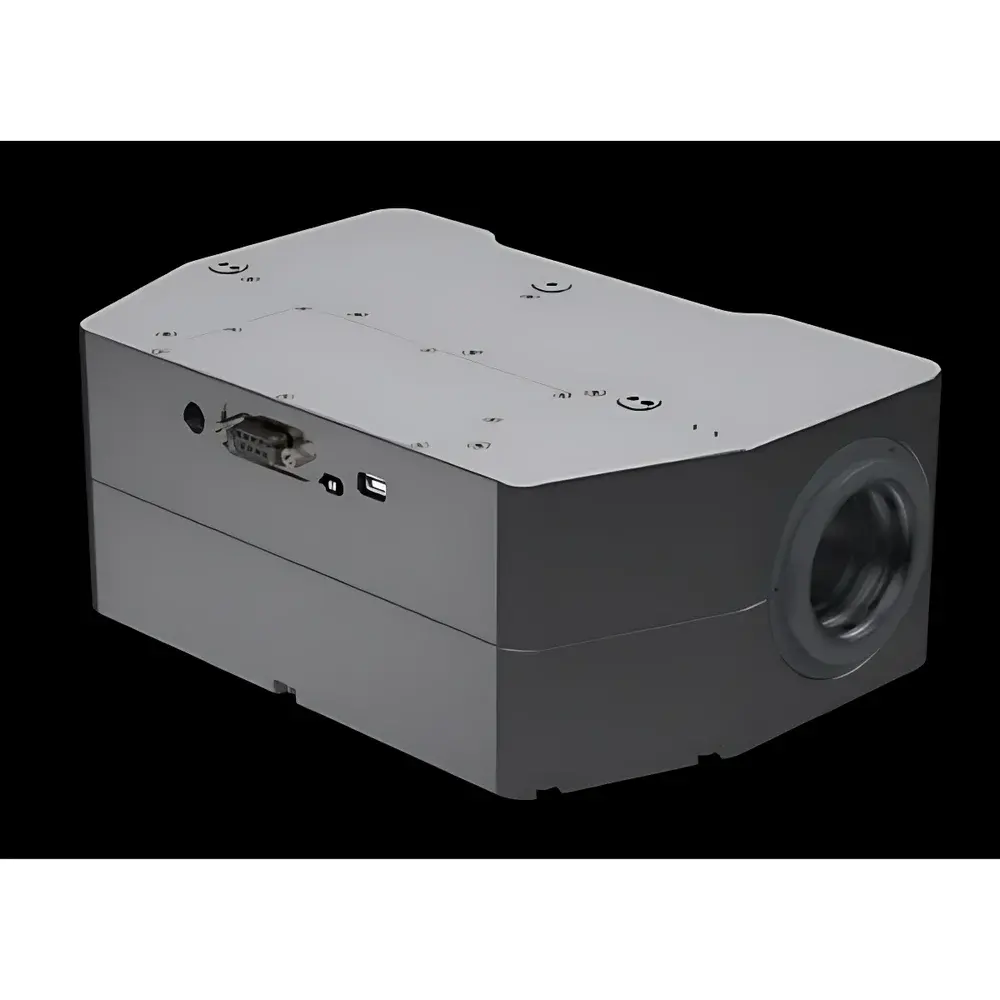
Auniontech Beamera High-Power Motorized Beam Expander
| Brand | Auniontech |
|---|---|
| Origin | Shanghai, China |
| Model | Beamera Motorized Beam Expander |
| Component Type | Optical Element |
| Wavelength Range | 343–1070 nm |
| Magnification Range | 1×–4× (continuous) |
| Max Input Beam Diameter | up to Ø9 mm (wavelength-dependent) |
| Beam Deviation | <200 µrad |
| Lens Material | Fused Silica |
| LIDT | >25 J/cm² @ 1064 nm, 10 ns, 100 Hz |
Overview
The Auniontech Beamera High-Power Motorized Beam Expander is an engineered optical component designed for precision beam scaling in demanding continuous-wave (CW) and pulsed laser systems. Operating on the principle of Galilean or Keplerian beam expansion—implemented via a sliding-lens mechanical architecture—the device enables continuous, stepless magnification from 1× to 4× while preserving beam collimation and wavefront fidelity. Unlike manual or piezoelectric alternatives, its motorized actuation provides repeatable, programmable positioning with sub-microradian angular stability, essential for integration into automated laser processing platforms, ultrafast amplifier chains, and high-repetition-rate scientific setups. The absence of internal foci eliminates thermal lensing risks and ensures safe operation at multi-kilowatt average powers and high peak fluences typical of industrial fiber, disk, and ultrafast solid-state lasers.
Key Features
- Diffraction-limited performance across the full 1×–4× magnification range for input beams ≥ Ø6 mm, validated at critical UV–NIR wavelengths including 343 nm, 355 nm, 515 nm, 532 nm, 1030 nm, and 1064 nm
- Motorized, continuous zoom with integrated divergence compensation—enabling real-time, fine-tuning of output beam divergence without mechanical re-alignment
- Fused silica optics with high-LIDT anti-reflection coatings optimized per wavelength band; certified LIDT values exceed 25 J/cm² @ 1064 nm (10 ns, 100 Hz), 10 J/cm² @ 532 nm, and 5 J/cm² @ 355 nm
- Thermally stable, monolithic housing with kinematic lens mounts minimizing drift under thermal cycling or vibration
- No internal focus design eliminates focal plane exposure, reducing risk of air breakdown, coating damage, or plasma formation in high-peak-power regimes
- Beam pointing stability <200 µrad over full zoom range—critical for alignment-sensitive applications such as interferometry, lithography, and nonlinear frequency conversion
Sample Compatibility & Compliance
The Beamera expander accommodates input beam diameters up to Ø9 mm depending on wavelength and magnification setting (e.g., Ø8 mm at 1× for 1030–1070 nm; Ø6.5 mm at 4× for 515–532 nm). Its fused silica construction meets ISO 10110-3 surface quality standards (scratch-dig 10–5), and AR coatings comply with ISO 9211-3 for environmental durability. The mechanical design conforms to IEC 60825-1:2014 for Class 4 laser product safety integration, and thermal management supports continuous operation in ambient temperatures from 15 °C to 35 °C. While not certified as a standalone medical or aerospace device, it is routinely deployed in systems compliant with FDA 21 CFR Part 11 (when integrated with audit-trail-capable controllers) and adheres to GLP/GMP-aligned installation and calibration documentation practices.
Software & Data Management
The expander interfaces via RS-232 or USB-C (optional EtherCAT) to host motion controllers or OEM system software. Aboard firmware supports absolute position reporting, velocity profiling, and homing routines with ±0.05% repeatability. SDKs are provided for Python, LabVIEW, and C/C++ environments, enabling synchronization with pulse pickers, galvo scanners, or adaptive optics loops. All position and status logs—including timestamped zoom steps, temperature readings, and error flags—are exportable in CSV/JSON format. When integrated into validated manufacturing workflows, the device supports electronic record retention, user-access control, and change history tracking aligned with 21 CFR Part 11 requirements for regulated environments.
Applications
- Laser micromachining: Enables dynamic spot-size optimization for drilling, cutting, and surface structuring across varying material thicknesses and absorption coefficients
- Ultrafast amplifier seeding: Maintains M² <1.1 during expansion of femtosecond pulses, preserving temporal contrast and enabling efficient CPA compression
- Nonlinear optics: Facilitates phase-matching tuning in OPOs and SHG crystals by adjusting beam radius without altering focus position
- Scientific instrumentation: Used in cavity-dumped oscillators, optical parametric amplifiers, and quantum optics testbeds requiring long-term pointing stability and vacuum compatibility (optional mounting flange)
- Defense & aerospace: Integrated into directed-energy prototypes and LIDAR transceivers where ruggedness, low SWaP-C, and radiation-tolerant materials are prioritized
FAQ
What is the maximum average power this beam expander can handle?
The device is rated for average powers up to 500 W when actively cooled (optional water-cooled mount available); uncooled operation is qualified up to 200 W at 1064 nm with appropriate beam homogenization.
Is vacuum-compatible mounting available?
Yes—custom CF-35 or KF-40 flange variants with outgassing-tested adhesives and stainless-steel hardware are offered upon request.
Can the expander be controlled via LabVIEW or Python?
Yes—full API documentation, example scripts, and driver packages are included with every unit.
Does it support bidirectional communication for closed-loop position verification?
Yes—integrated encoder feedback provides real-time positional confirmation with 0.01× magnification resolution.
Are custom AR coatings available for non-standard wavelengths?
Yes—multi-layer coatings can be specified for wavelengths between 250 nm and 2000 nm, subject to minimum order quantity and lead time validation.




