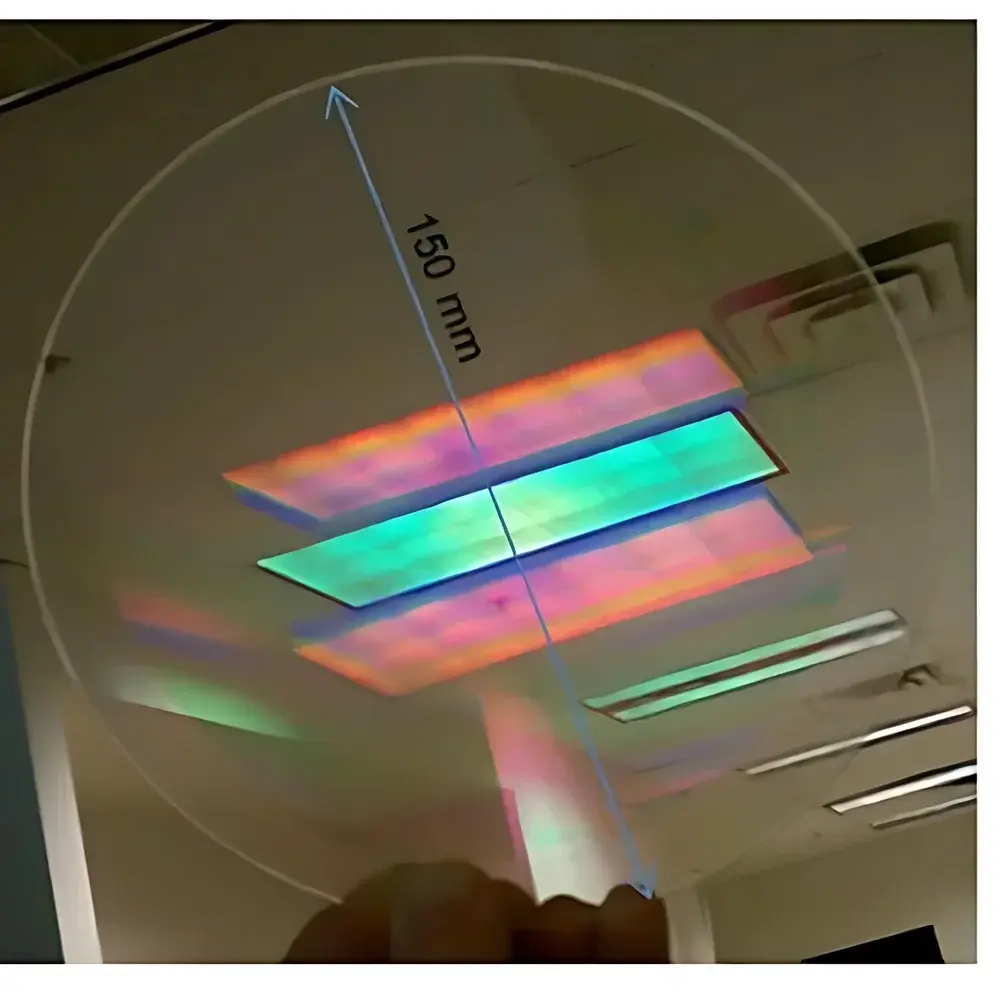
Meadowlark Optics LCPG-995 Series Liquid Crystal Polarization Grating (Active/Passive, High-Efficiency Beam Steering Element)
| Brand | Meadowlark Optics |
|---|---|
| Origin | USA |
| Type | Imported |
| Model | LCPG Beam Deflector |
| Design Wavelength | 458–1550 nm (customizable to MWIR/LWIR) |
| Clear Aperture | up to 200 mm |
| Diffraction Efficiency | >99.5% (single-element, circular polarization) |
| Transmission | >95% |
| Angular Deflection Range | ±50° |
| Angular Resolution | 0.01 mrad (with OPA control) |
| Switching Speed | <4 µs (fast axis), <3 ms (slow axis) |
| Damage Threshold | >1 J/cm² |
| Grating Period | Spatially varying birefringence architecture |
| Compliance | RoHS, ISO 10110-7 surface quality, MIL-STD-810G environmental ruggedness (upon request) |
Overview
The Meadowlark Optics LCPG-995 Series Liquid Crystal Polarization Grating is a solid-state, non-mechanical diffractive optical element engineered for ultra-high-efficiency beam steering and polarization-sensitive wavefront manipulation. Based on the geometric phase (Pancharatnam–Berry phase) principle, the LCPG leverages spatially modulated liquid crystal alignment to induce a helical phase delay across the aperture—enabling near-unity diffraction efficiency (>99.5%) into the ±1st diffraction orders for incident circularly polarized light. Unlike conventional blazed gratings or MEMS-based scanners, the LCPG operates without inertia, wear, or acoustic noise, making it uniquely suited for high-repetition-rate, precision optical systems where reliability, speed, and SWaP (Size, Weight, and Power) constraints are critical. Its operation is fundamentally polarization-selective: left-handed circular polarization (LCP) is diffracted into the +1st order, while right-handed circular polarization (RCP) is directed into the −1st order—enabling deterministic, bidirectional beam control via polarization state switching.
Key Features
- Diffraction efficiency exceeding 99.5% for circularly polarized input at design wavelengths (458–1550 nm); customizable variants available for mid-wave and long-wave infrared (3–12 µm)
- Clear aperture scalable from 10 mm × 10 mm to 200 mm × 200 mm, supporting large-diameter laser beams and high-energy applications
- Sub-microsecond polarization switching capability when integrated with fast electro-optic half-wave retarders (e.g., <4 µs rise time)
- Wide angular deflection range of ±50° with angular resolution down to 0.01 mrad (achievable using multi-stage LCPG stacks and precision polarization control)
- Optical damage threshold >1 J/cm² (10 ns pulse, 1064 nm, 10 Hz), validated per ISO 21254-1
- Transmittance >95% per element; minimal absorption and thermal lensing under CW or pulsed illumination
- Low power consumption (<100 mW per cm² active area), passive thermal stability, and compatibility with vacuum and low-outgassing environments
- Robust architecture compliant with ISO 10110-7 surface quality standards and optionally qualified to MIL-STD-810G for shock/vibration resilience
Sample Compatibility & Compliance
The LCPG-995 is compatible with continuous-wave (CW) and pulsed laser sources across UV–NIR–SWIR spectral bands. It maintains high fidelity under Gaussian, top-hat, and multimode beam profiles, provided input polarization purity exceeds 99.5% (measured via Stokes parameter analysis). When deployed in regulated environments—including aerospace avionics, medical imaging platforms, or GMP-aligned optical manufacturing lines—the device supports full traceability documentation and can be supplied with calibration certificates aligned to NIST-traceable polarization metrology. For FDA-regulated optical instrumentation (e.g., ophthalmic coherence tomography or flow cytometry systems), optional configuration includes 21 CFR Part 11–compliant audit trails when paired with Meadowlark’s certified control firmware. All units undergo rigorous environmental screening per IEC 60068-2 series, including thermal cycling (−40°C to +85°C), humidity exposure (85% RH, 1000 h), and particulate cleanliness verification (ISO Class 5 cleanroom assembly).
Software & Data Management
Meadowlark provides a vendor-agnostic SDK (C/C++, Python, MATLAB APIs) enabling direct integration with third-party motion controllers, DAQ systems, and real-time operating environments (e.g., NI VeriStand, dSPACE SCALEXIO). The SDK supports synchronized polarization switching, multi-element grating sequencing, and closed-loop feedback via external polarimeters or quadrant photodiodes. For GLP/GMP compliance, optional firmware packages include timestamped event logging, user-access-level permissions, and electronic signature support—fully auditable per ALCOA+ principles. Data export conforms to HDF5 and CSV formats, preserving metadata such as wavelength, incident angle, polarization ellipticity, and thermal drift compensation coefficients. Remote diagnostics and over-the-air firmware updates are supported via TLS-secured Ethernet or RS-422 interfaces.
Applications
- Coherent Doppler Wind Lidar: Enables single-aperture, multi-line-of-sight (LOS) scanning for 3D wind vector reconstruction—replacing gimbaled telescopes and reducing SWaP by >60% versus mechanical alternatives
- Automotive Flash LiDAR & ADAS: Provides sub-10 µs beam reconfiguration for high-SNR, wide-field-of-view illumination without moving parts—critical for ISO 26262 ASIL-B functional safety architectures
- Multi-Photon Microscopy: Paired with LC-based polarization rotators, enables axial focal stepping 500 µm depth range—supporting volumetric neural activity mapping at millisecond temporal resolution
- Free-Space Optical Communications: Serves as non-mechanical coarse pointing, acquisition, and tracking (PAT) element for GEO/MEO satellite links, meeting ITU-R F.1488 pointing stability requirements
- Time-of-Flight (ToF) 3D Imaging: Enhances SNR and angular resolution by dynamically narrowing and scanning the illumination cone—demonstrated with commercial ToF sensors to extend effective range by 3× while maintaining >1 MP equivalent resolution
- Quantum Optics Platforms: Used in polarization-encoded qubit routing, Bell-state analyzers, and adaptive quantum walk implementations requiring deterministic, low-loss path selection
FAQ
What is the fundamental physical principle behind the LCPG’s operation?
The LCPG exploits the Pancharatnam–Berry geometric phase, generated by spatially varying liquid crystal director orientation. This imparts a spin-to-orbital angular momentum conversion, resulting in polarization-dependent diffraction without absorption or dispersion penalties.
Can the LCPG operate with linearly polarized input light?
Yes—when preceded by a broadband quarter-wave plate, linear polarization is converted to circular polarization, enabling full utilization of the grating’s diffraction efficiency and directionality.
Is thermal drift compensated in high-stability applications?
Standard units include passive thermal expansion matching; active temperature stabilization (±0.1°C) and real-time phase calibration are available as OEM options.
How is alignment verified during system integration?
Each unit ships with interferometrically measured wavefront error maps (Zernike coefficients) and calibrated polarization extinction ratios (PER >30 dB), traceable to NIST SRM 2241.
Are custom designs available for non-standard wavelengths or apertures?
Yes—Meadowlark offers full custom engineering services, including MWIR/LWIR LCPGs (3–12 µm), curved-substrate variants, and hybrid LCPG/lens architectures with integrated focus tuning.