
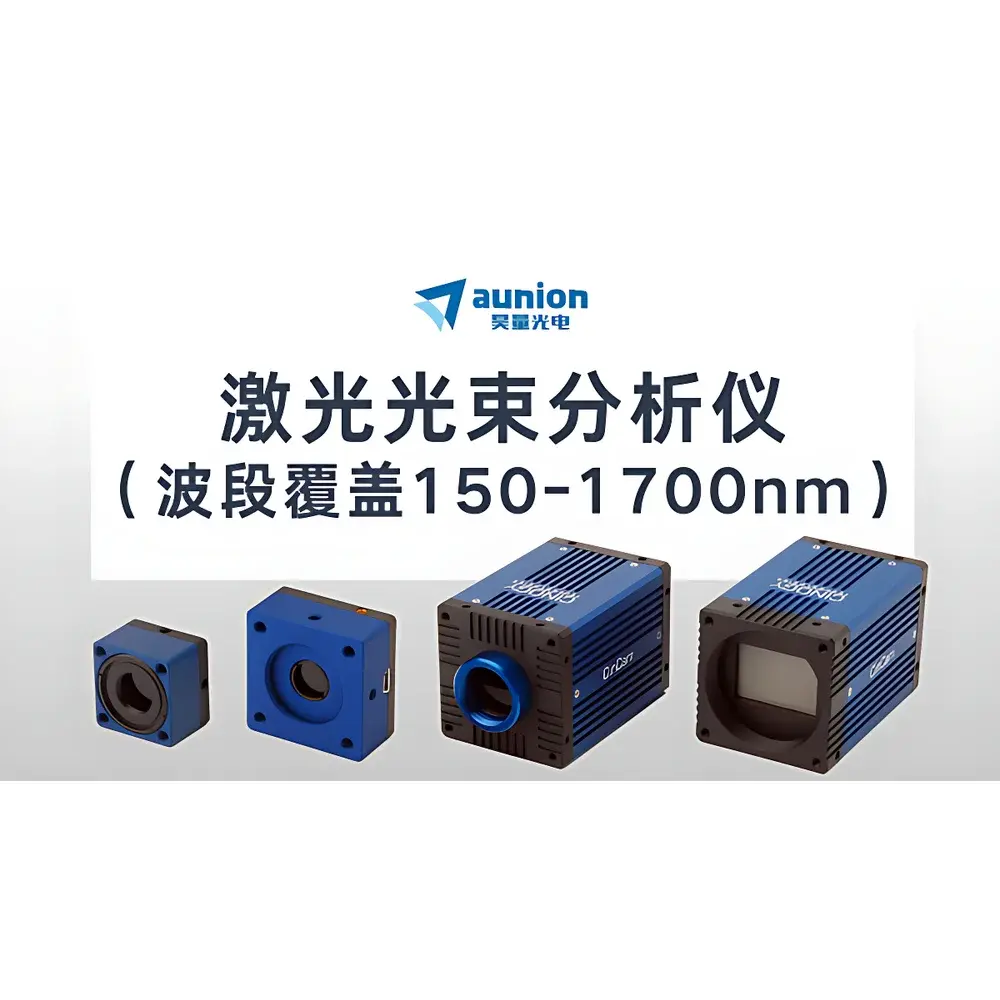
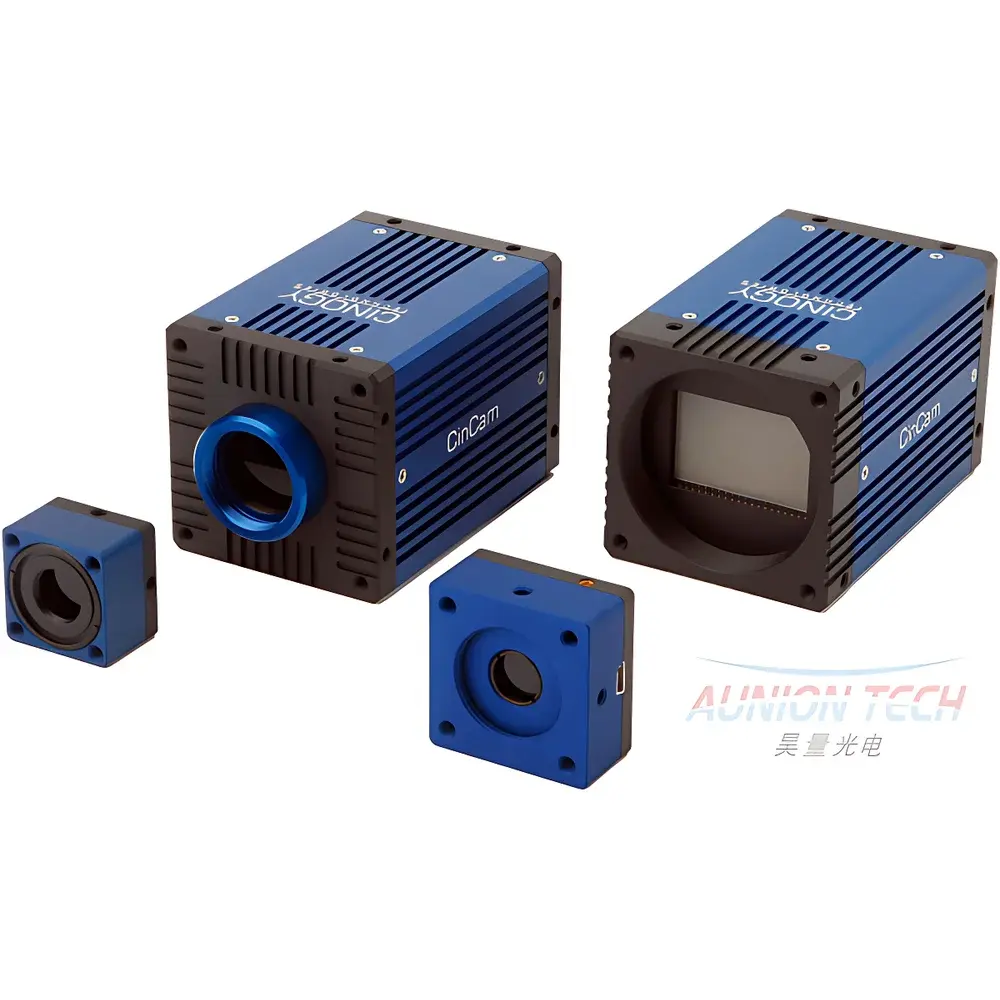
Cinogy CinCam UV-NIR Beam Profiler (150–1700 nm)
| Brand | Cinogy |
|---|---|
| Origin | Germany |
| Model | UV_NIR_beam_profiler |
| Sensor Types | CMOS / CCD / InGaAs |
| Spectral Range | 150–1700 nm |
| Interface | USB 2.0/3.0, FireWire 1394b, GigE |
| Mount | C-Mount / F-Mount |
| Cooling | Passive air-cooled (CCD), TE-cooled (InGaAs) |
| Software | RayCi Lite / Standard / Pro |
Overview
The Cinogy CinCam UV-NIR Beam Profiler (150–1700 nm) is a high-precision, multi-sensor optical beam characterization system engineered for quantitative spatial intensity profiling of continuous-wave (CW) and pulsed laser beams across the ultraviolet, visible, and near-infrared spectral domains. Unlike generic imaging sensors, the CinCam platform integrates purpose-built detectors—CMOS, CCD, and InGaAs—with proprietary optical coatings, pixel-level quantum efficiency optimization, and wavelength-specific calibration protocols to ensure traceable, repeatable beam parameter extraction in accordance with ISO 11146-1:2019 (lasers and laser-related equipment — test methods for laser beam parameters). Its core measurement principle relies on direct photon-to-electron conversion followed by centroid-based and second-moment analysis (M², D4σ, knife-edge equivalent, ellipticity, beam propagation ratio) within a calibrated radiometric framework. The system supports both single-shot pulse capture and real-time streaming at frame rates up to 100 Hz (USB 3.0 CMOS variants), enabling dynamic monitoring of thermal drift, mode instability, or alignment-induced aberrations in industrial laser processing, ultrafast optics labs, and semiconductor lithography R&D environments.
Key Features
- Multi-spectral detector architecture: Selectable CMOS (150–1320 nm), CCD (150–1150 nm + optional 1470–1605 nm bands), and TE-cooled InGaAs (900–1800 nm) sensor modules — each factory-calibrated for absolute irradiance response per wavelength band
- Sub-5 µm pixel pitch options (down to 2.2 µm) enabling diffraction-limited resolution for beams as small as ~10 µm (1/e²) without magnification
- C/F-mount mechanical interface standard across all models, supporting seamless integration of UV phosphor converters (e.g., for 150–200 nm), IR upconversion optics, ND filters, and beam expanders without optical realignment
- RayCi software suite with three tiers (Lite, Standard, Pro) offering ISO-compliant beam parameter reporting, temporal averaging, background subtraction, and user-defined ROI masking — compliant with FDA 21 CFR Part 11 audit trail requirements in Pro version
- Ruggedized aluminum housing with passive thermal management (CCD/CMOS) or stabilized TEC cooling (InGaAs) ensuring <±0.5°C detector temperature control over 8-hour continuous operation
Sample Compatibility & Compliance
The CinCam UV-NIR Beam Profiler accommodates free-space collimated or focused beams from 10 µm to >20 mm diameter (depending on sensor format), including Gaussian, multimode, top-hat, and structured beams generated by fiber lasers, DPSS systems, OPOs, and excimer sources. All detectors undergo individual NIST-traceable responsivity calibration at 12 discrete wavelengths across the 150–1700 nm range, with spectral interpolation validated per ISO/IEC 17025:2017. The system meets CE marking requirements for electromagnetic compatibility (EN 61326-1) and safety (EN 61010-1), and supports GLP/GMP workflows via RayCi Pro’s electronic signature, version-controlled report generation, and secure user role management.
Software & Data Management
RayCi software provides native support for Windows 10/11 (64-bit) and operates with deterministic latency under real-time acquisition modes. Data export formats include CSV (ASCII), HDF5 (for time-series beam evolution), and TIFF (16-bit linear). The Pro edition implements full 21 CFR Part 11 compliance: electronic signatures with PKI certificate binding, immutable audit logs tracking every parameter change, and encrypted database storage. Batch analysis scripts (Python API included) enable automated M² mapping across focal planes, while live FFT overlay aids in identifying spatial frequency artifacts induced by optics contamination or misalignment.
Applications
- Quantitative M² measurement of UV excimer (193 nm, 248 nm) and deep-UV laser sources used in photolithography tool qualification
- Real-time monitoring of beam pointing stability and mode hop dynamics in telecom-band DFB lasers (1310/1550 nm) and quantum cascade lasers
- Characterization of ultrafast Ti:sapphire oscillator output (700–1000 nm) and parametric amplifier idler beams (1200–1600 nm)
- Validation of beam homogenizers and diffractive optical elements (DOEs) in laser material processing lines (e.g., battery electrode annealing at 1070 nm)
- Alignment verification of multi-wavelength optical parametric amplifiers requiring simultaneous profiling at signal, idler, and pump wavelengths
FAQ
What spectral calibration standards are applied to the UV-NIR sensors?
Each sensor module is calibrated against NIST-traceable tungsten halogen and deuterium lamp sources at 12 reference wavelengths; calibration certificates include uncertainty budgets per ISO/IEC 17025.
Can the system measure pulsed lasers with repetition rates above 1 MHz?
Yes — when operated in external trigger mode with hardware synchronization (TTL input), the CMOS-1204 and InGaAs-640 models support single-pulse capture at up to 2 MHz PRF, limited only by detector reset time and host PC buffer throughput.
Is vacuum-compatible operation supported for EUV applications?
No — the current CinCam series is rated for ambient air or dry nitrogen purge only; vacuum-rated variants require custom engineering and are available under Cinogy’s OEM program.
How is pixel non-uniformity corrected during acquisition?
RayCi applies factory-measured flat-field and dark-current maps in real time; users may also acquire custom reference frames for in-situ correction under variable thermal or illumination conditions.
Does the system comply with laser safety standards for Class 4 laser environments?
The profiler itself carries IEC 60825-1:2014 Class 1 classification when used with appropriate beam attenuation; integration into interlocked enclosures is required for direct exposure to Class 4 source levels.




