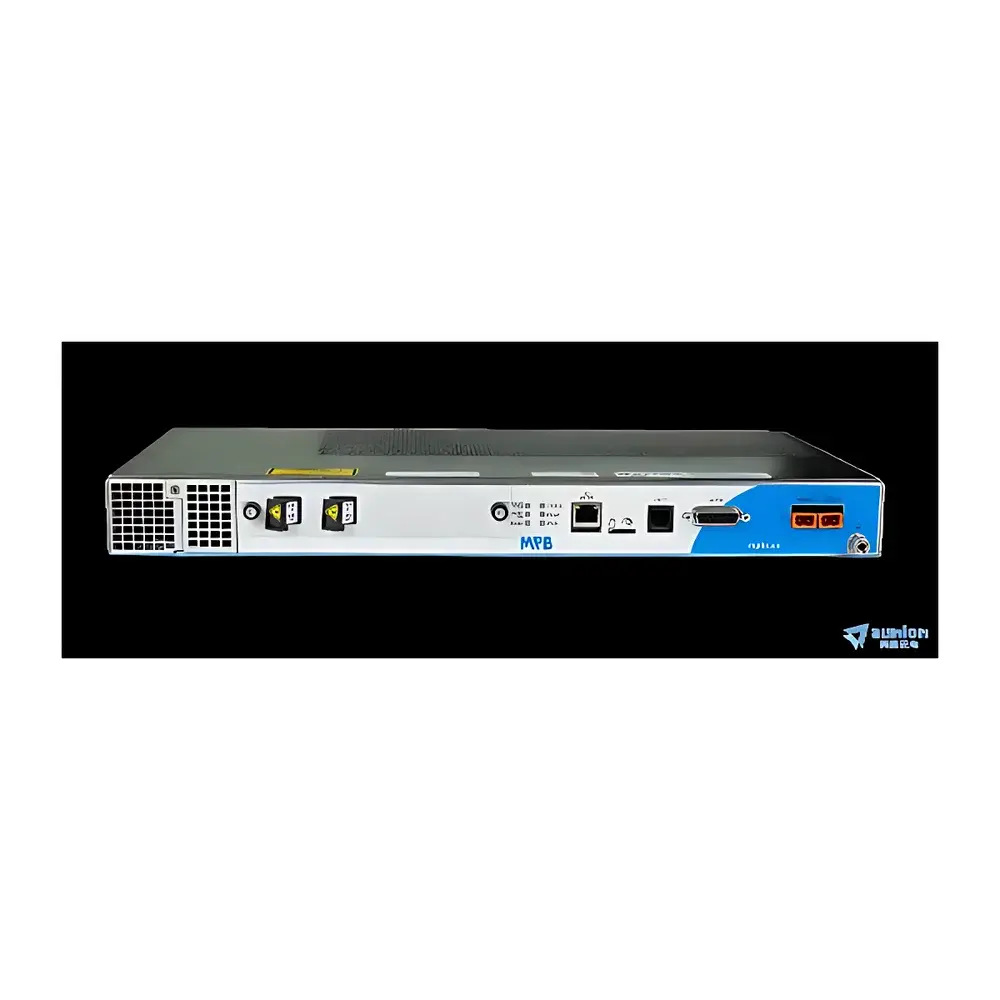
MPBC VERSA2 Wavelength Converter and EDFA Optical Amplifier
| Brand | MPBC |
|---|---|
| Country of Origin | Canada |
| Model | MPBC VERSA2 |
| Data Rate | up to 10.7 Gb/s |
| Input Wavelength Range (Tributary) | 1260–1620 nm |
| Line Output Wavelength (C-band) | 1529–1565 nm |
| Receiver Sensitivity | −49 dBm (BER = 1×10⁻¹⁰) |
| Max Output Power (EDFA) | +21 dBm |
| Noise Figure (Preamp) | ≤3.7 dB |
| Gain Flatness (Multi-channel) | ≤1.5 dB |
| Form Factor | 1U rack-mountable |
| Management Interface | NEM2 card with web-based GUI, CLI, SNMP v3, and NETCONF API |
| Compliance | ITU-T G.698.2, G.692, G.957, Telcordia GR-1312-CORE, RoHS, CE |
Overview
The MPBC VERSA2 Wavelength Converter and EDFA Optical Amplifier is a dual-function, carrier-grade photonic subsystem engineered for resilient, protocol-transparent operation in metro, regional, and long-haul optical transport networks. Built upon MPBC’s proprietary erbium-doped fiber amplifier (EDFA) architecture and integrated wavelength conversion engine, the VERSA2 implements optical-electrical-optical (OEO) conversion for client-side 1310 nm signals—translating them into standardized C-band DWDM wavelengths (1529–1565 nm, ITU-T G.692 grid compliant)—while simultaneously providing high-fidelity amplification across single- or multi-channel configurations. Its core measurement and control principle relies on precision pump-laser–driven erbium gain media combined with thermally stabilized tunable filters and low-noise transimpedance receivers. Designed explicitly for utility-grade infrastructure—including OPGW (Optical Ground Wire) deployments—the system operates reliably under extreme environmental conditions (−40 °C to +70 °C ambient, 95% RH non-condensing), meeting stringent requirements for power utility communications governed by IEC 61850-3 and IEEE 1646.
Key Features
- Integrated dual-mode functionality: independent or co-packaged wavelength conversion and EDFA amplification within a single 1U chassis
- Protocol-agnostic signal handling: supports SDH/SONET (STM-1 to STM-64), Gigabit Ethernet (1.25 Gb/s), 10G Ethernet (10.3/10.7/11.1 Gb/s), and OTN (OTU2/OTU2e)
- OSC (Optical Supervisory Channel) processing: converts 1510 nm CWDM OSC to defined C-band ITU channels (e.g., CH15 @ 1565.5 nm) and back, enabling end-to-end management plane continuity
- High-sensitivity input receivers: −49 dBm minimum sensitivity at BER = 1×10⁻¹⁰ for 155 Mb/s STM-1; scalable down to −22 dBm for 10.7 Gb/s line rates
- Flexible amplification topology: selectable booster (+15 to +21 dBm), pre-amplifier (NF ≤3.7 dB), or hybrid configurations with optional ASE filtering (narrowband/broadband)
- Embedded NEM2 management card: delivers secure, standards-compliant interface stack—HTTPS/TLS web GUI, SSHv2 CLI, SNMPv3 traps/informs, and YANG-based NETCONF over TLS
- Low-power, thermally optimized design: <25 W typical consumption; fanless convection cooling for silent, maintenance-free operation in sealed enclosures
Sample Compatibility & Compliance
The VERSA2 interfaces seamlessly with legacy and next-generation transport equipment via standardized LC/PC optical connectors and industry-aligned electrical signaling. It maintains full interoperability with third-party DWDM multiplexers, ROADMs, and OTDR test sets when configured per ITU-T G.698.2 (application-specific DWDM devices) and G.957 (optical interface parameters for equipment). For utility applications, the unit complies with IEC 61000-4 immunity standards (ESD, EFT, surge), IEC 60068-2 environmental testing protocols, and meets FCC Part 15 Subpart B and CE RED Directive requirements. Firmware and configuration logs support audit-ready GLP/GMP traceability through configurable syslog forwarding and local storage with timestamped event logging—fully aligned with FDA 21 CFR Part 11 electronic record controls when deployed in regulated telecom infrastructure.
Software & Data Management
Management is centralized via the embedded NEM2 interface card, which provides role-based access control (RBAC), certificate-based authentication, and encrypted session persistence. The web GUI features real-time optical power monitoring (input/output per port), gain tracking, pump current telemetry, and temperature profiling across critical thermal zones. All configuration changes are versioned and logged with user ID, timestamp, and change delta. SNMP MIBs include full support for RFC 3418 (system group), RFC 2863 (interfaces), and MPBC-private MIBs covering laser bias, ASE noise floor, and OSC channel lock status. NETCONF operations enable automated provisioning using vendor-neutral YANG models (draft-ietf-ccamp-optical-impairment-yang-03 compatible), allowing integration into ONAP, Cisco NSO, or Red Hat Ansible workflows without proprietary tooling dependencies.
Applications
The VERSA2 is purpose-built for mission-critical optical layer augmentation in electric power transmission networks—particularly those leveraging OPGW cable infrastructure. In Siberian substation interconnects, it extends reach beyond 120 km without regeneration while maintaining STM-16 timing jitter below 0.5 UI. In desert deployments across GCC utilities, its passive thermal design eliminates forced-air failure points, sustaining stable gain flatness (65% versus discrete solutions. Beyond utilities, the platform serves as a modular building block in open optical line systems (OLS), supporting disaggregated architectures compliant with Open ROADM MSA specifications.
FAQ
What data rates does the VERSA2 support for wavelength conversion?
The VERSA2 supports client-side data rates from 155 Mb/s (STM-1) up to 11.1 Gb/s (OTU2e), including 1.25 Gb/s (GbE), 2.488 Gb/s (STM-16), 9.953 Gb/s (10G-FC), and 10.709 Gb/s (OTU2).
Can the OSC conversion function operate independently of the main wavelength converter?
Yes—the OSC path is physically and logically isolated; it can be enabled/disabled via CLI or GUI without affecting tributary signal processing.
Is external calibration required for gain accuracy over temperature?
No—gain stabilization is achieved through closed-loop pump current control and internal reference photodiodes; factory calibration remains valid across the full operating temperature range.
Does the VERSA2 support automatic power reduction (APR) during fiber break events?
Yes—integrated safety logic triggers immediate pump shutdown upon loss-of-input detection, complying with IEC 60825-1 Class 1M laser safety requirements.
How is firmware updated in a live network without service interruption?
Firmware updates are performed via hitless dual-image activation: the standby image is loaded and verified, then activated on reboot with <500 ms control-plane switchover and zero data-plane disruption.