
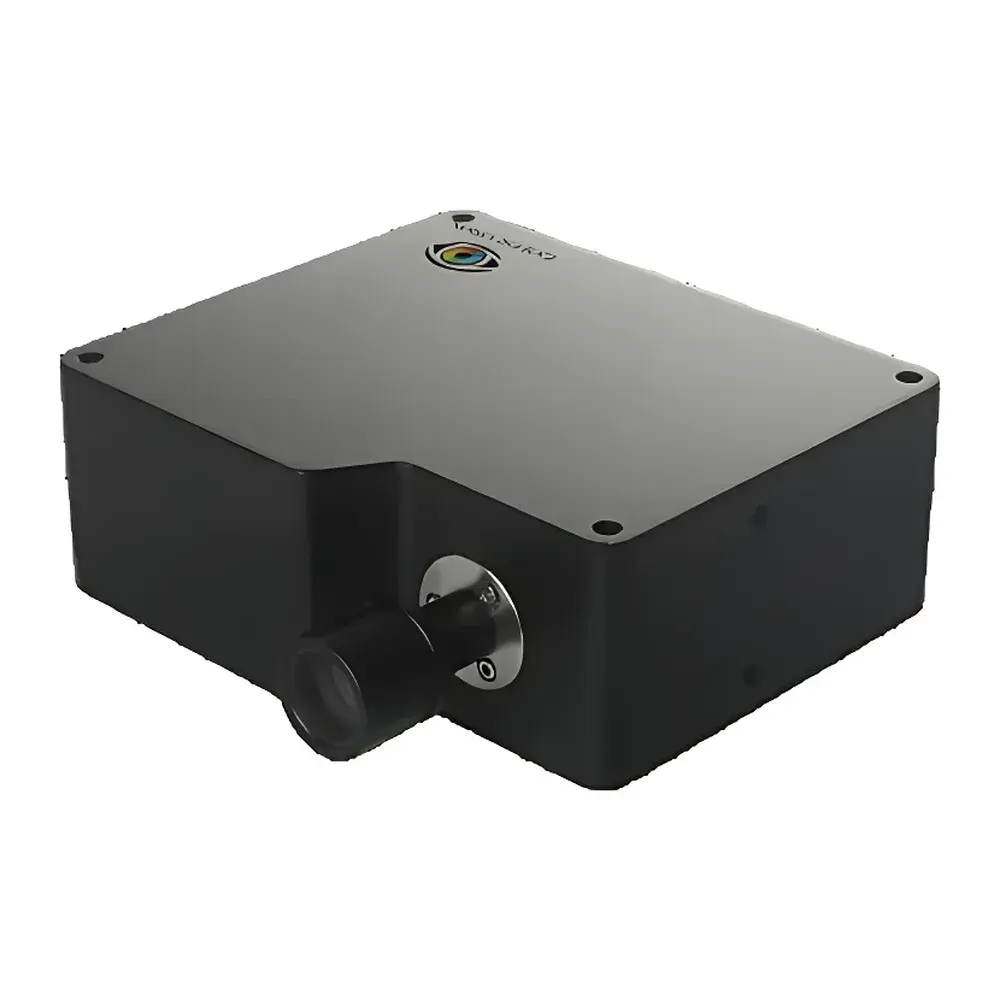
AunionTech AUT SP-100 Spectroradiometric Luminance and Colorimeter
| Brand | AunionTech |
|---|---|
| Origin | Shanghai, China |
| Model | AUT SP-100 |
| Spectral Range | 380–780 nm |
| Detector | Hamamatsu 2048-pixel linear CCD array |
| Calibration Traceability | NIST/NIM-traceable |
| Luminance Accuracy (at 100 cd/m²) | ±2% |
| Chromaticity Accuracy (at 100 cd/m²) | ±0.0015 Δu'v' |
| Measurement Modes | Contact and non-contact |
| Auto-zero & auto-integration | Yes |
| Trigger Options | Software, TTL, edge, timer |
| Optical Design | Holographic flat-field concave grating |
Overview
The AunionTech AUT SP-100 Spectroradiometric Luminance and Colorimeter is a compact, high-fidelity optical measurement instrument engineered for precision photometric and colorimetric characterization of self-luminous and reflective displays. Unlike filter-based tristimulus colorimeters, the AUT SP-100 employs a spectroradiometric architecture—capturing full spectral power distribution (SPD) across 380–780 nm using a Hamamatsu 2048-pixel linear CCD array coupled with a holographic flat-field concave grating. This design enables fundamental CIE 1931 XYZ tristimulus value computation via spectral integration, ensuring metrological rigor and minimizing metamerism-related uncertainty. The instrument is specifically optimized for display manufacturing environments where traceable, repeatable, and cross-platform compatible measurements are required—particularly for OLED, LCD, and microLED panels, backlight units (BLUs), and aging validation protocols. Its physical footprint and dual-mode (contact/non-contact) probe interface support both inline production testing and R&D lab deployment.
Key Features
- Spectroradiometric core: Full 380–780 nm spectral acquisition with <1 nm effective resolution (FWHM), enabling accurate calculation of luminance (cd/m²), chromaticity coordinates (CIE u’v’, x,y), CCT, Duv, and dominant wavelength.
- NIST/NIM-traceable calibration: Factory calibration performed against primary standards; optional absolute spectral response matching available to align measurement output with reference instruments including Konica Minolta CS-2000, PR-730, and Topcon SR-3—ensuring data continuity across multi-vendor test benches.
- Dual measurement modality: Interchangeable contact probe (for uniformity mapping and small-area pixel-level evaluation) and non-contact lens attachment (for standoff distances up to 500 mm), both maintaining identical spectral responsivity.
- Adaptive signal conditioning: Real-time auto-zero compensation and auto-integration time selection based on input irradiance level—minimizing operator dependency and optimizing SNR across brightness ranges from 0.01 to 10⁶ cd/m².
- Industrial-grade trigger architecture: Supports TTL-level hardware triggering, software command initiation, edge-triggered capture, and programmable timer intervals—enabling seamless integration into automated test stations and PLC-controlled assembly lines.
Sample Compatibility & Compliance
The AUT SP-100 is validated for quantitative assessment of emissive and transmissive display technologies including RGB OLED, WOLED, QD-OLED, TFT-LCD with LED/Mini-LED backlights, and direct-view microLED arrays. It meets essential requirements for photometric compliance testing per IEC 62341-6-3 (OLED displays), ISO 13406-2 (visual ergonomics), and VESA DisplayHDR™ verification workflows. While not certified as a Class I or II photometer per CIE S 023/E:2020, its spectral response function adheres to CIE 1931 V(λ) and y(λ) luminous efficiency functions within ±1.5% f1’ error—verified through independent third-party spectral mismatch analysis. Instrument firmware supports audit-ready logging aligned with GLP/GMP principles, including timestamped calibration history, user access logs, and configuration versioning.
Software & Data Management
The included AunionTech SpectrumView™ software provides a deterministic, low-latency interface for real-time spectral visualization, batch measurement scripting, and export of raw SPD data in CSV and JDX formats. All computed photometric values—including Y, x, y, u’v’, CCT, Duv, and gamut area—are stored with metadata (integration time, aperture setting, calibration ID, operator tag). The software supports FDA 21 CFR Part 11-compliant operation when deployed with optional electronic signature modules and role-based access control. Raw spectral datasets are fully interoperable with industry-standard analysis platforms such as MATLAB, Python (via NumPy/Pandas), and LightTools for custom spectral modeling and tolerance band analysis.
Applications
- Production-line luminance and chromaticity verification of display modules prior to final assembly.
- Backlight unit (BLU) uniformity mapping—including hot-spot detection and edge-lit panel gradient analysis.
- White point calibration and dynamic white balance adjustment across grayscale levels.
- Accelerated aging studies: Tracking chromaticity drift (Δu’v’) and luminance decay over time under constant current/voltage stress.
- Color gamut validation against sRGB, DCI-P3, and Rec. 2020 targets using CIE 1976 u’v’ chromaticity diagrams.
- Research-grade spectral characterization of novel emissive materials, phosphors, and quantum dot films.
FAQ
Is the AUT SP-100 suitable for measuring ultra-low-brightness microLED subpixels?
Yes—the instrument’s auto-integration algorithm and low-noise CCD architecture enable stable spectral acquisition down to 0.01 cd/m², provided appropriate optical attenuation and dark-current compensation are applied.
Can calibration data be transferred between multiple AUT SP-100 units?
Yes—absolute spectral response files (.spc) generated during factory or field recalibration are portable across devices of the same model revision, supporting inter-unit measurement equivalence.
Does the system support real-time spectral streaming to external DAQ systems?
Yes—via TCP/IP socket interface with documented ASCII command protocol; spectral frames can be streamed at up to 10 Hz (depending on integration time and host bandwidth).
What is the recommended recalibration interval under continuous production use?
AunionTech recommends annual recalibration against traceable standards; however, internal verification using supplied reference LEDs should be performed daily or per shift in high-accuracy applications.
Is the contact probe interchangeable with third-party fiber-optic adapters?
No—the contact probe uses a proprietary mechanical and optical coupling interface; only AunionTech-certified accessories maintain spectral fidelity and geometric alignment specifications.




