
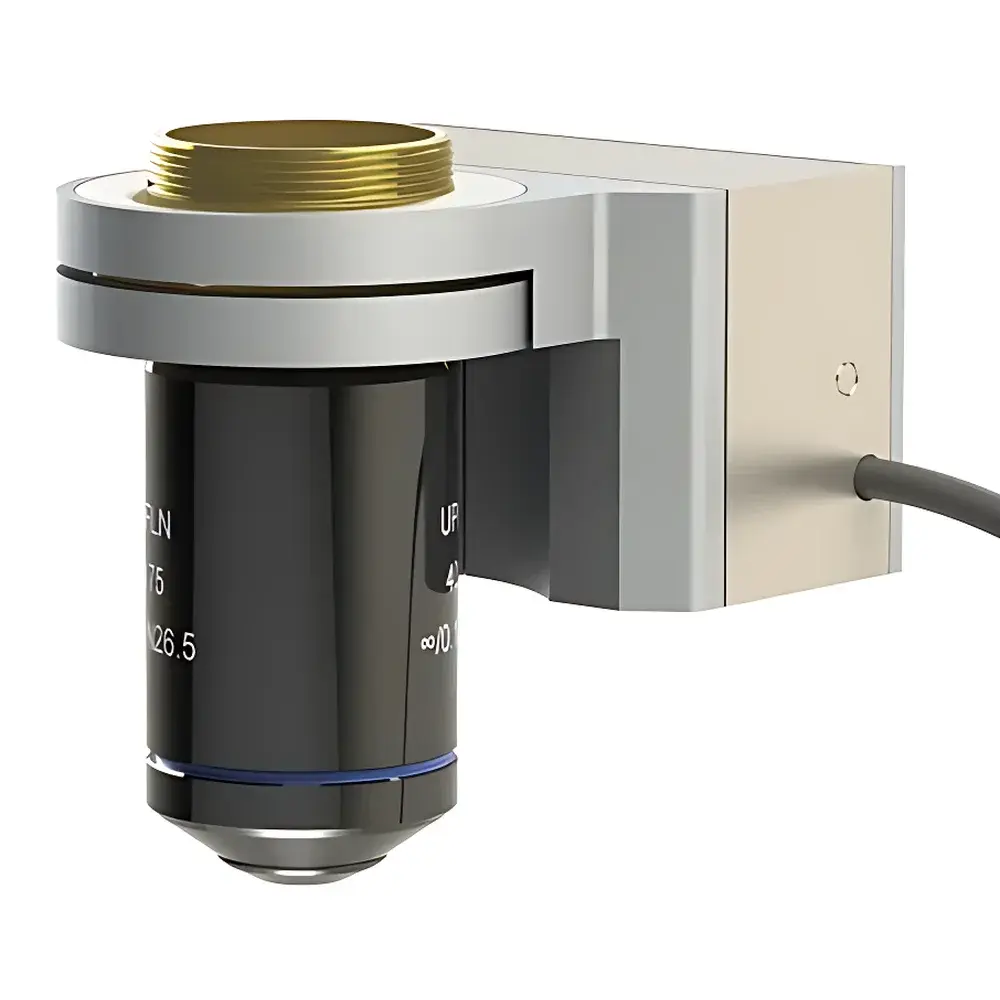
Auniontech PIEZOCONCEPT AU-FOCHS & AU-FOC High-Precision Piezoelectric Objective Scanning Stages for Microscopy
| Brand | Auniontech |
|---|---|
| Origin | France |
| Manufacturer Type | Authorized Distributor |
| Product Category | Imported Precision Motion Equipment |
| Model | PIEZOCONCEPT AU-FOCHS / AU-FOC |
| Actuation Principle | Direct Piezoelectric Drive with Flexure Guidance |
| Sensor Technology | Monolithic Silicon Position Sensor |
| Resolution | 0.01 nm (typ.) |
| Noise Floor | <10 pm RMS |
| Travel Range | 100–500 µm (configurable) |
| Resonant Frequency | Up to 1175 Hz |
| Material | Aluminum, Brass, Stainless Steel |
| Compatibility | RMS, M25, M26, M27, M32 Objective Mounts |
| Application Domain | Super-resolution Microscopy, AFM, Optical Trapping, Confocal Imaging, 3D Volume Imaging |
Overview
The Auniontech PIEZOCONCEPT AU-FOCHS and AU-FOC are high-performance piezoelectric objective scanning stages engineered specifically for ultra-precise, dynamic positioning of microscope objectives in demanding optical research and industrial metrology environments. These stages operate on the principle of direct piezoelectric actuation coupled with monolithic flexure guidance—eliminating backlash, hysteresis, and mechanical wear inherent in screw- or stepper-motor-driven systems. Unlike traditional capacitive displacement sensors, the integrated silicon position sensor delivers superior linearity (<0.01% FS), thermal stability, and sub-picometer noise floor (<10 pm RMS), enabling closed-loop control with nanoscale repeatability and long-term positional fidelity. Designed for integration into inverted and upright microscopes, both models support rapid axial translation (Z-axis) while maintaining optical axis alignment and minimal parasitic motion—critical for time-resolved volumetric imaging, adaptive optics correction, and real-time autofocus stabilization.
Key Features
- Sub-nanometer resolution (0.01 nm typical) and picometer-level stability enabled by monolithic silicon position sensing technology
- High dynamic performance: resonant frequencies up to 1175 Hz ensure fast step response and minimal settling time (<1 ms for 100 nm steps)
- Zero-friction, zero-backlash flexure-guided architecture ensures consistent mechanical behavior over >10⁹ cycles without maintenance
- Modular brass mounting ring system compatible with standard objective thread formats (RMS, M25, M26, M27, M32), enabling rapid interchange across diverse optical configurations
- Compact, low-profile design (AU-FOCHS: tube-style geometry optimized for space-constrained microscope nosepieces; AU-FOC: planar variant for custom optical breadboard integration)
- Hermetically sealed internal components resist environmental drift; aluminum and stainless steel housing provides EMI shielding and thermal mass for enhanced thermal stability
Sample Compatibility & Compliance
These scanning stages are designed for use with standard commercial and custom microscope objectives ranging from 10× to 100× magnification, including oil-immersion and water-dipping variants. The modular mounting interface allows direct coupling without optical path obstruction or beam deviation. All units comply with CE marking requirements for electromagnetic compatibility (EMC Directive 2014/30/EU) and low-voltage safety (LVD Directive 2014/35/EU). While not certified under ISO 13849 or IEC 61508, the closed-loop control architecture supports integration into GLP- and GMP-compliant workflows when paired with validated host software and audit-trail-enabled data acquisition systems. Traceable calibration certificates (NIST-traceable interferometric verification) are available upon request for metrology-critical applications such as semiconductor wafer inspection and quantitative biophotonics.
Software & Data Management
The PIEZOCONCEPT stages interface via USB 2.0 or analog ±10 V inputs, supporting native integration with common microscopy platforms including MicroManager, MATLAB Instrument Control Toolbox, Python (PySerial, PyVISA), and LabVIEW. A dedicated SDK provides low-latency API access to real-time position feedback, voltage output scaling, and waveform generation (sine, triangle, arbitrary LUT-based trajectories). All firmware supports non-volatile memory storage of user-defined calibration tables and PID tuning parameters. When deployed in regulated environments, the system supports FDA 21 CFR Part 11-compliant operation through third-party electronic lab notebook (ELN) or LIMS integrations that enforce electronic signatures, audit trails, and role-based access control for motion parameter configuration.
Applications
- Automated focus stabilization in live-cell time-lapse microscopy and light-sheet fluorescence imaging (LSFM)
- Z-stack acquisition in confocal and multiphoton microscopes with <50 nm axial sampling intervals
- Drift compensation and active focus correction in single-molecule localization microscopy (SMLM), STORM, and PALM
- Precision depth scanning in optical coherence tomography (OCT) and interferometric synthetic aperture microscopy (ISAM)
- Dynamic objective repositioning during laser microdissection and femtosecond laser ablation protocols
- Integration with adaptive optics wavefront correctors for aberration compensation in deep-tissue imaging
FAQ
What is the difference between AU-FOCHS and AU-FOC?
AU-FOCHS features a cylindrical, coaxial design optimized for direct insertion into standard microscope nosepiece turrets, whereas AU-FOC adopts a planar, low-height form factor suited for custom optical mounts and multi-axis nanopositioning stacks.
Can these stages be used in vacuum or inert gas environments?
Standard units are rated for ambient laboratory conditions only; vacuum-compatible variants with outgassing-controlled materials and feedthrough connectors are available under custom order (lead time: 12–16 weeks).
Is thermal drift compensated in closed-loop operation?
Yes—the silicon sensor exhibits negligible thermal coefficient (<0.05 ppm/°C), and the controller’s real-time offset correction algorithm compensates for residual thermal drift during extended acquisitions.
Do you provide OEM integration support?
Yes—Auniontech offers mechanical CAD models (STEP, IGES), electrical schematics, and firmware documentation under NDA for seamless integration into original equipment manufacturer (OEM) microscope platforms.
What is the warranty and service coverage?
All units include a 24-month limited warranty covering material and workmanship defects; extended calibration and preventive maintenance contracts are available globally through authorized service centers in Europe, North America, and Asia-Pacific.





