
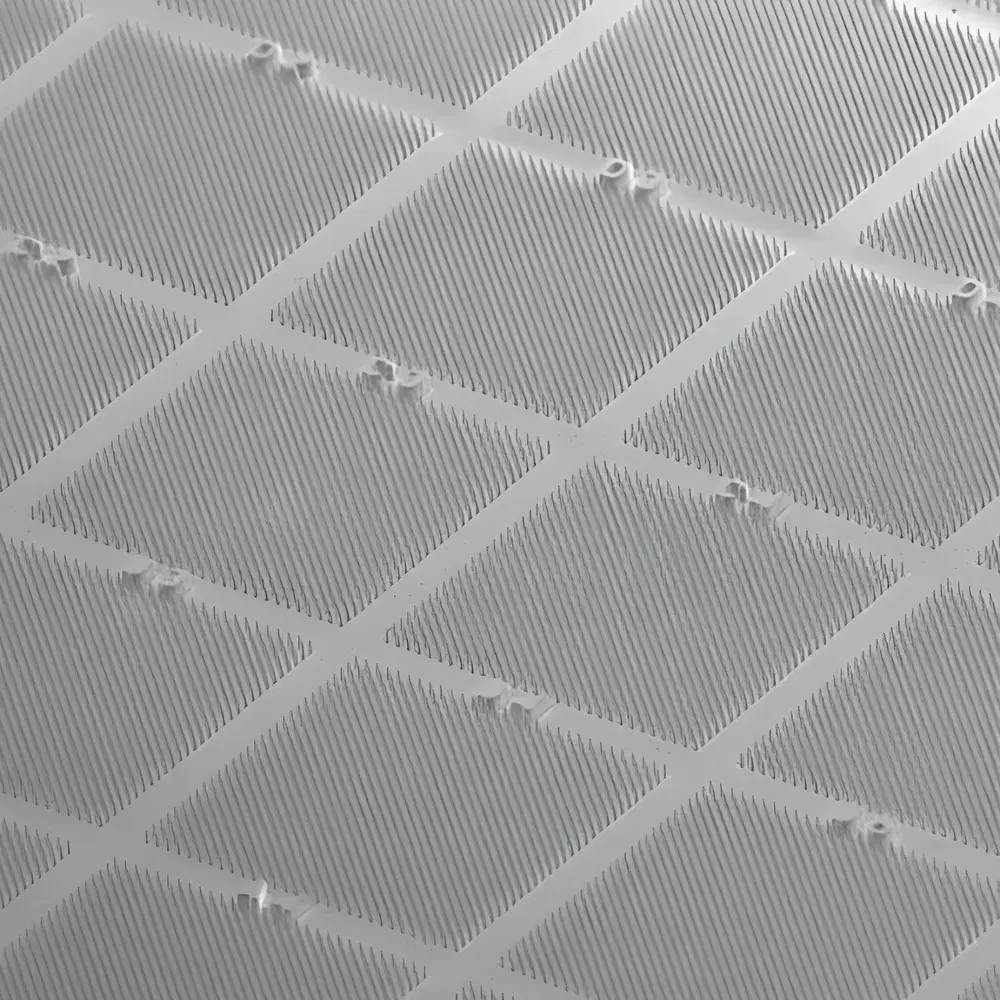
Auniontech Diamond NV Center Array for Quantum Sensing & Single-Photon Applications
| Brand | Auniontech |
|---|---|
| Origin | Shanghai, China |
| Model | NV-Array-Sapphire-36 |
| Type | Solid-State Quantum Sensor Platform |
| Application Domain | Magnetometry, Quantum Optics, Nanoscale NMR, Single-Photon Source Integration |
| Compliance | Designed for GLP-aligned lab environments |
Overview
The Auniontech Diamond NV Center Array is a monolithic, chip-scale quantum sensing platform engineered for high-throughput, reproducible deployment of nitrogen-vacancy (NV) centers in diamond. Unlike discrete single-crystal NV samples requiring labor-intensive alignment and stabilization, this device integrates 36 precisely fabricated, parabolic microstructures—each hosting one or more optically addressable NV⁻ centers—onto a thermally stable sapphire substrate. The architecture leverages solid immersion lens (SIL) principles: each 200 × 200 µm² pillar is shaped to approximate a paraboloid, enhancing photon collection efficiency by >10× compared to planar diamond films under identical excitation (532 nm CW laser) and detection conditions (650 nm longpass filter, Mitutoyo 50× HR objective, NA 0.75). This design directly improves signal-to-noise ratio (SNR) in optically detected magnetic resonance (ODMR), enabling robust nanotesla-level DC/AC magnetometry, nanoscale nuclear magnetic resonance (nano-NMR), and deterministic single-photon generation without cryogenic infrastructure.
Key Features
- Monolithic sapphire-mounted diamond membrane with 36 individually structured NV pillars (200 × 200 µm² each)
- Pre-characterized NV distribution map: ~30% of pillars contain ≥1 isolated NV center; ~5% host high-coherence NVs with T₂ > 3 µs (shallow configuration)
- Two calibrated NV depth options: shallow target depth ≈ 8 nm (optimized for surface-sensitive magnetometry and nano-NMR); medium target depth ≈ 50–100 nm (optimized for single-photon source stability and extended T₂* in ambient conditions)
- Typical ODMR contrast: 15–25% at 10 MHz microwave modulation bandwidth under continuous-wave illumination
- Saturation count rate up to 1 MCts/s per NV center—enabling fast, low-drift field sensing and real-time spin-state readout
- Robust mechanical and thermal interface: sapphire substrate ensures minimal thermal drift (<50 nm/°C) and compatibility with standard XYZ piezo stages and vacuum-compatible optical mounts
Sample Compatibility & Compliance
The NV-Array-Sapphire-36 is fully compatible with commercial confocal microscopes (e.g., Nikon Ti2, Zeiss LSM 980), widefield quantum imaging systems, and home-built ODMR setups using standard 532 nm lasers and GHz microwave delivery via coplanar waveguides or loop antennas. No custom mounting hardware is required—the chip fits standard 25 mm diameter sample holders and aligns with common objective working distances (≥1 mm). While not certified to ISO/IEC 17025 or ASTM E2912, the device is manufactured under controlled cleanroom protocols (Class 1000) and supplied with traceable characterization reports including pillar-wise NV location coordinates, ODMR linewidth (FWHM), contrast, and preliminary T₂* estimates derived from XY8 dynamical decoupling sequences. It supports GLP-compliant experimental documentation when integrated into systems with audit-trail-capable acquisition software.
Software & Data Management
The array operates seamlessly with open-architecture control platforms including Qudi, QCoDeS, and LabVIEW-based quantum instrument drivers. Raw ODMR spectra, time-resolved fluorescence traces, and microwave sweep data are exported in HDF5 or CSV format, preserving metadata (laser power, microwave amplitude, temperature, pillar ID). Each delivered chip includes a digital map file (.json) specifying spatial coordinates of all characterized NV pillars, their measured zero-field splitting (ZFS), and associated coherence metrics. Integration with Python-based analysis pipelines (e.g., QTT, SpinDynamics) is supported out-of-the-box for automated spin-state fitting, magnetic field vector reconstruction, and noise spectral density estimation.
Applications
- Ambient-condition nanoscale magnetometry: mapping stray fields from 2D materials, skyrmions, or spintronic devices with <50 nm spatial resolution
- Nanoscale NMR spectroscopy: detecting proton signals from sub-100 nm biological volumes (e.g., lipid bilayers, protein complexes) using shallow-depth NVs
- Scalable quantum photonic interfaces: parallel addressing of multiple NVs for multiplexed single-photon sources in quantum communication testbeds
- Quantum metrology education and prototyping: rapid validation of pulse sequences (Hahn echo, CPMG, XY8), microwave calibration, and lock-in detection strategies
- Material science screening: non-invasive evaluation of magnetic domain dynamics in thin-film ferromagnets and antiferromagnets
FAQ
What is the typical coherence time (T₂) for shallow vs. medium-depth NVs on this array?
Shallow NVs (≈8 nm depth) exhibit T₂ ≈ 3 µs under single-pulse Hahn echo; medium-depth NVs (≈50–100 nm) show T₂ > 10 µs in comparable ambient conditions, depending on local strain and ¹³C concentration.
Is the chip compatible with cryogenic operation?
Yes—the sapphire substrate and chemical vapor deposition (CVD) diamond film are rated for operation down to 4 K; however, thermal contraction mismatch must be accounted for in mechanical mount design.
Do you provide microwave delivery solutions with the array?
No—microwave delivery (e.g., coplanar waveguide chips, wirebonded loops) must be integrated separately based on your microscope or chamber geometry.
Can I perform ensemble-averaged ODMR across multiple pillars simultaneously?
Yes—widefield illumination and EMCCD or sCMOS detection enable parallel readout; confocal scanning remains necessary for single-NV isolation and nanoscale field mapping.
Are the NV centers pre-polarized or require optical initialization?
All NVs require standard 532 nm green laser initialization prior to microwave manipulation; no permanent polarization is retained between measurements.



