
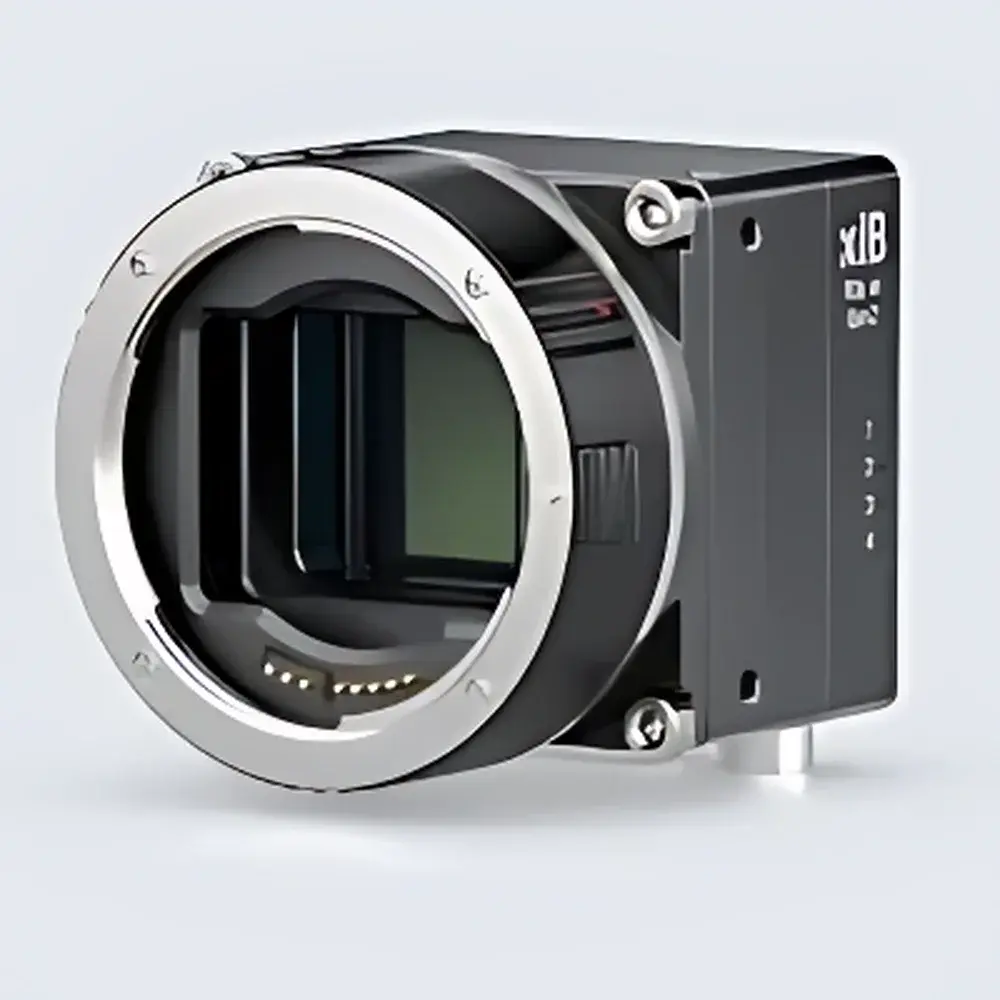
Auniontech sCMOS Camera for Scientific Imaging
| Brand | Auniontech |
|---|---|
| Model | Scientific sCMOS Camera |
| Sensor Type | Back-Illuminated sCMOS |
| Resolution | 2048 × 2048 |
| Pixel Size | 6.5 µm × 6.5 µm |
| Active Area | 13.3 mm × 13.3 mm |
| Diagonal Field | 18.8 mm |
| Full Well Capacity | 54,000 e⁻ |
| Frame Rate | 40 fps (full resolution) |
| Read Noise | 1.2 e⁻ (typ.) |
| Dark Current | <2 e⁻/pixel/s (at −25 °C) |
| Dynamic Range | 90 dB (HDR) |
| Peak Quantum Efficiency | 93% |
| Cooling | Peltier TEC (ΔT ≤ −25 °C below ambient) |
| Interface | USB 3.0 |
| Digital I/O | 2 IN, 2 OUT, Serial Port |
| Bit Depth | 12-bit native (16-bit via API scaling) |
| Mount | C-mount |
| Shutter | Optional electronic shutter |
| Weight | 170 g |
| Dimensions | 50 mm × 50 mm × 55 mm |
| Compliance | CE, RoHS |
Overview
The Auniontech Scientific sCMOS Camera is a high-performance, back-illuminated scientific complementary metal-oxide-semiconductor (sCMOS) imaging platform engineered for quantitative low-light microscopy and spectroscopy applications. Leveraging deep-depletion, back-illuminated sensor architecture, the camera achieves exceptional photon detection efficiency—peaking at 93% quantum efficiency in the visible to near-ultraviolet range (400–650 nm). Its 2048 × 2048 pixel array delivers uniform spatial sampling across a 13.3 mm × 13.3 mm active area, with each 6.5 µm × 6.5 µm pixel optimized for high fill factor and minimal crosstalk. The integrated thermoelectric (Peltier) cooler enables stable sensor operation at up to 25 °C below ambient temperature, suppressing dark current to <2 e⁻/pixel/s—critical for long-exposure fluorescence and single-molecule imaging. With a native 12-bit readout (scalable to 16-bit via application programming interface), 40 fps full-frame acquisition, and 90 dB high-dynamic-range (HDR) capability, this camera balances speed, sensitivity, and quantitative fidelity without compromise.
Key Features
- Back-illuminated sCMOS sensor with 93% peak QE—optimized for fluorescence, GFP, and UV-excited emission detection
- Ultra-low read noise of 1.2 e⁻ (typ.), enabling single-photon-level signal discrimination in low-flux regimes
- Active thermoelectric cooling (−25 °C ΔT) with real-time thermal stabilization for consistent dark current suppression
- USB 3.0 interface supporting sustained 40 fps full-resolution streaming with zero dropped frames under standard host configuration
- Programmable GPIO (2 input, 2 output) and serial port for hardware synchronization with lasers, shutters, or stage controllers
- C-mount mechanical interface ensures compatibility with standard microscope adapters, filter wheels, and relay optics
- Compact form factor (50 × 50 × 55 mm) and lightweight design (170 g) facilitate integration into space-constrained optical setups including confocal, TIRF, and super-resolution platforms
Sample Compatibility & Compliance
This sCMOS camera is designed for use with fixed and live biological specimens, thin-film photovoltaic materials, luminescent quantum dots, and spectral calibration standards. It supports both widefield and point-scanning modalities, delivering linear response over five orders of magnitude intensity—validated per ISO 15739:2013 for noise and dynamic range characterization. The device conforms to CE marking requirements for electromagnetic compatibility (EN 61326-1) and safety (EN 61010-1), and meets RoHS 2011/65/EU restrictions on hazardous substances. While not FDA-cleared as a medical device, its data integrity features—including timestamped frame metadata, non-destructive image buffering, and deterministic exposure control—support GLP-compliant documentation workflows in academic and industrial R&D laboratories.
Software & Data Management
The camera ships with a cross-platform SDK (Windows, Linux, macOS) supporting native integration into Python (via ctypes and NumPy), MATLAB, LabVIEW, and C/C++ environments. All acquired images include embedded EXIF-style metadata: exposure time, gain setting, sensor temperature, frame counter, and hardware trigger status. The API enforces strict memory management protocols to prevent buffer overflow during high-throughput acquisition. For regulated environments, optional audit-trail logging (timestamped user actions, parameter changes, and export events) can be enabled—aligning with principles outlined in FDA 21 CFR Part 11 for electronic records and signatures when deployed with validated third-party acquisition software.
Applications
- Widefield and spinning-disk confocal fluorescence microscopy requiring high SNR and temporal fidelity
- TIRF and single-molecule localization microscopy (SMLM), including PALM and STORM, where sub-electron read noise is essential for precise centroid fitting
- Live-cell GFP/YFP imaging with minimal phototoxicity due to high QE and low illumination dose requirements
- Quantitative photovoltaic characterization, including spatially resolved external quantum efficiency (EQE) mapping
- Time-resolved fluorescence lifetime imaging (FLIM) when synchronized with pulsed laser sources via TTL input
- High-speed spectral imaging in conjunction with imaging spectrometers (e.g., transmission grating + slit coupling)
FAQ
What is the maximum achievable frame rate at reduced regions of interest (ROI)?
Frame rates scale inversely with pixel count; sub-array readout (e.g., 512 × 512) enables >200 fps while preserving full bit depth and noise performance.
Is hardware binning supported?
No—this camera uses native sCMOS architecture without analog binning; however, on-the-fly digital binning (2×2, 4×4) is implemented in firmware with corresponding gain and offset recalibration.
Can the camera operate in triggered or free-running mode?
Yes—both internal (software-timed) and external (TTL-synchronized) acquisition modes are fully supported, with programmable delay and pulse width for precise timing alignment.
Does the SDK support multi-camera synchronization?
Yes—the SDK provides master-slave triggering via dedicated GPIO lines, enabling sub-microsecond inter-camera skew control for stereo or multi-spectral configurations.
Is the sensor vacuum-sealed or nitrogen-purged?
The sensor chamber is hermetically sealed with dry nitrogen fill to prevent condensation and oxidation during extended cryogenic operation.






