
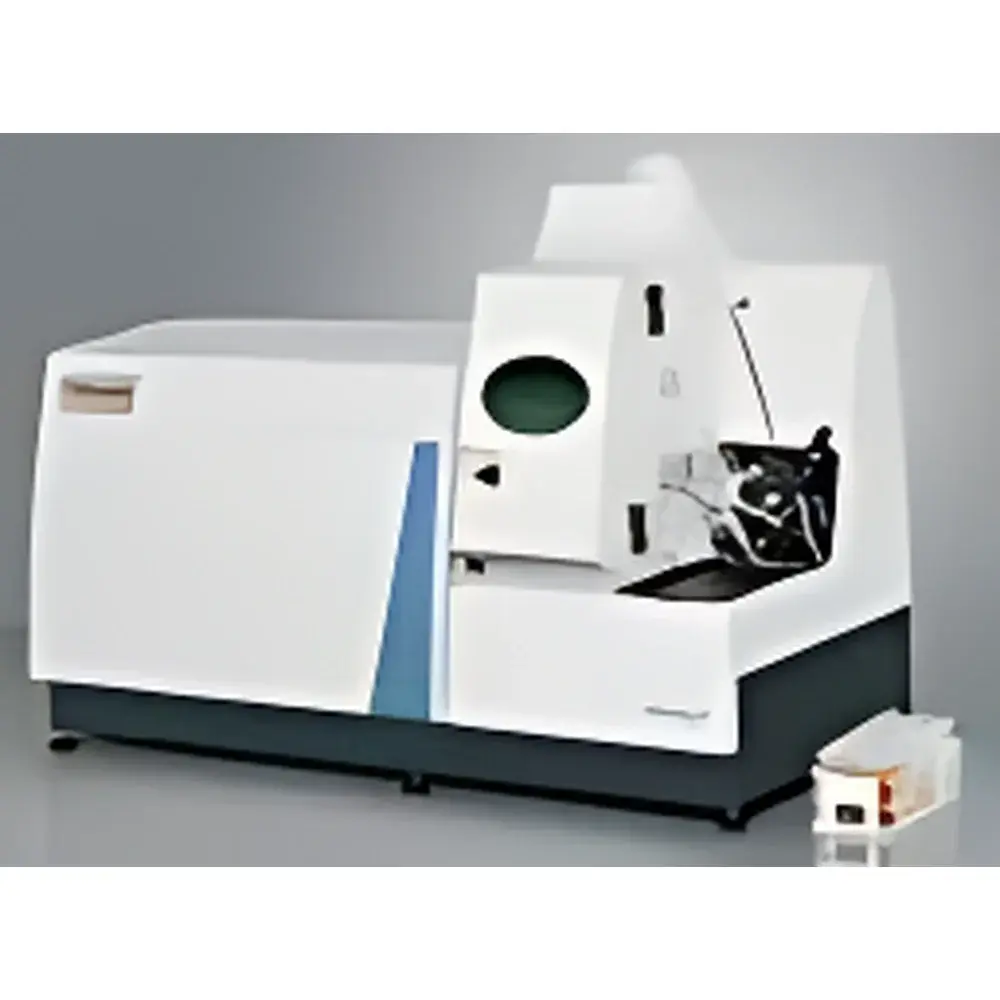
Thermo Fisher Scientific X Series 2 Inductively Coupled Plasma Mass Spectrometer
| Brand | Thermo Fisher Scientific |
|---|---|
| Origin | USA |
| Model | X Series 2 |
| Ion Optics | Interchangeable Xt/Xs Interface |
| Collision/Reaction Cell | Third-Generation CCT with Peltier-Cooled Quadrupole |
| Vacuum System | Split-Flow Turbomolecular Pump + Mechanical Pump |
| Detection System | Simultaneous Analog/Pulse Multi-Channel Electron Multiplier |
| Dynamic Linear Range | >8 Orders of Magnitude |
| Software | PlasmaLab v3.x (FDA 21 CFR Part 11 Compliant) |
| Gas Options | 7% H₂/He or 1% NH₃/He for CCT Operation |
| Background Noise | Optimized via Chicane-Based Hexapole Ion Deflection |
| Compliance | ASTM D5673, ISO 17294-2, USP <232>/<233>, GLP/GMP-Auditable Data Handling |
Overview
The Thermo Fisher Scientific X Series 2 Inductively Coupled Plasma Mass Spectrometer (ICP-MS) is a compact, high-performance quadrupole-based instrument engineered for trace elemental analysis at sub-part-per-quadrillion (sub-fg g⁻¹) detection levels. It employs robust inductively coupled plasma ionization—where sample aerosols are atomized and ionized at ~7,000 K—followed by mass separation via a high-transmission, temperature-stabilized quadrupole mass analyzer. Its ergonomic footprint—smaller than many atomic absorption spectrometers—enables seamless integration into space-constrained laboratories without compromising analytical integrity. Designed for routine and regulated environments alike, the X Series 2 delivers exceptional sensitivity, isotopic precision, and long-term stability across diverse matrices including environmental waters, clinical biofluids, semiconductor-grade reagents, and geological digests.
Key Features
- Compact, human-centered architecture with integrated electronics and minimized cable routing for reduced electromagnetic interference and simplified maintenance.
- Infinity II ion optics platform featuring a chicane-based hexapole ion deflector, enabling ultra-low background noise (<0.1 cps at m/z 89) through efficient removal of neutral species and photon-induced signals.
- Interchangeable Xt (high-sensitivity) and Xs (robustness-optimized) interface configurations—field-upgradable without realignment—to support method flexibility across low-level environmental screening and high-matrix clinical applications.
- Third-generation Collision/Reaction Cell (CCT) with Peltier-cooled quadrupole rods and dual-gas capability: supports both 7% H₂/He and 1% NH₃/He mixtures to suppress polyatomic interferences (e.g., ⁴⁰Ar³⁵Cl⁺ on ⁷⁵As⁺) while preserving >90% of analyte transmission in standard mode.
- Dual-mode detector system combining analog and pulse-counting electron multipliers with real-time, synchronized multi-channel electronics—ensuring linear response from sub-pulse to 10⁸ cps without range-switching artifacts.
- Dedicated vacuum architecture: split-flow turbomolecular pump (200 L/s on ion path, 100 L/s on CCT) backed by oil-free diaphragm mechanical pump, achieving base pressure <5×10⁻⁸ Torr within 15 minutes of cold start.
Sample Compatibility & Compliance
The X Series 2 accommodates liquid samples introduced via concentric nebulizers (e.g., MicroMist, PFA-ST), desolvating systems (Aridus III), and laser ablation modules (e.g., NWR213). It supports direct analysis of digested soils, filtered natural waters, acid-leached pharmaceutical excipients, and single-cell suspensions following optimized dilution protocols. Regulatory compliance is embedded at the firmware and software layer: PlasmaLab v3.x provides full audit trail, electronic signatures, role-based access control, and data integrity safeguards aligned with FDA 21 CFR Part 11, EU Annex 11, and ISO/IEC 17025 requirements. Instrument qualification documentation supports IQ/OQ/PQ execution per ASTM D5673 (water analysis) and ISO 17294-2 (wastewater testing).
Software & Data Management
PlasmaLab v3.x serves as the central control and data processing environment, offering method-driven workflows—from plasma ignition and tuning (including automatic mass calibration and resolution optimization) to time-resolved LA-ICP-MS mapping and transient signal deconvolution. Raw data files (.raw) are stored in vendor-neutral HDF5 format with embedded metadata (instrument parameters, gas flows, integration times, operator ID). Batch processing supports internal standard correction, isotope ratio calculation (e.g., ²⁰⁶Pb/²⁰⁷Pb), and statistical outlier detection per USP . All data modifications are logged with timestamp, user ID, and pre-/post-value; raw files remain immutable post-acquisition.
Applications
- Environmental monitoring: quantification of U, Th, and actinides in drinking water per EPA Method 200.8 revision 5.2.
- Clinical toxicology: multi-element profiling (e.g., Se, Zn, Cu, As) in serum and whole blood with certified reference material traceability (NIST SRM 1640a, 1643e).
- Geochemistry: high-precision isotope ratio analysis (e.g., ⁸⁷Sr/⁸⁶Sr) using external normalization and Faraday cup–compatible tuning protocols.
- Materials science: impurity screening in Li-ion battery cathode precursors (Ni, Co, Mn, Al) at ≤10 pg g⁻¹ LODs with matrix-matched calibration.
- Pharmaceutical quality control: elemental impurities testing per ICH Q3D guidelines, including Category 1 (As, Cd, Hg, Pb) and Category 2A (Co, V, Ni) metals in APIs and excipients.
FAQ
Does the X Series 2 support hyphenated techniques such as HPLC-ICP-MS?
Yes—its fast dwell time (≤10 ms per mass) and transient signal optimization enable coupling with nanoflow HPLC and SEC systems for speciation analysis of metalloproteins and organometallic compounds.
Is collision/reaction cell operation compatible with routine daily use in regulated labs?
Absolutely—the CCT module operates under fully automated gas delivery control with real-time pressure feedback; all CCT-related parameters are recorded in the audit trail and included in 21 CFR Part 11-compliant reports.
Can the instrument be validated for GLP compliance?
Yes—Thermo Fisher provides comprehensive IQ/OQ documentation packages, including performance verification protocols for sensitivity (e.g., ¹¹⁵In ≥ 1×10⁹ cps/ppq), oxide ratio (<1.5%), and background equivalent concentration (BEC) across 10–250 amu.
What maintenance intervals are recommended for the ion optics and detector?
Xt/Xs interface cleaning is recommended every 3 months under typical usage; detector replacement is typically required after ≥2×10¹² total counts—monitored automatically via PlasmaLab’s lifetime counter.
Is remote diagnostics supported?
Yes—via Thermo Fisher’s SecureLink™ gateway, enabling encrypted, firewall-compliant remote support with customer-controlled session initiation and termination.




