
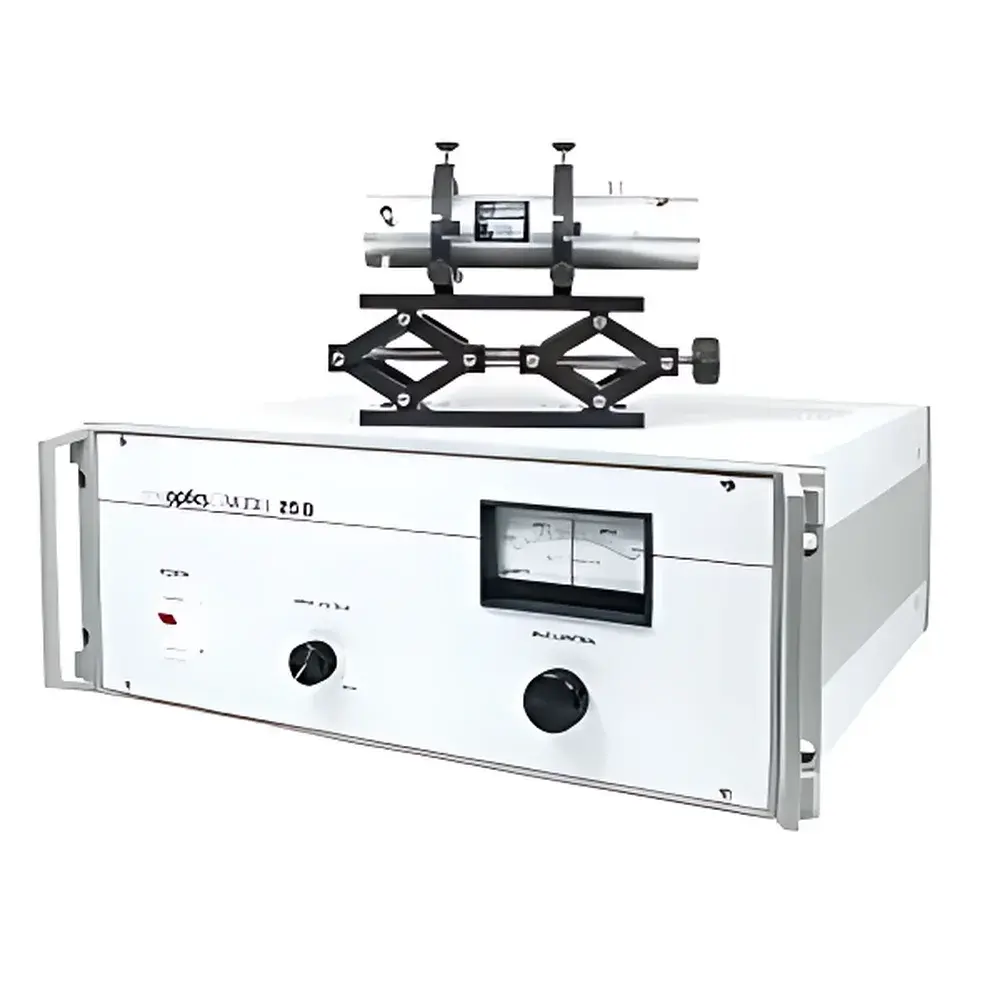
ConOptics Model 310A–312 & 412 Series Electro-Optic Deflection Systems
| Brand | ConOptics |
|---|---|
| Origin | USA |
| Type | Imported Optical Component |
| Model | Electro_Optic_Deflection_Systems |
| Aperture | 2.0–2.7 mm |
| Deflection Efficiency | 0.6–4.0 µrad/V |
| Capacitance | 40–185 pF |
| Spectral Range | 400–2000 nm (model-dependent) |
| Length | 71–219 mm |
| UV/Deep-UV Options | Yes (models 310A, 311A, 312, 312-2) |
| Collinear Configuration | Center-In/Center-Out |
| Amplifier Compatibility | Models 302RM, 412 Dual, and 25D (DC to >200 kHz bandwidth, ±450 V output, <2.5 µs rise time, 8 ns for Model 25D) |
Overview
The ConOptics Model 310A, 311A, 312, 312-2, and 412 Series Electro-Optic Deflection (EOD) Systems are precision solid-state beam steering devices engineered for high-speed, analog-controlled angular displacement of collimated optical beams. Unlike mechanical galvanometers or acousto-optic deflectors, these systems operate on the linear electro-optic (Pockels) effect in single-crystal media—typically KD*P or RTP—where an applied transverse electric field induces a spatially uniform, voltage-proportional birefringence gradient. This gradient produces a controllable wavefront tilt, resulting in deterministic beam deflection without moving parts, hysteresis, or mechanical wear. The absence of piezoelectric coupling—achieved through crystal orientation optimization and quadrupole electrode geometry—ensures long-term stability, sub-microradian repeatability, and immunity to vibration-induced drift. Designed for integration into ultrafast laser systems, confocal microscopy, adaptive optics testbeds, and quantum control setups, these EODs deliver diffraction-limited performance across visible, NIR, and extended IR bands.
Key Features
- Solid-state architecture with zero moving components—no mechanical fatigue, no alignment drift over years of operation
- Quadrupole electrode configuration eliminates piezoelectric artifacts and minimizes thermal lensing under DC or low-frequency bias
- Collinear center-in/center-out optical path preserves beam axis and simplifies integration into folded or multi-pass optical layouts
- Modular amplifier compatibility: Model 302RM (DC–200 kHz), Model 412 Dual (dual-channel, matched gain), and Model 25D (ultrafast, 8 ns rise time for gating applications)
- UV/Deep-UV options available (down to 200 nm) via optimized anti-reflection coatings and crystal grade selection
- High linearity (≤0.1% FS, 10-bit referenced) enabled by precision DC bias control and low-noise high-voltage amplification
- Rack-mountable 3U amplifier cabinets with forced-air cooling, built-in self-test functionality, and rear-panel impedance switching (50 Ω / 1 kΩ)
Sample Compatibility & Compliance
These EOD systems are compatible with continuous-wave and pulsed laser sources operating from 400 nm to 2000 nm, including Ti:Sapphire, Nd:YAG, OPOs, and fiber lasers. Beam diameters up to 2.7 mm (depending on model) are supported while maintaining uniform phase front modulation. All units comply with IEC 61000-6-3 (EMC emission standards) and IEC 61010-1 (safety requirements for laboratory electrical equipment). Amplifier cabinets meet UL 61010-1 and CSA C22.2 No. 61010-1 for Class I laboratory use. While not certified for medical or aerospace deployment, the systems support GLP-compliant calibration traceability when used with NIST-traceable high-voltage meters and autocollimators. Firmware and amplifier control logic adhere to deterministic timing constraints required for synchronization with digital delay generators and pulse pickers in ultrafast labs.
Software & Data Management
ConOptics EODs interface directly with standard analog control infrastructure—no proprietary drivers or closed-loop firmware are required. Voltage commands are delivered via BNC or SHV connectors using ±10 V, 0–10 V, or TTL-compatible inputs depending on amplifier configuration. For automated workflows, the systems integrate seamlessly with LabVIEW, MATLAB, Python (via PyVISA or DAQmx), and EPICS-based control environments. Amplifier models 302RM and 412 include front-panel digital voltmeters for real-time bias monitoring and rear-panel test points for oscilloscope verification of drive signal fidelity. Audit-ready operation is supported through external logging of analog setpoints and environmental telemetry (ambient temperature, supply voltage); full 21 CFR Part 11 compliance requires integration with validated third-party data acquisition platforms that enforce electronic signatures and audit trails.
Applications
- Ultrafast laser pulse picking and cavity dumping in regenerative amplifiers
- Beam steering in multi-photon excitation microscopy and light-sheet imaging
- Real-time correction of beam pointing fluctuations in interferometric metrology
- Dynamic holography and programmable wavefront shaping in optical trapping
- High-repetition-rate scanning for laser micro-machining and maskless lithography
- Quantum optics experiments requiring shot-to-shot polarization and angle control (e.g., Bell state analysis, quantum memory addressing)
- Calibration reference for angular encoder validation and autocollimator linearity testing
FAQ
What is the maximum usable repetition rate for analog beam steering?
For small-signal deflection (≤1 mrad), the 302RM amplifier supports closed-loop bandwidths exceeding 200 kHz into 90 pF loads; the 25D amplifier extends this to >100 MHz for binary gating applications.
Can these EODs be used in vacuum or inert-gas environments?
Yes—optical elements are hermetically sealed within aluminum housings; optional dry-nitrogen purge ports are available upon request for UV-sensitive configurations.
Is there a difference between “deflection efficiency” and “angular sensitivity”?
No—they are synonymous in this context: both denote the incremental angular change (in microradians) per volt applied across the crystal electrodes under specified load and wavelength conditions.
Do ConOptics EODs require temperature stabilization?
Not for most laboratory applications; however, for sub-10 µrad stability over 8-hour periods, active crystal temperature control (±0.1°C) is recommended—especially for Model 312 variants operating near 1100 nm.
How is calibration traceability established?
ConOptics provides factory calibration reports referencing NIST-traceable autocollimators and high-voltage standards. End users may perform in-situ verification using a theodolite-grade rotary stage and position-sensitive detector.



