
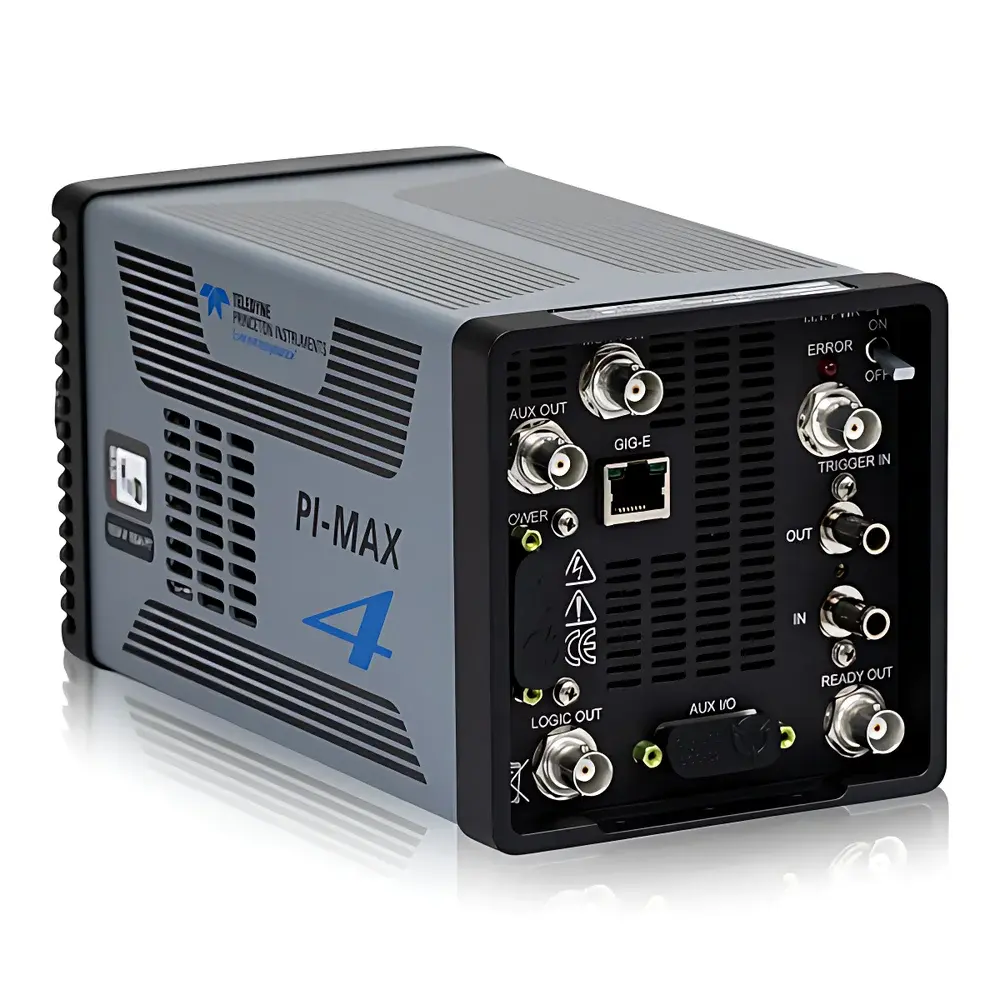
Teledyne Princeton Instruments PI-MAX 4 Series Enhanced emICCD Camera
| Brand | Teledyne Princeton Instruments |
|---|---|
| Sensor Type | Electron-Multiplying Intensified CCD (emICCD) |
| Gate Width | <500 ps |
| Maximum Gating Repetition Rate | 1 MHz |
| Spectral Acquisition Rate | >10,000 spectra/s |
| Dual-Image Mode (PI-MAX 4 | 1024i): Inter-frame Interval <2 µs |
| Pixel Format Options | 1024×1024 (12.8 µm), 1024×256 (26 µm) |
| Photocathode Types | Gen II/III Unfilmed |
| Phosphor Screens | P43 / P46 / P47 |
| Read Noise | Sub-electron (EM gain enabled) |
| Dark Current | ≤2.5 e⁻/pixel/s |
| Compatibility | Fully compatible with SpectraPro HRS and IsoPlane® imaging spectrometers |
Overview
The Teledyne Princeton Instruments PI-MAX 4 Series is a high-performance electron-multiplying intensified CCD (emICCD) camera engineered for ultrafast, low-light scientific imaging and time-resolved spectroscopy. Based on the proven principles of image intensification combined with on-chip electron multiplication, the PI-MAX 4 delivers single-photon sensitivity with picosecond-level temporal resolution—enabling quantitative detection in photon-starved regimes where conventional CCD or sCMOS detectors fail. Its core architecture integrates a microchannel plate (MCP) intensifier with a back-illuminated, deep-depletion CCD sensor and proprietary SuperHV gating electronics. Unlike traditional ICCDs that employ metal-mesh MCPs—which degrade quantum efficiency—the PI-MAX 4 utilizes a meshless MCP design, preserving photocathode QE across UV–visible wavelengths while enabling true optical full-width-at-half-maximum (FWHM) gate profiles. This ensures precise temporal discrimination of transient events, critical for applications requiring background rejection, pulse-to-pulse fidelity, or lifetime-resolved signal isolation.
Key Features
- Sub-500 ps Optical Gating: Achieved via SuperHV high-voltage pulsing circuitry, delivering deterministic gate widths without compromising quantum efficiency or spatial uniformity.
- 1 MHz Gating Repetition Rate: Synchronized with high-repetition-rate pulsed lasers (e.g., Ti:Sapphire, OPOs, and fiber lasers), supporting shot-to-shot acquisition at up to 10,000 spectra per second in spectroscopic mode.
- Dual-Image Acquisition (PI-MAX 4:1024i model): Leverages interline CCD architecture to capture two full-resolution frames with <2 µs inter-frame delay—ideal for particle image velocimetry (PIV), pump-probe differential imaging, and real-time reference/background subtraction.
- High Linearity & Dynamic Range: emICCD architecture provides linear response over 4+ decades (up to 10⁴:1), eliminating intensity-dependent gain nonuniformity common in standard ICCDs—essential for quantitative fluorescence lifetime imaging (FLIM) and calibrated spectral radiance measurements.
- Modular Intensifier Options: Supports Gen II and Gen III un-filmed photocathodes (S-20, GaAs) and selectable phosphor screens (P43 green, P46 blue, P47 red) for optimized spectral response and decay time matching.
Sample Compatibility & Compliance
The PI-MAX 4 is designed for integration into vacuum-compatible, laser-safe, and radiation-hardened experimental environments. Its sealed intensifier tube meets MIL-STD-810G environmental robustness requirements for shock, vibration, and thermal cycling. The camera complies with CE, FCC Class A, and RoHS directives. For regulated laboratories, firmware supports audit-trail logging and user-access control—facilitating alignment with GLP and GMP documentation practices. While not inherently 21 CFR Part 11 compliant, its metadata-rich TIFF and FITS output formats, coupled with timestamped frame headers and hardware-triggered acquisition logs, provide traceability required for ISO/IEC 17025-accredited testing labs conducting time-resolved optical diagnostics.
Software & Data Management
Controlled via LightField® 6.5 software (Windows 10/11, 64-bit), the PI-MAX 4 offers intuitive configuration of gate width, delay, EM gain, and readout modes—including kinetic, multi-track, and spectroscopic line-binning. LightField supports automated calibration routines (flat-field, dark-frame, gain-map), real-time histogram analysis, and export to HDF5, MATLAB .mat, and vendor-neutral SPE formats. An optional SDK (C/C++, Python, LabVIEW) enables custom automation for OEM integration or closed-loop feedback systems. All acquired data embeds EXIF-like metadata: exposure parameters, trigger timestamps (±1 ns resolution), sensor temperature, and intensifier voltage history—ensuring full experimental reproducibility.
Applications
- Plasma Diagnostics: Picosecond-resolved emission spectroscopy for electron temperature and density mapping in fusion-relevant tokamak edge plasmas and laser-induced breakdown spectroscopy (LIBS).
- Combustion Science: Planar laser-induced fluorescence (PLIF) of OH, CH, and NO radicals with kHz-gated imaging for flame front tracking and soot volume fraction quantification.
- Quantum Optics: Single-photon counting and correlation measurements in quantum entanglement verification, heralded photon generation, and cavity QED experiments.
- Time-Resolved Fluorescence Microscopy: FLIM with TCSPC-compatible gating for FRET efficiency mapping in live-cell studies and pharmaceutical screening.
- Ultrafast Spectroscopy: Transient absorption and stimulated Raman scattering (SRS) using synchronized pump-probe delays and spectral multiplexing.
FAQ
What distinguishes emICCD from standard ICCD technology?
The emICCD combines image intensification with on-chip electron multiplication, achieving sub-electron read noise at high gain—whereas standard ICCDs rely solely on MCP gain and suffer from multiplicative noise and limited dynamic range.
Can the PI-MAX 4 be used with third-party spectrometers?
Yes—it features standard C-mount and F-mount interfaces, and its electronic triggering and pixel binning modes are configurable to match slit dimensions and dispersion characteristics of non-Princeton spectrometers.
Is cooling required for optimal performance?
The sensor is thermoelectrically cooled to –15°C (standard) or –25°C (optional), reducing dark current to ≤2.5 e⁻/pixel/s and enabling long-exposure quantitative measurements without significant thermal noise accumulation.
How is timing synchronization achieved with external lasers?
Via TTL or LVDS input triggers with <1 ns jitter; internal delay generators support programmable gate delays from –10 µs to +10 µs relative to trigger edge, with 5 ps resolution.
Does the PI-MAX 4 support vacuum or UHV environments?
The camera head is rated for operation at pressures down to 10⁻⁵ Torr; for UHV (<10⁻⁹ Torr), optional conflat flange mounting and bake-out–compatible cabling are available through Teledyne Princeton Instruments’ OEM division.




