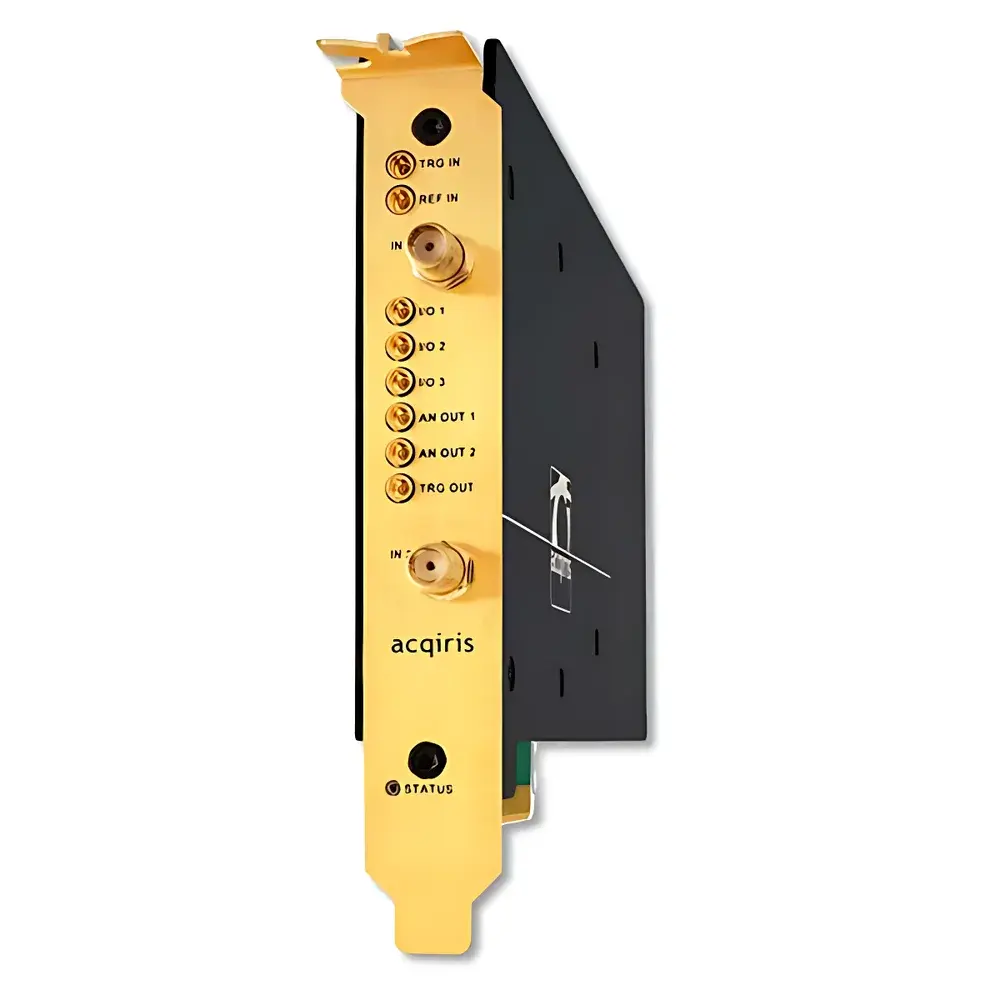
Acqiris SA3 High-Speed Data Acquisition Card
| Brand | Auniontech |
|---|---|
| Origin | Shanghai, China |
| Manufacturer Type | Authorized Distributor |
| Product Category | Domestic |
| Model | PS-OCT Dedicated PCIe DAQ Card |
| Price | Upon Request |
Overview
The Acqiris SA3 is a high-performance, 12-bit, multi-channel PCIe data acquisition card engineered for demanding real-time signal capture in photonics, biomedical imaging, and industrial test systems. Designed specifically for polarization-sensitive optical coherence tomography (PS-OCT) and swept-source OCT (SS-OCT), the SA3 implements on-board FPGA-based signal processing to enable deterministic latency, hardware-accelerated demodulation, and real-time beam scanning synchronization. Its architecture leverages dual 1.5 GS/s analog-to-digital converters (ADCs) with 2.4 GHz analog bandwidth and 50 Ω DC-coupled inputs—optimized for high-fidelity digitization of interferometric fringe signals from fiber-based OCT interferometers. Unlike general-purpose DAQ cards, the SA3 integrates domain-specific firmware for PS-OCT signal reconstruction, including polarization state tracking, Jones matrix computation, and birefringence mapping—all executed in hardware without host CPU intervention. This ensures sub-millisecond image generation latency and deterministic timing critical for clinical-grade OCT systems and OEM integration into medical imaging platforms compliant with IEC 62304 and ISO 13485 design controls.
Key Features
- 12-bit resolution ADC with programmable full-scale ranges: ±400 mV, ±800 mV, or ±1.1 V (DC-coupled, 50 Ω input impedance)
- Configurable channel count: 1, 2, or 3 independent acquisition channels
- Maximum single-channel sampling rate: 6.25 GS/s (interleaved mode); dual-channel simultaneous sampling at 1.5 GS/s each
- On-board Xilinx Kintex-7 FPGA enabling real-time signal processing: FFT, Hilbert transform, envelope detection, polarization state decomposition, and phase-resolved birefringence calculation
- Hardware-accelerated averaging (AVG) with configurable accumulation depth up to 65,536 frames
- Dedicated CST (Clock & Synchronization Trigger) output for precise coordination with laser sweep triggers, galvo scanners, or external motion stages
- On-board memory: 4 GB or 8 GB DDR3 SDRAM for deep transient capture and ring-buffer streaming
- PCIe Gen2 x8 interface providing sustained throughput >3.2 GB/s for continuous high-speed streaming
- Input voltage offset adjustment range: ±0.6 FSR for dynamic baseline compensation in low-SNR OCT applications
Sample Compatibility & Compliance
The SA3 is validated for direct interfacing with fiber-coupled Michelson and Mach-Zehnder interferometers used in SS-OCT and PS-OCT systems operating across 800–1350 nm wavelength bands. It supports standard OCT signal conditioning topologies including balanced detection and dual-quadrature demodulation. The card complies with CE marking requirements for electromagnetic compatibility (EN 61326-1) and safety (EN 61010-1). Firmware and driver stacks are developed under traceable configuration management per ISO 9001 and support audit-ready documentation for GLP/GMP environments. While not a medical device itself, the SA3 meets essential design attributes required for Class IIa/IIb medical imaging subsystems under MDR 2017/745 when integrated into certified OCT platforms.
Software & Data Management
The SA3 ships with a comprehensive IVI-compliant driver suite supporting IVI-C and IVI.NET standards, enabling seamless integration into LabVIEW, MATLAB, Python (via PyVISA), C/C++, C#, and VB.NET development workflows. A dedicated Acqiris OCT Studio application provides GUI-based configuration, real-time B-scan preview, polarization ellipse visualization, and export to DICOM-SR, HDF5, and raw binary formats. All acquisitions include embedded metadata (timestamp, trigger edge, gain setting, offset value) stored in IEEE 1588 PTP-synchronized headers. The SDK supports FDA 21 CFR Part 11-compliant audit trails—including user login events, parameter change logs, and acquisition session records—with optional digital signature and electronic signature validation modules available upon request.
Applications
- Real-time PS-OCT for retinal nerve fiber layer birefringence mapping and glaucoma progression monitoring
- Swept-source OCT endoscopy with 3 GS/s remapped sampling for enhanced axial resolution in gastrointestinal and intravascular imaging
- Fiber Bragg grating (FBG) sensor interrogation in structural health monitoring systems
- Laser Doppler vibrometry and time-of-flight LiDAR signal capture requiring picosecond-level timing fidelity
- High-speed semiconductor wafer inspection using time-domain reflectometry (TDR) waveforms
- Ultrafast laser pulse characterization via asynchronous optical sampling (ASOPS) setups
FAQ
Is the SA3 compatible with third-party OCT light sources?
Yes—the SA3 accepts TTL or LVDS-compatible sweep trigger signals and supports user-defined clock scaling for synchronization with commercial swept lasers (e.g., Insight Photonic Solutions, Santec, or Thorlabs TeraScan).
Can the on-board FPGA logic be reprogrammed for custom algorithms?
Firmware updates are supported via secure JTAG interface; however, the PS-OCT core IP is locked. Custom algorithm integration is possible through the provided HDL reference design package under NDA.
Does the card support Linux kernel drivers?
Yes—fully open-source kernel modules and userspace libraries are provided for Ubuntu 20.04+ and Red Hat Enterprise Linux 8+, including DMA buffer management and real-time scheduling hooks.
What is the typical latency from trigger input to first pixel in B-scan?
End-to-end deterministic latency is ≤1.8 µs (measured from rising edge of CST input to first processed A-line in host memory), verified using oscilloscope-triggered timestamp correlation.
Is calibration traceable to NIST standards?
Each unit ships with factory calibration certificate covering gain linearity, offset drift, and effective number of bits (ENOB) across all input ranges, traceable to NIM (National Institute of Metrology, China) standards.