
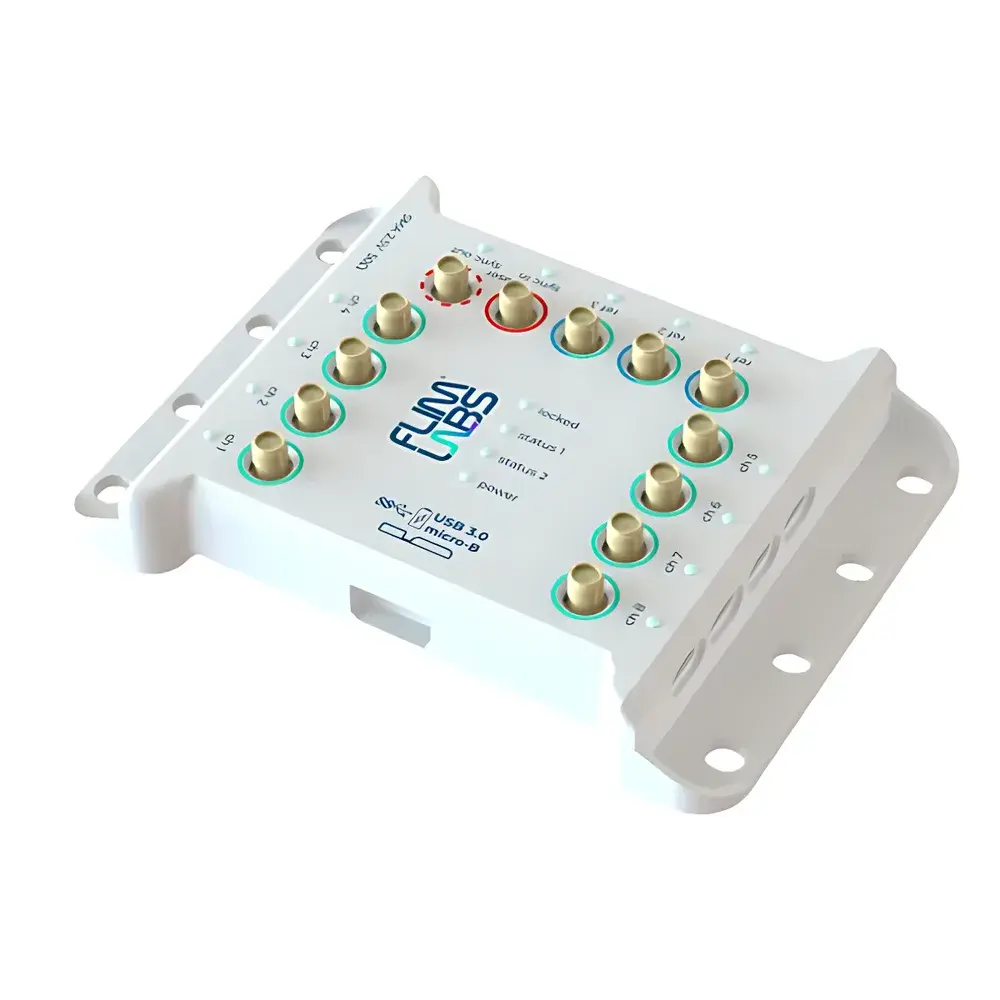
Auniontech Portable FLIM Fluorescence Lifetime Measurement TDC
| Brand | Auniontech |
|---|---|
| Origin | Shanghai, China |
| Model | Time-to-Digital Converter for FLIM |
| Channel Count | 26 |
| Time Resolution | 24 ps / 48 ps (configurable) |
| Single-Shot Timing Precision | < 300 ps (σ/√2) |
| Dead Time | 1.5 ns |
| Max Laser Sync Rate | 80 MHz |
| Differential Nonlinearity | < 0.5% RMS |
| Throughput | Up to 100 M counts/sec |
| Peak Count Rate per Channel | 640 Mcounts/s |
| Input Interface | 11 × SMA LVTTL 50 Ω (single-ended), 1 × SMA Laser Trigger In, 1 × SMA Laser Trigger Out, 13 × USB-C LVDS I/O (reconfigurable) |
| Power | USB-powered |
| Operating Systems | Windows, Linux |
Overview
The Auniontech Portable FLIM Fluorescence Lifetime Measurement TDC is a compact, USB-powered time-to-digital converter engineered for high-fidelity fluorescence lifetime imaging (FLIM) and time-resolved spectroscopy in laboratory, field-deployable, and mobile research environments. Based on time-correlated single-photon counting (TCSPC) architecture, the device precisely measures photon arrival times relative to a laser excitation pulse—enabling quantitative extraction of nanosecond-scale fluorescence decay kinetics. Its core functionality centers on ultrafast timing discrimination with sub-300 ps single-shot precision (σ/√2), supporting both phasor-based and multi-exponential decay analysis without requiring bulky rack-mounted electronics or external power supplies. Designed for integration into custom optical setups—including confocal, widefield, and fiber-coupled FLIM systems—the TDC operates as a modular timing engine compatible with pulsed diode lasers, supercontinuum sources, and SPAD/PMT detectors.
Key Features
- USB-powered portability: No external power supply required; operational in lab, cleanroom, or outdoor settings with stable USB 3.2 Gen 2 (10 Gbps) connectivity.
- High-resolution timing: Configurable time-bin resolution of 24 ps or 48 ps across all 26 input channels, optimized for resolving complex multi-component decays.
- Low dead time architecture: 1.5 ns dead time enables accurate high-count-rate measurements up to 640 Mcounts/s per channel, minimizing pile-up distortion in dense photon flux conditions.
- Flexible I/O synchronization: 11 SMA LVTTL inputs support pixel-, line-, and frame-clock routing for camera-synchronized FLIM acquisition; dedicated laser trigger input/output enables precise modulation of picosecond laser drivers (e.g., gain-switched diodes or mode-locked oscillators).
- Reconfigurable LVDS interface: 13 USB-C LVDS lines provide bidirectional programmable signaling for integration with AO deflectors, piezo stages, galvanometers, or FPGA-based control systems.
- Real-time data throughput: Sustained acquisition at up to 100 million timestamp events per second, with on-device buffering and low-latency streaming to host memory.
Sample Compatibility & Compliance
The TDC supports direct interfacing with industry-standard single-photon detectors—including silicon SPADs, MCP-PMTs, and hybrid photodetectors—across visible to near-infrared spectral ranges (400–900 nm). It is compatible with pulsed excitation sources operating from 10 kHz to 80 MHz repetition rates, including diode lasers (e.g., 405 nm, 488 nm, 640 nm), OPOs, and Ti:sapphire systems. The hardware and software stack are designed to meet GLP-compliant data integrity requirements: all timestamps are stored with monotonic clock references, and software enforces audit-trail logging for acquisition parameters, calibration history, and user actions. While not certified for clinical diagnostics, the system adheres to general-purpose instrumentation standards aligned with ISO/IEC 17025 principles for measurement traceability and uncertainty quantification.
Software & Data Management
The included cross-platform software suite (Windows/Linux) provides real-time histogram reconstruction, phasor plot generation, and decay curve fitting using nonlinear least-squares or maximum-likelihood estimation. Phasor analysis includes AI-assisted clustering algorithms to automatically segment heterogeneous lifetime distributions within FLIM datasets. A comprehensive API supports Rust, C, C++, C#, Python, Node.js, and .NET bindings for custom pipeline development. Export formats include HDF5 (with metadata schema compliant with the FLIM community’s open-data conventions), MATLAB (.mat), SVG vector graphics for publication-ready phasor diagrams, and standardized FLIM metadata tags (e.g., FLIMX, PHASOR-XML). Cloud synchronization is implemented via encrypted HTTPS endpoints supporting AWS S3 and Azure Blob storage backends. All exported results retain full traceability: timestamps, instrument configuration, laser sync jitter logs, and detector bias settings are embedded in metadata headers.
Applications
- Fluorescence Lifetime Imaging Microscopy (FLIM): Enables rapid, quantitative mapping of molecular microenvironments (e.g., pH, ion concentration, oxygen tension) via lifetime-sensitive probes such as FRET reporters, NAD(P)H, and fluorescent proteins (mCherry, EGFP).
- Phasor-based FLIM Analysis: Delivers intuitive graphical representation of lifetime heterogeneity; eliminates need for iterative exponential fitting and supports real-time classification of spectrally overlapping fluorophores.
- Fluorescence Correlation Spectroscopy (FCS): Provides high-temporal-resolution photon stream processing for autocorrelation function computation, enabling diffusion coefficient, concentration, and molecular brightness quantification at single-molecule sensitivity.
- Förster Resonance Energy Transfer (FRET): Measures donor–acceptor distance changes with sub-nanometer resolution through lifetime quenching analysis, applicable to protein–protein interaction studies and conformational dynamics.
- Near-Infrared Spectroscopy (NIRS) Timing Validation: Serves as a reference timing module for validating time-of-flight (ToF) response in diffuse optical tomography systems.
FAQ
Is this TDC compatible with third-party TCSPC software platforms such as SymPhoTime or Becker & Hickl SPCM?
Yes—the device exposes raw timestamp streams via memory-mapped buffers and supports standard TCSPC file formats (e.g., .ptu, .sdt) through optional conversion utilities. API access allows direct integration into custom or vendor-agnostic acquisition frameworks.
What laser synchronization jitter specifications does the TDC support?
The laser trigger input accepts LVTTL signals with < 50 ps RMS jitter tolerance; internal timing reference is derived from a low-phase-noise OCXO (±50 ppb stability over 0–40°C), ensuring sub-100 ps long-term timing reproducibility.
Can multiple TDC units be synchronized for multi-detector FLIM configurations?
Yes—via the configurable LVDS interface, one unit can act as master clock distributor while others operate as slaves, achieving inter-unit skew < 200 ps across daisy-chained deployments.
Does the software support batch processing of large FLIM datasets?
Yes—command-line tools enable headless processing of terabyte-scale .h5 files, including parallelized phasor transformation, background subtraction, and intensity-normalized lifetime histogram generation.
Are calibration certificates and uncertainty budgets available upon request?
Traceable calibration reports (including time-bin linearity, DNL, and channel-to-channel skew characterization) are provided with each unit; extended uncertainty budgets (k=2) conforming to GUM guidelines are available under NIST-traceable metrology service agreements.



