
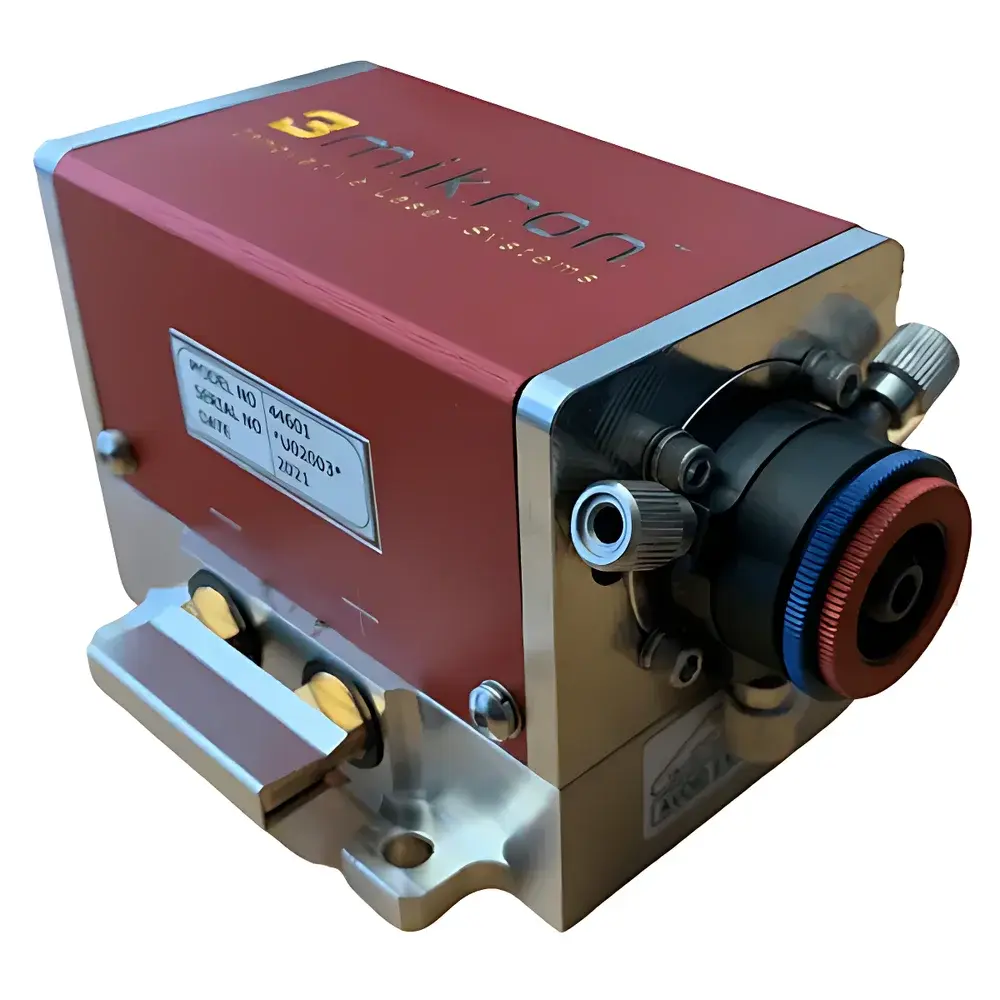
Auniontech Er:YAG Pulsed Laser System (2940 nm)
| Brand | Auniontech |
|---|---|
| Wavelength | 2940 nm |
| Laser Medium | Erbium-doped Yttrium Aluminum Garnet (Er:YAG) |
| Operation Mode | Pulsed |
| Pump Source | Diode-pumped |
| Pulse Duration | < 250 µs |
| Repetition Rate | Adjustable (1–50 Hz typical) |
| Average Output Power | Up to 50 W |
| Beam Quality (M²) | < 1.3 |
| Water Absorption Coefficient | ~12,000 cm⁻¹ (at 2940 nm) |
| Compliance | ISO 13697, IEC 60825-1:2014 Class 4 Laser Product |
| Cooling | Air or Closed-loop Water |
| Fiber Coupling | Optional (ZBLAN or Hollow-Core Silica Fiber) |
Overview
The Auniontech Er:YAG Pulsed Laser System operates at a precisely defined wavelength of 2940 nm—coincident with the strongest fundamental vibrational absorption peak of liquid water (OH-stretch mode). This spectral alignment enables exceptional energy deposition within aqueous biological tissues, resulting in highly localized ablation with minimal thermal diffusion. As a diode-pumped solid-state (DPSS) laser, it replaces traditional flashlamp-pumped Er:YAG systems with superior wall-plug efficiency, reduced thermal load, and enhanced long-term stability. Engineered for continuous-duty operation (24/7), the system delivers pulse energies up to several hundred millijoules at repetition rates spanning 1–50 Hz, with pulse widths configurable below 250 µs. Its near-diffraction-limited beam quality (M² < 1.3) ensures consistent focusability for precision applications in medical microsurgery, dental hard-tissue ablation, and non-metallic material processing.
Key Features
- Optimized 2940 nm emission matching the peak water absorption coefficient (~12,000 cm⁻¹), exceeding CO₂ laser absorption by 10× and Ho:YAG (2100 nm) by 200×
- Diode-pumped architecture enabling >30% optical-to-optical conversion efficiency and eliminating high-voltage flashlamp drivers
- Thermally robust monolithic resonator design with integrated air or closed-loop water cooling—reducing footprint by >40% vs. lamp-pumped equivalents
- Configurable pulse duration (<250 µs) and repetition rate (1–50 Hz) for tunable ablation depth and thermal confinement
- Optional fiber coupling via low-OH ZBLAN or hollow-core silica fibers—enabling flexible delivery for endoscopic or handheld medical platforms
- Compliant with IEC 60825-1:2014 Class 4 safety requirements and equipped with interlock-ready control interfaces for integration into regulated clinical environments
Sample Compatibility & Compliance
The Er:YAG laser interacts selectively with hydrated substrates, making it intrinsically compatible with soft and hard biological tissues—including skin epidermis, dentin, enamel, corneal stroma, and mucosal membranes—without requiring exogenous chromophores. In industrial settings, it processes polymers, composites, paper, textiles, foams, and thin-film coatings where thermal sensitivity precludes CO₂ or Nd:YAG use. All systems are manufactured under ISO 9001-certified processes and conform to essential health and safety requirements per EU Directive 2014/35/EU (Low Voltage Directive) and 2014/30/EU (EMC Directive). For clinical deployment, the laser supports audit-ready operation logs and meets foundational criteria for GLP-compliant tissue ablation studies per ISO 10993-1.
Software & Data Management
The embedded control firmware provides real-time monitoring of pulse energy, repetition rate, coolant temperature, and diode current via RS-232, USB-C, or Ethernet (TCP/IP). Optional PC-based software enables parameter scripting, shot-count tracking, and export of timestamped ablation metrics in CSV or HDF5 format. When integrated into FDA-regulated workflows, the system supports 21 CFR Part 11-compliant user authentication, electronic signatures, and immutable audit trails—facilitating validation for QSR and GMP environments. No proprietary runtime environments or dongle dependencies are required; all drivers are WHQL-certified for Windows 10/11 LTSB.
Applications
- Dermatology: Ablative resurfacing for photodamage, actinic keratosis, seborrheic keratosis, and superficial vascular lesions—with sub-10 µm thermal damage zone (TDZ) and epithelial recovery within 3–5 days
- Dentistry: Caries removal, cavity preparation, osseous surgery, and periodontal pocket decontamination—achieving >6 mm cutting depth in cortical bone while preserving adjacent pulp vitality
- Ophthalmology: Precise corneal lamellar dissection and stromal sculpting in refractive and therapeutic keratectomy protocols
- Materials Processing: Micromachining of polyimide flex circuits, drilling of hydrogel-based biosensors, and selective ablation of polymer-coated stents without substrate carbonization
- Research: Time-resolved thermography of laser-tissue interaction dynamics, comparative ablation threshold mapping across tissue analogs, and LIBS-compatible elemental analysis of calcified tissues
FAQ
What is the typical ablation threshold for human skin using this Er:YAG system?
Fluence thresholds range from 0.5–2.5 J/cm² depending on hydration level and epidermal thickness; precise values require in situ calibration per ISO 13697 Annex B.
Can the laser be integrated with robotic surgical platforms?
Yes—standard TTL and analog voltage interfaces support synchronization with motion controllers compliant with IEC 61508 SIL-2 functional safety requirements.
Is fiber delivery validated for clinical use in dental applications?
ZBLAN fiber-coupled configurations have demonstrated >95% transmission stability over 10⁶ pulses at 2940 nm and are CE-marked for Class IIa medical devices under MDR 2017/745.
How does thermal management compare to flashlamp-pumped Er:YAG lasers?
Diode pumping reduces waste heat by ~60%, allowing air-cooled operation up to 30 W average power and extending diode lifetime beyond 10,000 hours under continuous duty.
Are OEM customization options available for system integration?
Auniontech offers mechanical, electrical, and optical interface adaptations—including custom beam shaping optics, OEM housing designs, and embedded FPGA-based pulse control modules—under NDA.



