
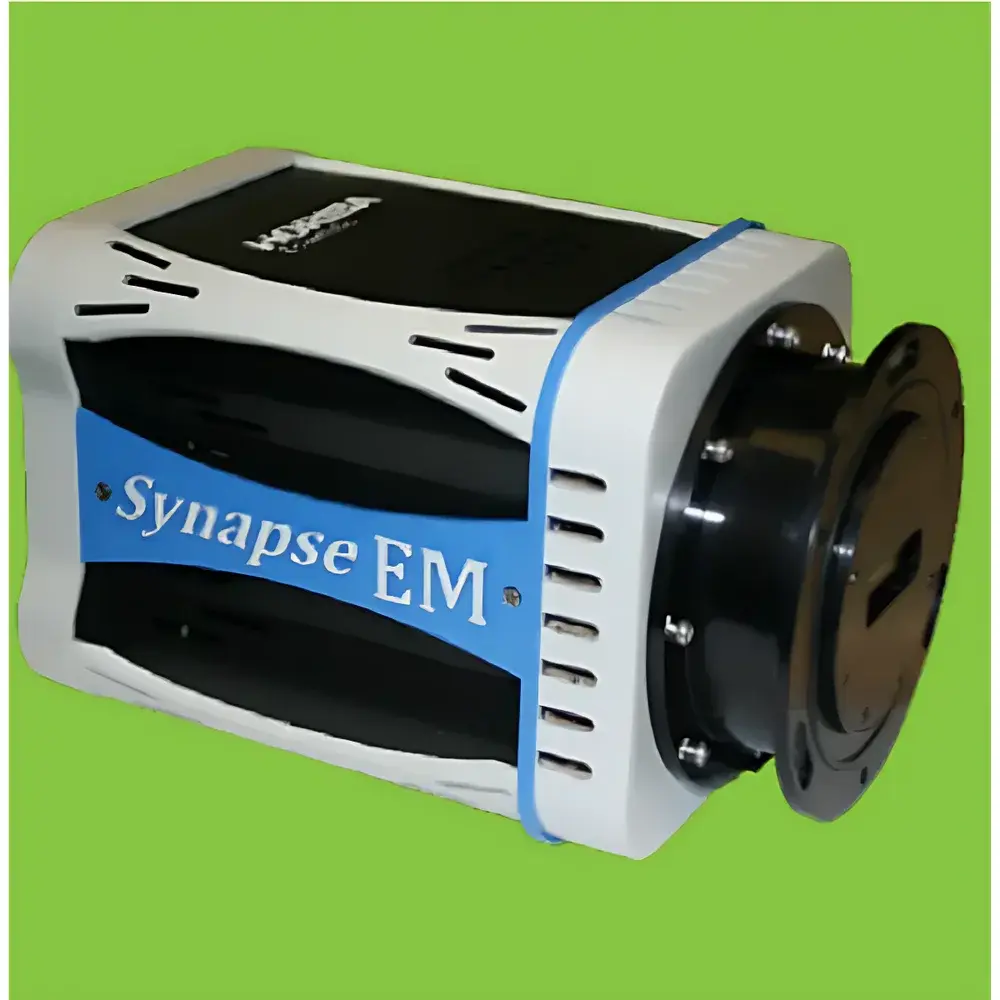
Auniontech EMCCD Camera Series – High-Sensitivity Electron-Multiplying CCD Imaging System for Low-Light Scientific Applications
| Brand | Auniontech |
|---|---|
| Sensor Format | 1600 × 200 or 1600 × 400 pixels |
| Pixel Size | 16 µm × 16 µm |
| Image Area | 25.6 mm × 3.2 mm or 25.6 mm × 6.4 mm |
| QE Enhancement | Back-Illuminated Quantum Efficiency (BIQE) technology with fused-silica vacuum window |
| Cooling | Thermoelectric cooling to –60°C (guaranteed), –75°C typical (air- or liquid-cooled) |
| Dark Current | < 0.0025 e⁻/pixel/s at –60°C (FI-BI), < 0.015 e⁻/pixel/s (BI) |
| Readout Noise | < 1 e⁻ RMS in EM mode (typical), < 60 e⁻ RMS in high-sensitivity CCD mode |
| EM Gain Range | 1–1000, software-controlled |
| Readout Speed | Up to 3 MHz (EM mode) |
| Non-linearity | < 0.75% (measured across all readout speeds) |
| Digitization | 16-bit ADC |
| Vertical Shift Rates | 4.9, 9.6, 19 µs (software-selectable) |
| Gain Calibration | Software-adjustable conversion gain (0.6–4.0 e⁻/count in HS mode |
| Register Well Depth | 300,000 e⁻ (HS mode), 1,300,000 e⁻ (EM mode) |
| Output Interface | Standard Camera Link or USB 3.0 (model-dependent) |
| Compliance | CE, RoHS, ISO 9001-certified manufacturing and quality control |
Overview
The Auniontech EMCCD Camera Series is a high-performance, thermoelectrically cooled electron-multiplying charge-coupled device imaging system engineered for quantitative low-light scientific applications requiring single-photon sensitivity and high temporal resolution. Based on back-illuminated (BI) EMCCD sensor architecture, the camera leverages on-chip electron multiplication gain—applied prior to analog-to-digital conversion—to overcome the fundamental limitations of read noise in conventional CCDs. This enables effective sub-electron read noise performance (95% at 550–700 nm. Its dual-readout capability—switching seamlessly between standard high-sensitivity CCD and electron-multiplying modes—provides operational flexibility across illumination regimes without hardware reconfiguration.
Key Features
- Back-illuminated EMCCD sensors available in two configurations: 1600 × 200 and 1600 × 400 active pixels, both with uniform 16 µm × 16 µm pixel geometry for consistent spatial sampling and optical magnification scalability.
- Deep thermoelectric cooling to –60°C (guaranteed) and –75°C (typical), achieved via integrated air- or liquid-recirculation thermal management—critical for suppressing dark current to <0.0025 e⁻/pixel/s in front-illuminated BI variants and maintaining long-exposure fidelity.
- Electron multiplication register with digitally calibrated gain range of 1–1000, enabling precise signal amplification while preserving linearity (<0.75% non-linearity across all operating speeds).
- High-speed 3 MHz serial readout architecture supports real-time spectral acquisition at up to 1613 spectra per second—ideal for multichannel or multi-track dispersive spectroscopy systems requiring synchronized frame capture and minimal dead time.
- Fused-silica vacuum-sealed package eliminates internal reflections and absorption losses, ensuring broadband transmission stability from UV to NIR and compatibility with vacuum-compatible optical benches and cryogenic stages.
- Dual-mode operation: users select between high-sensitivity CCD mode (optimized for moderate-light conditions with 300 ke⁻ full-well capacity) and EM mode (1.3 Me⁻ effective well depth with gain-enabled dynamic range extension).
Sample Compatibility & Compliance
The Auniontech EMCCD Camera is designed for integration into regulated and research-grade optical platforms, including confocal microscopes, spectrometers, streak cameras, and custom-built quantum optics setups. Its mechanical footprint, C-mount interface, and standardized digital output (Camera Link or USB 3.0, depending on model variant) ensure drop-in compatibility with major OEM instrumentation. From a compliance standpoint, the camera conforms to IEC 61000-6-3 (EMC emissions), IEC 61000-6-2 (immunity), and RoHS 2015/863/EU directives. Manufacturing adheres to ISO 9001:2015 quality management standards. While not inherently FDA 21 CFR Part 11-compliant as a standalone device, its data output architecture supports traceable acquisition workflows when deployed within validated laboratory information management systems (LIMS) or GLP/GMP-compliant environments—particularly when paired with timestamped metadata logging and audit-trail-enabled acquisition software.
Software & Data Management
Auniontech provides native SDKs for Windows (C/C++, C#, Python) and Linux (C/C++, Python), supporting full remote control of exposure time, EM gain, vertical/horizontal binning, region-of-interest (ROI) selection, and cooling setpoint. Acquisition software includes real-time histogram analysis, dark-frame subtraction, flat-field correction, and non-uniformity calibration tools—all compliant with NIST-traceable intensity calibration protocols. Raw image data is saved in FITS or TIFF format with embedded EXIF-style metadata (timestamp, temperature, gain setting, exposure duration). For regulatory environments, optional software modules enable electronic signature enforcement, user access level control, and immutable audit trails—facilitating alignment with GLP and GMP documentation requirements. All firmware updates are digitally signed and delivered via secure HTTPS channels.
Applications
- Ultra-low-light fluorescence lifetime imaging (FLIM): Sub-nanosecond temporal resolution enabled by gated acquisition synchronized with pulsed laser sources.
- Raman spectroscopy: Detection of weak Stokes/anti-Stokes signals under ambient or low-laser-power conditions without compromising spectral fidelity.
- Single-particle tracking and super-resolution microscopy (PALM/STORM): Precise centroid localization accuracy down to ~10 nm using photon-limited point-spread function fitting.
- Astronomical photometry and adaptive optics wavefront sensing: High dynamic range and low dark current support long integrations on faint stellar targets.
- Time-resolved luminescence in material science: Quantitative decay curve fitting for phosphors, quantum dots, and perovskite emitters under nanosecond excitation pulses.
- Bioluminescence and chemiluminescence assays: Label-free detection of enzymatic activity in microplate readers and flow-cell systems.
FAQ
What is the difference between EMCCD and ICCD technology?
EMCCDs use on-chip electron multiplication prior to readout, offering superior quantum efficiency (>90%) and no gating latency, whereas ICCDs rely on intensifier tubes with lower QE (~20–30%) and limited lifetime due to photocathode degradation.
Can this camera be used in vacuum environments?
Yes—the sealed fused-silica vacuum window allows direct mounting onto vacuum chambers with appropriate flange adapters; operational pressure range: 10⁻⁶ to 760 Torr.
Is cooling performance affected by ambient temperature fluctuations?
No—the integrated closed-loop thermal controller maintains stable sensor temperature within ±0.1°C regardless of ambient drift between 15–30°C, provided adequate heat dissipation (airflow ≥1 m/s or liquid coolant flow ≥1 L/min).
How is EM gain calibrated and verified?
Each unit undergoes factory calibration using photon-transfer curve (PTC) analysis; gain values are stored in non-volatile memory and accessible via software API for traceable recalibration.
Does the camera support hardware triggering and synchronization?
Yes—TTL-compatible input/output ports support external trigger, gate, and sync signals with jitter <10 ns, enabling precise coordination with lasers, shutters, and scanning mirrors.




