Corning Advanced Optical Glass Materials (HPFS 7979/7980/8655, ULE® 7973, Gorilla Armor 2, Gorilla Glass Ceramic 2)
| Brand | Corning |
|---|---|
| Distributed by | Auniontech |
| Origin | Shanghai, China |
| Distribution Status | Authorized Distributor |
| Product Type | Fused Silica & Low-Expansion Optical Glass Substrates |
| Compliance | ASTM E1545, ISO 10110-3, MIL-G-17465A (applicable grades) |
| Certification | Lot-specific CoC per batch |
Overview
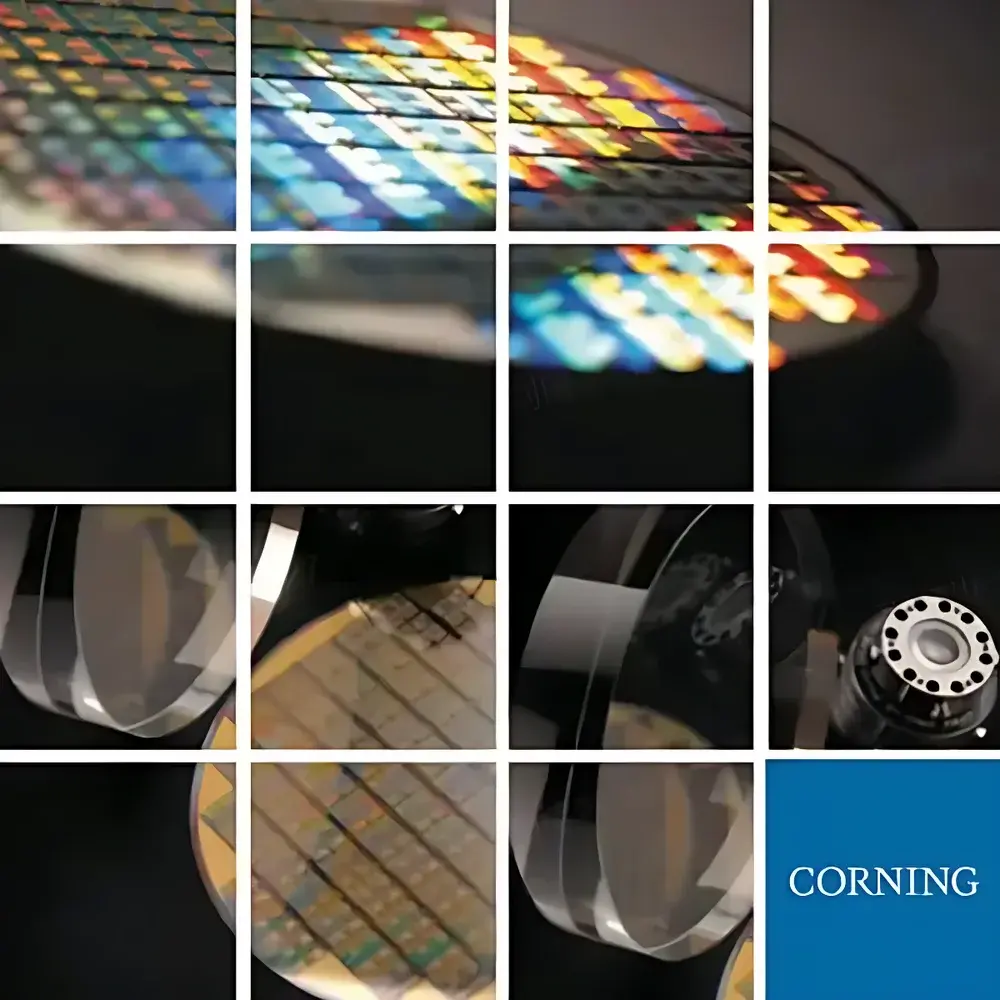
Corning Advanced Optical Glass Materials represent a family of high-purity, precision-engineered optical substrates designed for mission-critical applications in photolithography, high-power laser systems, astronomical instrumentation, semiconductor metrology, and next-generation display technologies. These materials are not generic “glass”—they are compositionally controlled, thermally stabilized, and optically homogenized products manufactured under stringent process controls. Key families include Corning HPFS® fused silica (grades 7979, 7980, and 8655), Corning ULE® ultra-low expansion glass (7973), and Corning Gorilla Armor 2 and Gorilla Glass Ceramic 2—engineered glass-ceramic composites for durable, high-transmission cover optics. Each grade is defined by its coefficient of thermal expansion (CTE), hydroxyl (OH⁻) content, refractive index homogeneity, UV–IR transmission range, and intrinsic birefringence—parameters rigorously verified via interferometric mapping, spectral ellipsometry, and dilatometric analysis.
Key Features
- HPFS® Fused Silica (7979/7980/8655): Ultra-low metallic impurity content (<1 ppb Fe, Cr, Ni), OH⁻ concentration tunable from 1000 ppm (wet), CTE ≈ 5.5 × 10⁻⁷ /°C (20–300°C), transmission >99.5% at 193 nm (7980), and exceptional radiation resistance—validated for excimer laser optics and synchrotron beamline components.
- ULE® 7973: Zero-CTE glass-ceramic (±3 ppb/°C over 0–50°C), fabricated via flame hydrolysis deposition and controlled crystallization. Engineered for EUV lithography mask blanks and space telescope primary mirrors where sub-nanometer dimensional stability over thermal transients is non-negotiable.
- Gorilla Armor 2: Anti-reflective glass-ceramic with integrated nanostructured AR coating; surface reflectance 700 HV; impact survivability up to 2.2 m drop onto simulated concrete (per Corning internal ASTM D3029-compliant testing).
- Gorilla Glass Ceramic 2: Phase-separated lithium aluminosilicate matrix with controlled nanocrystallite dispersion (≈10–20 nm); achieves fracture toughness KIC > 1.2 MPa·m½ while maintaining >91% visible transmittance; strengthened via dual-stage ion exchange (K⁺/Na⁺ diffusion profile optimized for edge compression).
- All materials are supplied with full traceability: lot-specific Certificate of Conformance (CoC), interferometric flatness maps (λ/20 PV typical), and spectral transmission reports (200–2500 nm).
Sample Compatibility & Compliance
Corning optical glasses are compatible with standard optical fabrication processes—including CNC grinding, magnetorheological finishing (MRF), ion-beam figuring (IBF), and multi-layer dielectric coating (e.g., Ta₂O₅/SiO₂ stacks). All HPFS and ULE grades comply with ISO 10110-3 (surface form tolerance), ISO 10110-7 (striae limits), and ASTM E1545 (optical glass identification). For regulated environments, documentation supports GLP/GMP audit readiness: raw material traceability, environmental exposure logs (humidity/temperature during storage), and QC test records archived for ≥10 years. ULE® 7973 meets SEMI F57 specifications for EUV mask substrate dimensional stability. Gorilla Armor 2 and Gorilla Glass Ceramic 2 conform to IEC 60950-1 mechanical safety standards and pass ISO 12095 abrasion testing (CS-10 wheels, 1000 cycles).
Software & Data Management
While Corning optical substrates are passive components, their integration into system-level qualification workflows requires rigorous data management. Auniontech provides digital delivery of all certification packages in PDF/A-1b format, including spectral transmission curves (CSV export), interferograms (Zemax .ZBF), and metrology reports (ASME B89.3.1 compliant). For OEM customers, secure API access is available to Corning’s Material Data Portal—enabling real-time validation of lot-specific CTE, density, and stress-optic coefficients against master calibration databases. All records support FDA 21 CFR Part 11 electronic signature compliance when deployed with validated e-signature platforms.
Applications
- Lithography: ULE® 7973 substrates for 13.5 nm EUV reticles; HPFS 7980 for 193 nm ArF immersion lenses and pellicles.
- Astronomy: HPFS 7979 blanks for segmented mirror segments (e.g., GMT, TMT secondary mirrors); ULE® 7973 for adaptive secondary mirrors requiring zero thermal drift.
- Laser Systems: HPFS 8655 for high-energy Nd:YAG amplifier slabs (1064 nm, >10 J/cm² fluence); radiation-hardened variants for fusion diagnostics.
- Consumer Electronics: Gorilla Armor 2 in flagship smartphone displays (e.g., Samsung Galaxy S25 Ultra) requiring simultaneous scratch resistance, anti-glare performance, and optical clarity; Gorilla Glass Ceramic 2 in foldable device hinge zones demanding cyclic flexural reliability (>200,000 folds).
- Quantum Technologies: Low-birefringence HPFS 7979 windows for vacuum feedthroughs in cold atom traps; ULE® substrates for Fabry–Pérot cavities requiring Q > 10¹¹.
FAQ
Are Corning optical glass materials available in custom geometries or coatings?
Yes—Auniontech offers CNC shaping, edge deletion, wedge correction, and thin-film coating (AR, HR, dichroic) via partner cleanroom facilities certified to ISO Class 5. Lead time for custom orders is typically 8–12 weeks.
What is the difference between HPFS 7979 and 7980?
HPFS 7979 features lower OH⁻ content (<1 ppm) and superior deep-UV transmission below 185 nm; HPFS 7980 contains higher OH⁻ (~100–300 ppm), offering improved IR transmission above 2.7 µm and enhanced resistance to solarization under prolonged 248 nm exposure.
Can ULE® 7973 be polished to λ/10 surface figure?
Yes—ULE® 7973 accepts deterministic polishing to λ/10 PV (633 nm) on apertures up to Ø600 mm. Surface roughness RMS <0.2 nm is achievable using ion-beam finishing, with residual stress <5 MPa measured via photoelastic imaging.
Do Gorilla Armor 2 and Gorilla Glass Ceramic 2 meet RoHS and REACH requirements?
Yes—both materials are fully compliant with EU Directive 2011/65/EU (RoHS) and Regulation (EC) No 1907/2006 (REACH), with full SVHC declaration available upon request.