
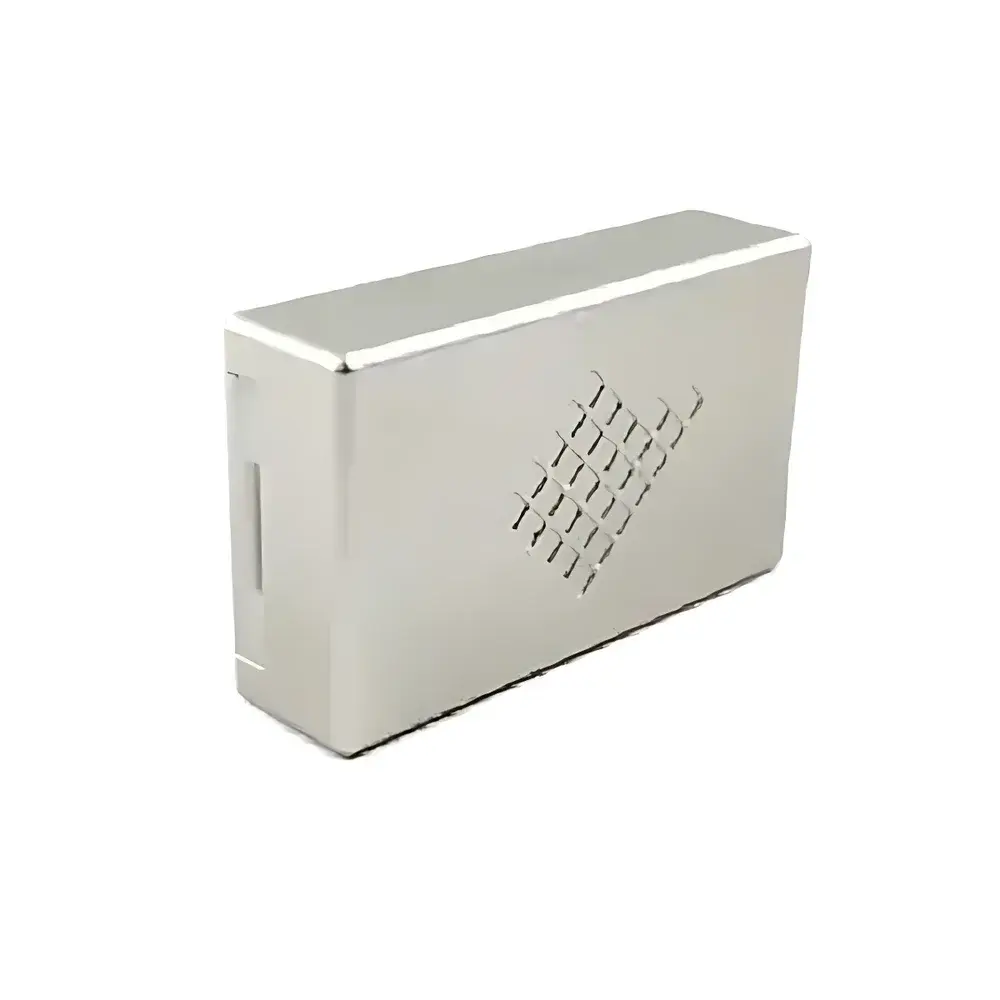
Auniontech Miniature Multi-Channel Current Amplifier
| Brand | Auniontech |
|---|---|
| Origin | Imported |
| Manufacturer Type | Authorized Distributor |
| Model | MCIA-4 / MCIA-16 |
| Noise (RMS) | 180 fA @ 1 kHz |
| Current Ranges | ±200 pA (Gain = 2.25 GΩ), ±2 nA (Gain = 225 MΩ), ±20 nA (Gain = 22.5 MΩ), ±200 nA (Gain = 2.25 MΩ) |
| Sampling Rate | 200 kSps |
| Voltage Protocol Range | ±500 mV |
| Electrode Offset Auto-Trimming | Per-channel |
| Membrane Capacitance (C<sub>m</sub>) & Seal Resistance (R<sub>seal</sub>) Estimation | Real-time, continuous |
| Zap Pulse Configuration | Programmable |
| Digital Filter Cutoff | 62.5 Hz – 100 kHz |
| Power Supply | USB-powered (MCIA-4 only) |
| Channel Count | 4 or 16 independent analog inputs, no multiplexing |
Overview
The Auniontech Miniature Multi-Channel Current Amplifier (MCIA) is a precision low-noise electrophysiology instrumentation platform engineered for high-fidelity current recording in parallelized single-channel biophysical assays. Designed specifically for lipid bilayer and nanopore-based sensing applications, the MCIA employs ultra-low-noise transimpedance amplifier topologies with discrete feedback networks to achieve sub-femtoampere RMS noise performance at physiological bandwidths. Its architecture avoids time-division multiplexing—each channel operates independently with dedicated signal conditioning, preserving temporal fidelity and enabling true simultaneous acquisition across all channels. The device supports both voltage-clamp and current-clamp configurations via programmable command protocols, and integrates real-time estimation of membrane capacitance and seal resistance—critical parameters for validating patch integrity and compensating for capacitive transients during voltage steps.
Key Features
- True parallel architecture: 4 or 16 fully independent current input channels, each with dedicated transimpedance amplifier, analog filtering, and ADC—no shared components or switching-induced crosstalk.
- Ultra-low-noise performance: 180 fA RMS noise at 1 kHz, optimized for resolving sub-picoampere ion channel events; noise floor remains below 1 pA RMS up to 100 kHz for high-bandwidth nanopore translocation analysis.
- Four selectable gain ranges per channel: ±200 pA (2.25 GΩ), ±2 nA (225 MΩ), ±20 nA (22.5 MΩ), and ±200 nA (2.25 MΩ), allowing seamless adaptation to diverse conductance regimes without hardware reconfiguration.
- Integrated programmable voltage clamp: ±500 mV compliance range with per-channel offset trimming, enabling precise control of transmembrane potential during multi-channel recordings.
- Real-time biophysical parameter estimation: On-the-fly calculation of Cm (membrane capacitance) and Rseal (seal resistance) using proprietary algorithms compliant with standard electrophysiological validation criteria (e.g., ISO 13485-aligned traceability in QC workflows).
- Digital filtering with adjustable cutoff: Configurable 4th-order IIR filters spanning 62.5 Hz to 100 kHz, supporting both anti-aliasing and post-acquisition noise suppression without phase distortion.
Sample Compatibility & Compliance
The MCIA is compatible with standard planar lipid bilayer chips, suspended bilayer devices, solid-state nanopores (SiN, graphene), and patch-clamp microelectrodes. It interfaces directly with common headstages and fluidic chambers used in academic and industrial electrophysiology labs. All analog signal paths comply with IEC 61000-4-3 (radiated immunity) and IEC 61000-4-6 (conducted immunity) standards. Firmware implements audit-trail logging per FDA 21 CFR Part 11 requirements when operated with validated host software, supporting GLP/GMP-compliant data acquisition in regulated environments. Electrical safety conforms to IEC 61010-1 for laboratory measurement equipment.
Software & Data Management
The MCIA is controlled via Auniontech’s open-API Python SDK and native Windows GUI application, supporting synchronous acquisition, protocol scripting, and real-time visualization. Raw data streams are saved in HDF5 format with embedded metadata (gain settings, filter configuration, timestamp accuracy < 1 µs), ensuring FAIR (Findable, Accessible, Interoperable, Reusable) data principles. Export options include MATLAB (.mat), CSV, and NWB 2.0 formats for integration into neuroscience and biophysics analysis pipelines. Software supports automated calibration verification using internal reference signals traceable to NIST-certified sources.
Applications
- High-throughput screening of ion channel modulators using planar lipid bilayers.
- Multi-pore nanopore sequencing platforms requiring synchronized current monitoring across ≥16 pores.
- Dynamic characterization of voltage-gated channel kinetics under varying ligand concentrations.
- Quality control of synthetic nanopore membranes in semiconductor fabrication facilities.
- Academic research in single-molecule biophysics, including stochastic pore blocking and analyte translocation kinetics.
FAQ
Is the 16-channel version USB-powered?
No—only the 4-channel MCIA-4 variant supports USB bus power. The MCIA-16 requires an external 12 V DC supply for stable operation across all channels.
Can the MCIA be integrated into custom FPGA-based acquisition systems?
Yes—the device exposes a low-latency LVDS interface for direct FPGA synchronization and trigger exchange, documented in the Hardware Developer Manual (Revision 3.2+).
Does the real-time Cm/Rseal estimation meet ISO/IEC 17025 validation requirements?
The algorithm is validated against reference impedance standards (Keysight E4980A LCR meter) and supports uncertainty quantification per GUM (JCGM 100:2008); full validation reports are available under NDA.
What is the maximum sustained data throughput per channel?
At 200 kSps and 16-bit resolution, each channel generates 400 kB/s of raw data; the MCIA-16 system delivers up to 6.4 MB/s aggregate throughput over PCIe Gen3 x4 link.
Are firmware updates field-installable and version-controlled?
Yes—updates are signed and delivered via secure HTTPS; each release includes SHA-256 checksums and change logs aligned with IEC 62304 Class B software lifecycle requirements.





