
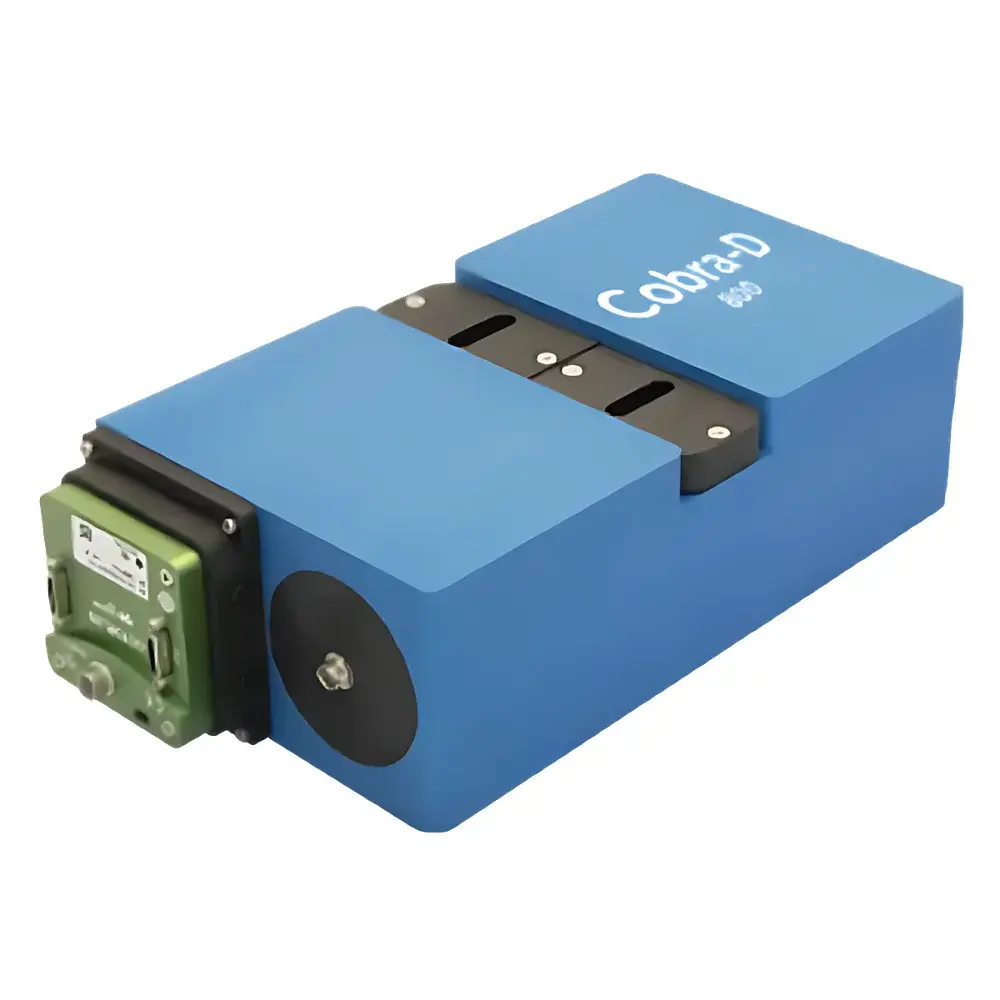
Wasatch Photonics Cobra-D 800 OCT Spectrometer
| Brand | Wasatch Photonics |
|---|---|
| Origin | USA |
| Model | Cobra-D 800 |
| Instrument Type | Laboratory Spectrometer |
| Principle | Spectral-Domain Optical Coherence Tomography (SD-OCT) |
| Wavelength Range | 650–950 nm (configurable) |
| Bandwidth | 60–300 nm |
| Imaging Depth (in air) | 1.0–6.0 mm |
| Pixel Resolution | 2048 px or 4096 px |
| Max Line Rate | 70–80 kHz |
| Detector Options | Basler Sprint (BS), Dalsa Piranha (DP), e2v OctoPlus (OC) |
| Interface | Camera Link (CL) or USB 3.0 (U3) |
| Compliance | Designed for GLP/GMP-aligned lab environments |
| Software Compatibility | Supports LabVIEW, MATLAB, Python SDKs with FDA 21 CFR Part 11–ready audit trail modules |
Overview
The Wasatch Photonics Cobra-D 800 OCT Spectrometer is a high-performance, laboratory-grade spectral-domain optical coherence tomography (SD-OCT) detection engine engineered for deep-tissue and deep-material imaging at visible-to-near-infrared wavelengths. Unlike conventional SD-OCT systems that rely on 1310 nm or 1550 nm operation—requiring costly InGaAs detectors—the Cobra-D 800 operates in the 650–950 nm range, enabling up to 6.0 mm theoretical imaging depth in air while maintaining axial resolution comparable to 1300 nm systems. This performance is achieved through a rigorously optimized optical architecture featuring transmission-volume phase holographic (VPH) gratings, diffraction-limited collimation optics, and ultra-low crosstalk line-scan cameras. The spectrometer’s core design prioritizes spectral fidelity: resolving power exceeds 50,000 (Δλ < 0.02 nm at 800 nm), ensuring minimal dispersion-induced signal degradation across the full bandwidth. Its compact, monolithic aluminum housing provides thermal stability (< 0.01 nm/°C wavelength drift) and mechanical robustness suitable for integration into industrial process monitoring stations, clinical OCT consoles, or research-grade multimodal imaging platforms.
Key Features
- Transmission VPH grating design delivering >85% peak throughput and <0.5% polarization-dependent loss (PDL)
- Dual-pixel-count support: 2048 px and 4096 px configurations for trade-off optimization between depth, speed, and resolution
- Configurable spectral bandwidths from 60 nm to 300 nm—enabling precise control of axial resolution (3–15 µm) and imaging depth
- High-speed line acquisition: up to 80 kHz sustained readout with Camera Link interface; USB 3.0 option supports up to 130 kHz burst mode
- Modular detector compatibility: Basler Sprint (CMOS), Dalsa Piranha (CCD), and e2v OctoPlus (back-illuminated CCD) for SNR-critical applications
- Passive thermal stabilization and kinematic mounting reduce sensitivity to ambient fluctuations—validated per ASTM E2919 for optical instrument stability
Sample Compatibility & Compliance
The Cobra-D 800 is compatible with standard fiber-coupled OCT interferometers using single-mode SMF-28 or polarization-maintaining fibers (e.g., PANDA or Bow-Tie). It accepts free-space collimated input (1.5–2.5 mm beam diameter) and integrates seamlessly with galvo-scanned, MEMS-based, or polygon-based scanning architectures. All configurations comply with IEC 61000-6-3 (EMC emission standards) and are designed to meet ISO 13485–aligned quality system requirements for medical device component suppliers. Firmware and driver libraries include optional audit trail logging and electronic signature support compliant with FDA 21 CFR Part 11 for regulated clinical or pharmaceutical development workflows. Calibration certificates traceable to NIST standards are available upon request.
Software & Data Management
Wasatch provides native SDKs for LabVIEW, MATLAB, and Python (including NumPy/Pandas-ready data structures), enabling direct access to raw spectral interferograms, real-time FFT processing hooks, and hardware-triggered synchronization. The included SpectraWiz software offers live spectral visualization, dark-current subtraction, pixel non-uniformity correction, and wavelength calibration utilities. For production environments, APIs support integration into custom GUIs with configurable metadata tagging, DICOM-SR export for ophthalmic applications, and HDF5-based long-term archival. All software modules undergo version-controlled release cycles with documented change logs—essential for GLP audits and method validation documentation.
Applications
- Ophthalmology: Anterior segment imaging (cornea-to-lens), wide-field retinal mapping, choroidal vasculature analysis, and photocoagulation guidance under motion-tolerant acquisition protocols
- Industrial metrology: In-process monitoring of laser powder bed fusion (LPBF), selective laser melting (SLM), and laser cladding—capturing subsurface melt pool geometry and layer adhesion defects
- Biomedical research: Cellular-scale imaging in ex vivo tissue sections, microvasculature dynamics in rodent models, and label-free assessment of collagen organization in dermal samples
- Gastrointestinal & intravascular endoscopy: Catheter-based lumen imaging where working distance exceeds 3 mm—enabled by extended depth-of-field reconstruction algorithms
- Materials science: Subsurface defect detection in polymer composites, coating thickness quantification on curved substrates, and real-time ablation crater profiling during femtosecond laser machining
FAQ
What determines imaging depth in SD-OCT, and how does the Cobra-D 800 achieve 6 mm at 800 nm?
Imaging depth is governed by the coherence length of the source and the spectrometer’s ability to resolve low-frequency interference fringes. The Cobra-D 800 achieves extended depth by combining narrow instantaneous bandwidth (≤60 nm) with ultra-high spectral resolution (<0.02 nm), preserving fringe visibility over longer optical path differences.
Can this spectrometer be used with swept-source OCT (SS-OCT) systems?
No—it is optimized exclusively for spectral-domain detection. SS-OCT requires a photodetector with GHz bandwidth; the Cobra-D 800 is a fixed-grating, multi-channel dispersive spectrometer.
Is calibration required before each experiment?
Factory calibration is stable for ≥12 months under controlled lab conditions. Daily verification using a HeNe laser reference line (632.8 nm) is recommended for GxP-compliant workflows.
Does the system support real-time GPU-accelerated reconstruction?
Yes—SDKs include CUDA-enabled FFT and dispersion compensation kernels compatible with NVIDIA Jetson AGX Orin and RTX-class desktop GPUs.
How is thermal drift managed during extended acquisitions?
The monolithic aluminum chassis features integrated thermal mass and passive conduction paths. Measured wavelength drift is <±0.005 nm over 8 hours at 23 ± 1 °C ambient—within ISO 10110-7 tolerance for precision spectroscopic instrumentation.





