
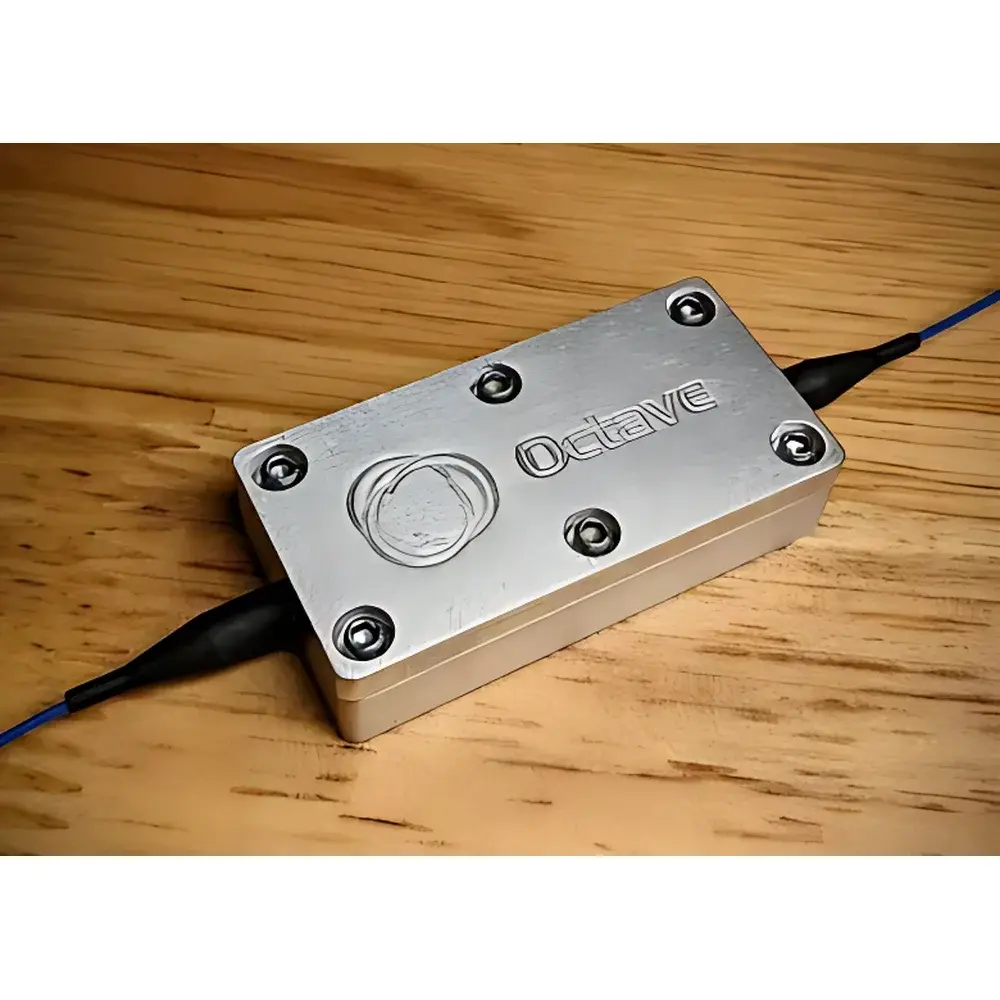
OCTave Photonics SC-Series Nonlinear Nanophotonic Waveguides for Supercontinuum Generation
| Origin | Imported |
|---|---|
| Manufacturer Type | Authorized Distributor |
| Model | SC-Series |
| Input Pulse Wavelength | ~1560 nm (SC-1560-780) / 1000–2000 nm (SC-Custom) |
| Input Pulse Energy | >150 pJ (SC-1560-780) / >100 pJ (SC-Custom) |
| Output Spectral Range | ~750–2000 nm (SC-1560-780) / Customizable (600–2500 nm) |
| Dispersion-Wavelength Peak | 780 nm (SC-1560-780) / Customizable |
| Input Fiber | PM1550 |
| Input Connector | FC/APC |
| Output Fiber | PM780 or Free-Space Beam |
| Output Connector | FC/APC or Collimating Lens |
| Dimensions | 50 × 25 × 12 mm (SC-1560-780) / Customizable |
| Average Power Handling | <2 W (SC-1560-780) / <4 W (SC-Custom) |
| Operating Temperature | –20 to +60 °C (SC-1560-780) / 0 to +40 °C (SC-Custom) |
| Polarization-Maintaining Output | Yes |
| Active Thermal Stabilization | Integrated |
| Power Handling Capacity | Multi-watt class |
Overview
The OCTave Photonics SC-Series Nonlinear Nanophotonic Waveguides are monolithic, chip-scale integrated devices engineered for efficient supercontinuum (SC) generation directly from femtosecond or picosecond pulsed laser sources. Unlike conventional nonlinear photonic crystal fibers, these waveguides leverage sub-micron silicon nitride (SiN) or stoichiometric silicon-rich nitride platforms to achieve ultra-low threshold supercontinuum generation via engineered dispersion and high Kerr nonlinearity. The device operates on the principle of soliton fission, dispersive wave radiation, and intrapulse four-wave mixing—enabling octave-spanning spectral broadening from a single, compact, alignment-free module. Designed for integration into metrology-grade optical frequency comb systems, ultrafast spectroscopy setups, and quantum optical instrumentation, the SC-Series delivers deterministic spectral shaping, polarization-maintained output, and long-term thermal stability without active realignment—making it suitable for deployment in GLP-compliant laboratories and OEM instrument platforms.
Key Features
- Chip-integrated nanophotonic waveguide architecture with sub-100-fs pulse compatibility
- Low-threshold supercontinuum generation: >150 pJ input energy sufficient for octave-spanning output (750–2000 nm)
- Engineered anomalous dispersion profile enabling controlled dispersive wave emission at 780 nm (SC-1560-780 variant)
- Hermetically sealed, actively temperature-stabilized housing (±0.1 °C regulation) for spectral reproducibility over extended operation
- Polarization-maintaining input (PM1550) and output (PM780 or free-space collimated beam) with extinction ratio >20 dB
- Multi-watt average power handling capability with optimized thermal management for continuous-wave-pumped or high-repetition-rate pulsed operation
- FC/APC input/output interfaces standard; optional free-space collimation with AR-coated aspheric lenses
Sample Compatibility & Compliance
The SC-Series is compatible with mode-locked fiber lasers (Er-doped, Yb-doped, or Tm-doped), optical parametric amplifiers (OPAs), and electro-optic frequency combs operating in the 1–2 µm window. It meets mechanical and environmental requirements per IEC 61326-1 (EMC for laboratory equipment) and is rated for operation in ISO Class 5 cleanroom environments. While not a medical or safety-critical device, its hermetic packaging and passive thermal design support compliance with ISO/IEC 17025 calibration traceability frameworks when used in accredited metrology labs. For frequency comb stabilization applications, the waveguide’s spectral repeatability and low timing jitter transfer (<1 fs RMS added jitter) enable direct use in f–2f interferometry meeting NIST-traceable measurement uncertainty budgets.
Software & Data Management
The SC-Series operates as a fully passive optical component and requires no embedded firmware or driver software. However, when integrated into frequency comb or ultrafast spectroscopy systems, it functions seamlessly with industry-standard control environments—including MATLAB-based acquisition scripts, Python (PyVISA, NumPy, SciPy), LabVIEW FPGA modules, and commercial lock-in amplifier suites (e.g., Zurich Instruments HF2LI). Its deterministic spectral response enables automated calibration routines for wavelength-dependent responsivity correction in spectrometer-coupled configurations. For GxP-regulated environments, full audit trails for operational parameters (temperature setpoint, ambient conditions, input pulse energy monitoring) can be maintained externally via integrated thermistor and photodiode feedback channels—supporting 21 CFR Part 11 compliance when paired with validated data acquisition software.
Applications
- f–2f self-referencing of Er-fiber frequency combs (e.g., COSMO module integration)
- Octave-spanning electro-optic (EO) comb stabilization and CEO detection
- Broadband coherent anti-Stokes Raman scattering (CARS) and stimulated Raman scattering (SRS) microscopy
- Time-resolved pump–probe spectroscopy across visible–NIR–MIR spectral regions
- Atomic clock interrogation using optical lattice transitions (e.g., Sr, Yb)
- Exoplanet atmospheric spectroscopy via high-resolution heterodyne detection
- On-chip nonlinear photonics research including quantum state generation and entanglement distribution
FAQ
What input laser specifications are required for reliable SC generation?
A transform-limited, polarization-maintained pulse train centered near 1560 nm (FWHM 150 pJ pulse energy and repetition rates between 10 MHz and 1 GHz is optimal for the SC-1560-780 variant. Longer wavelengths (up to 2000 nm) require custom dispersion engineering.
Can the output spectrum be tuned or filtered post-generation?
Yes—the waveguide’s intrinsic dispersion map allows predictable spectral shaping via input pulse duration and chirp control. External bandpass filters, acousto-optic tunable filters (AOTFs), or MEMS-based spectral slicers may be inserted downstream without degrading coherence.
Is the device compatible with vacuum or cryogenic environments?
Standard units are rated for ambient operation only. Vacuum-compatible or cryo-cooled variants (4 K–300 K) are available under custom engineering agreement with thermal expansion matching and outgassing certification.
How is long-term spectral stability ensured?
Active thermal stabilization maintains the waveguide core at ±0.1 °C, suppressing thermally induced dispersion drift. Accelerated aging tests show <0.5% spectral centroid shift over 10,000 hours of continuous operation.
Does OCTave Photonics provide system-level integration support?
Yes—OCTave offers application-specific integration packages including matched dispersion compensation modules, collimator alignment fixtures, and OEM-ready mechanical housings with SMA/TNC electrical feedthroughs for synchronized detection electronics.





